
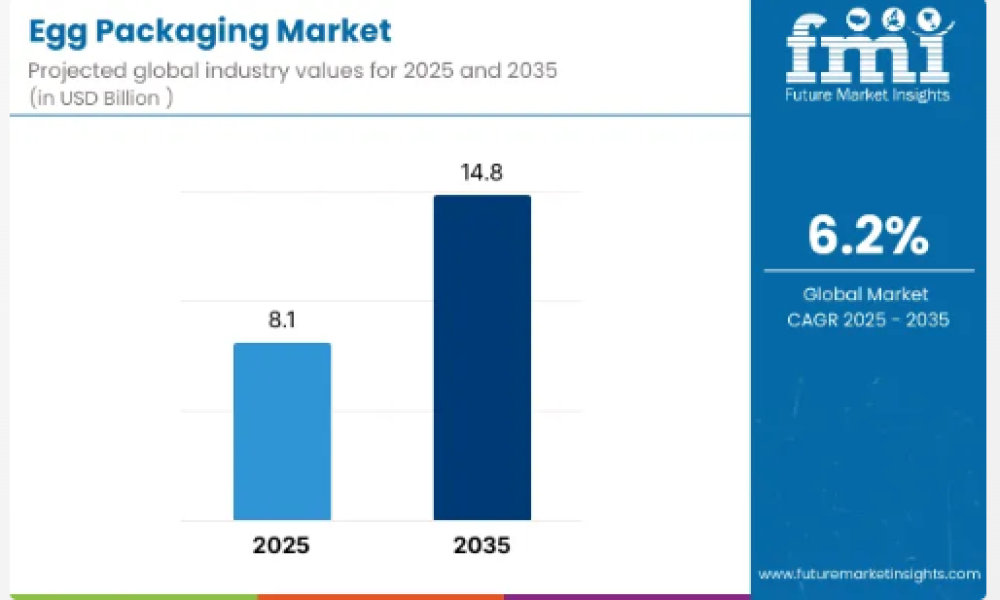
The global egg packaging market is undergoing a transformation, projected to expand from approximately US$ 8.1 billion in 2025 to US$ 14.8 billion by 2035, registering a robust CAGR of 6.2% over the next decade. The surge is being driven by rising global egg consumption, stringent food-safety regulations, and an urgent push toward sustainable, recyclable, and eco-friendly packaging solutions.
Key Market Insights at a Glance
The demand for molded fiber, recycled paper, and bio-based plastics is accelerating as manufacturers steer away from traditional plastics. Innovations such as antimicrobial coatings, QR-coded traceability, AI-driven material engineering, and smart freshness indicators are creating value across the supply chain. Automation in packaging lines is helping reduce production costs while improving throughput and efficiency. Meanwhile, regulatory pressure to cut single-use plastic, coupled with consumer sustainability awareness, is reshaping investment strategies and product portfolios.
Segment Overview
By material, molded fiber cartons continue to dominate, thanks to their low environmental footprint, cushioning strength, and biodegradability. PET trays and other plastics remain in use, but their growth is being challenged by greener alternatives. Smart packaging features—such as freshness sensors and labeling for traceability—are gaining traction, especially in premium and e-commerce channels. In terms of application, retail remains the largest driver, followed by logistics and food-service, where protective and tamper-evident packaging is essential.
Regional Overview
The Asia–Pacific region (particularly China, India, and Japan) is emerging as the fastest-growing market, fueled by increasing egg consumption, urbanization, and rising awareness around sustainable packaging. Regulatory initiatives to cut down plastic waste are further supporting this growth. North America maintains a strong foothold, with established poultry farming, large-scale retail channels, and active adoption of recycled fiber solutions. Across Europe, stringent environmental policies and consumer demand for compostable packaging are stimulating innovation in molded-pulp and bio-based trays.
Competitive Landscape
The egg packaging space is highly competitive, with sustainability and innovation at its heart. Companies like Huhtamaki Oyj, Hartmann Group, Tekni-Plex, CKF Inc., and Ovotherm are leading the charge, investing heavily in eco-friendly materials, design sophistication, and smart packaging. Industry participants are pursuing collaborations, acquiring new capabilities, and expanding their geographic footprints to meet both regulatory demands and consumer expectations.
Market Outlook: Powering the Next Decade
Over the next ten years, the egg packaging market is expected to be shaped by a few powerful trends: increasing regulations limiting single-use plastics, rising consumer preferences for circular economy solutions, and ongoing technological innovation. Manufacturers are likely to double down on molded-fiber and plant-based polymers, integrate predictive and AI-driven design systems, and scale-up smart packaging that embeds freshness tracking. These shifts will enhance shelf life, minimize waste, and make egg packaging a critical sustainability lever in the food chain.
Key Players of the Sustainable Egg Packaging Industry
Leading firms such as Huhtamaki, Hartmann, Tekni-Plex, Cascades, CKF, and Ovotherm are investing in fiber-based and bio-polymer designs to reduce environmental impact. Their strategies include R&D into moisture-resistant coatings, development of compostable structures, and roll-out of automation technologies to improve yield and strength while lowering costs.
Recent Strategic Developments
In recent months, several major players have unveiled new initiatives: some are introducing molded-fiber cartons with anti-microbial coatings to prolong freshness and reduce contamination risks; others have launched smart packaging with embedded freshness indicators and QR-enabled traceability; a few are also scaling up automated, high-speed production lines to meet surging demand from retail and e-commerce channels committed to sustainable packaging.
To access the complete data tables and in-depth insights, request a sample report here: https://www.futuremarketinsights.com/reports/sample/rep-gb-4015
Subscribe for Year-Round Insights → Stay ahead with quarterly and annual data updates : https://www.futuremarketinsights.com/checkout/4015
Have a specific Requirements and Need Assistant on Report Pricing or Limited Budget please contact us – [email protected]
About Future Market Insights (FMI)
Future Market Insights, Inc. (ESOMAR certified, recipient of the Stevie Award, and a member of the Greater New York Chamber of Commerce) offers profound insights into the driving factors that are boosting demand in the market. With a vast team of over 400 analysts worldwide, FMI provides global, regional, and local expertise on diverse domains and industry trends across more than 110 countries.



