
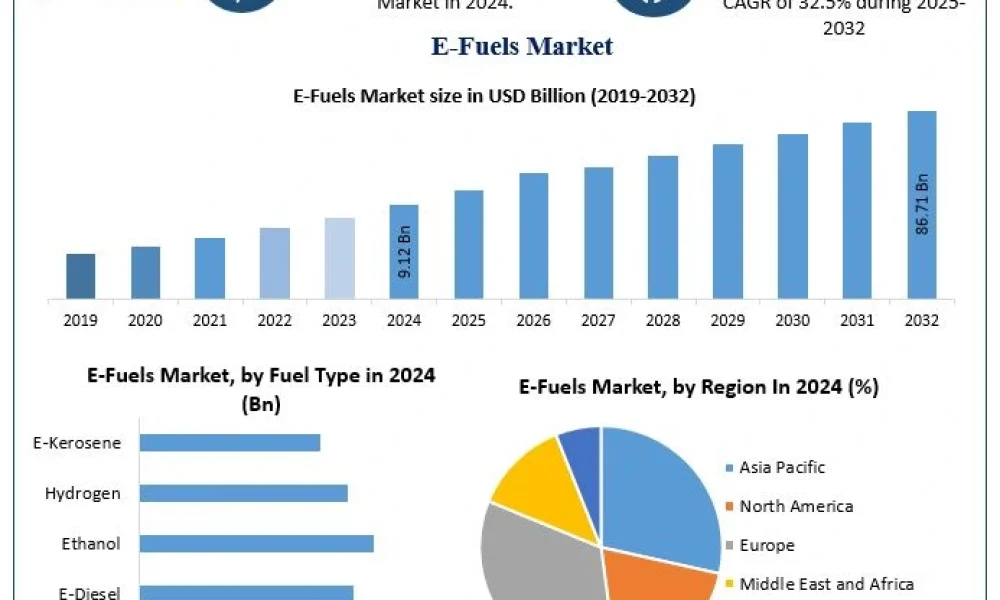
E-Fuels Market Overview:
E-Fuels Market valued at USD 8.75 billion in 2024, is projected to surge from USD 11.74 billion in 2025 to USD 87.92 billion by 2032, achieving a remarkable CAGR of 33.33%. This explosive growth is driven by stringent carbon neutrality mandates, advancements in green hydrogen production, and demand for drop-in fuels compatible with existing infrastructure in aviation, shipping, and automotive sectors, with North America dominating due to aggressive renewable energy policies and hyperscale production initiatives.
Key Highlights & Insights
Market Size & Growth: Expected to expand from USD 11.74 billion (2025) to USD 87.92 billion (2032) at a CAGR of 33.33%.
Dominating Region: North America holds the largest share (47.88% in 2024), propelled by U.S. incentives for clean fuels, Texas-based production hubs, and corporate commitments from e-commerce giants transitioning fleets.
Leading Segment: Automotive applications command over 40% market share, as e-fuels enable heavy-duty vehicles and long-haul trucking to achieve net-zero emissions without engine redesigns.
Key Driver: Global push for carbon-neutral alternatives to fossil fuels, supported by falling renewable electricity costs and scalable electrolysis for hydrogen-based e-fuels.
► Get a sample of the report:https://www.maximizemarketresearch.com/request-sample/221731/
Recent Developments
2025: Infinium (U.S.) broke ground on a Texas e-fuels plant, securing Amazon as its first major customer for sustainable aviation fuel (SAF).
2024: Prometheus Fuels (U.S.) scaled direct air capture-integrated e-diesel production, targeting North American trucking fleets.
2025: HIF Global (U.S./global) advanced e-methanol projects in partnership with European shipping firms for maritime decarbonization.
Porsche and Siemens Energy (Germany/U.S.) expanded synthetic e-fuel facilities in Chile, exporting to North American markets.
FAQs:
What are e-fuels? Synthetic fuels produced from renewable electricity, hydrogen, and captured CO2—chemically identical to fossil fuels but carbon-neutral.
Why automotive leads? E-diesel and e-gasoline provide seamless compatibility for existing fleets, holding 40%+ share amid electrification limits for heavy transport.
How viable are they cost-wise? Production costs dropping 50% by 2030 via scaled renewables, making them competitive with biofuels.
Market Dynamics
Growth Drivers:
Regulatory mandates like EU ReFuelEU and U.S. Inflation Reduction Act mandating SAF blends and low-carbon fuels.
Hard-to-abate sectors (aviation, shipping) requiring drop-in solutions beyond batteries.
Technological leaps in electrolyzers and CO2 capture boosting production efficiency.
Corporate net-zero pledges accelerating fleet transitions.
Challenges:
High energy intensity and current premium pricing versus fossil fuels.
Dependency on intermittent renewables and green hydrogen supply chains.
Scaling infrastructure for global distribution.
Opportunities:
Asia Pacific’s hydrogen strategies in Japan/South Korea for e-ammonia imports.
Co-location with solar/wind farms reducing costs.
Blending mandates creating guaranteed demand.
Regional Analysis
North America: Market leader with USD 4.19 billion in 2024; U.S. reaches USD 31.36 billion by 2032 via policy and private investment.
Europe: Rapid growth through mandates; Germany/Netherlands pioneer e-kerosene for aviation.
Asia Pacific: Fastest-expanding with China’s CCUS and Japan’s green growth strategy.
Latin America & Middle East/Africa: Emerging via export-oriented plants in sunny regions.
Product Segmentation
By Fuel Type: E-methane, e-kerosene (aviation leader), e-methanol, e-ammonia, e-diesel, e-gasoline.
By State: Gaseous (growing via hydrogen hubs), liquid (dominant for transport).
By Application: Automotive (40%+), aviation/shipping, power generation, chemicals.
By Source: Hydrogen (55% share), CO2-based (fastest-growing).
Key Trends
Integration of direct air capture (DAC) for sustainable CO2 sourcing.
Power-to-liquid (PtL) plants co-located with renewables for cost parity.
E-SAF mandates driving aviation segment to 30% of demand.
Modular electrolyzers enabling rapid scaling.
Certification standards for carbon accounting and blending.
Conclusion
The e-fuels market is revolutionizing energy, offering carbon-neutral paths for aviation, shipping, and trucking where electrification falls short. Led by North America’s momentum and global regulatory tailwinds, it promises scalable, compatible solutions—accelerating net-zero goals and reshaping fuel landscapes through 2032.
◉ Get Market Research Latest Trends
♦ Maximize Market Research is launching a subscription model for data and analysis in the MMR Statistics
Contact Maximize Market Research:
3rd Floor, Navale IT Park, Phase 2
Pune Bangalore Highway, Narhe,
Pune, Maharashtra 411041, India
[email protected]
+91 96071 95908, +91 9607365656
About Maximize Market Research:
Maximize Market Research is a multifaceted market research and consulting company with professionals from several industries. Some of the industries we cover include medical devices, pharmaceutical manufacturers, science and engineering, electronic components, industrial equipment, technology and communication, cars and automobiles, chemical products and substances, general merchandise, beverages, personal care, and automated systems. To mention a few, we provide market-verified industry estimations, technical trend analysis, crucial market research, strategic advice, competition analysis, production and demand analysis, and client impact studies.




