
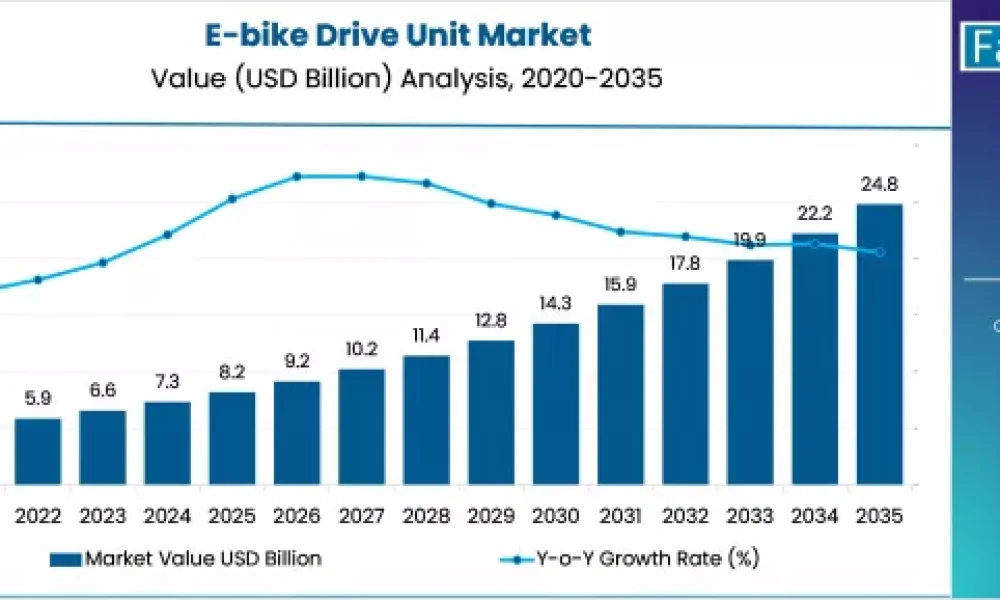
The global e-bike drive unit market is projected to grow from USD 8.2 billion in 2025 to approximately USD 24.8 billion by 2035, representing a compound annual growth rate (CAGR) of around 11.7% over the forecast decade. The growth is driven by the accelerating adoption of electric bicycles across urban mobility, cargo/last-mile delivery, recreational and mountain segments, together with rising interest in higher-performance mid-drive systems and smart connectivity features.
The transition from hub-motor systems to more advanced mid-drive architectures is a key factor, as manufacturers and consumers demand better performance, range, efficiency, and integration with e-mobility ecosystems. With e-bike penetration rising in developed markets and increasingly in emerging markets, the drive unit sub-system is becoming a strategic growth area within the broader electric mobility value chain.
Key Market Insights at a Glance
Market Value (2025): USD 8.2 billion
Forecast Value (2035): USD 24.8 billion
CAGR (2025-2035): ~11.7%
Leading Motor Type (2025): Mid-drive motors (~55% share)
Dominant Application (2025): Commuter e-bikes (~40% share)
Key Growth Regions: North America, Europe, Asia-Pacific
Notable Players: Bosch eBike Systems; Shimano; Yamaha Motor; Brose Fahrzeugteile; Panasonic; Continental AG
To Access the Complete Data Tables & in-depth Insights, Request a Discount on this report: https://www.factmr.com/connectus/sample?flag=S&rep_id=11157
Market Drivers / Growth Overview
The e-bike drive unit market is being propelled by multiple converging forces. First, the growth of urbanisation, rising traffic congestion, and environmental awareness are driving adoption of e-bikes as sustainable transport alternatives. Drive units serve as the core propulsion sub-system, and higher quality/efficiency units enhance ride performance, range, and user experience.
Second, technical innovation in drive units—such as torque-sensing mid-drive systems, better integration with battery and connectivity systems, and lighter weight designs—is enabling more attractive e-bike platforms and expanding potential use-cases (cargo, mountain, shared mobility).
Third, regulatory and policy support in many regions (incentives, subsidies, urban mobility programmes) are boosting e-bike uptake, which in turn grows demand for drive units. Fourth, the expansion of e-bike sharing services, commercial delivery fleets (cargo e-bikes), and multi-modal mobility solutions is generating new demand beyond individual consumer ownership.
While the market offers strong potential, barriers such as high initial cost of advanced drive systems, battery/charging infrastructure limitations, and varying regulatory definitions (power ratings, speed classes) may temper near-term growth in some regions.
Segmentation & Key Drivers
By Motor Type:
Mid-drive motors dominate the segment (≈ 55% share in 2025) due to superior performance, weight distribution and integration capability.
Hub-motors remain relevant, especially for lower-priced models and certain form-factors (city bikes, budget segments).
Other types (e.g., geared hub, specialised drives) offer niche opportunities but smaller share.
By Application:
Commuter e-bikes lead demand (~40% share) as urban mobility shifts expand and commute-by-e-bike gains traction.
Mountain e-bikes and cargo/last-mile e-bikes are growing segments as higher-performance drives enable new functionalities.
Others (leisure, rental/sharing fleets) also contribute to volume growth over time.
By Region:
North America and Europe benefit from high disposable income, mature cycling culture, and infrastructure.
Asia-Pacific is a key growth engine thanks to large population bases, e-mobility adoption momentum and manufacturing ecosystems.
Other regions (Latin America, Middle East & Africa) present emerging opportunities as transport electrification expands.
Key segmentation drivers include cost/performance trade-offs, product reliability and durability, local regulation/power-rating classes, localisation of supply-chains, and the shift of shared/micromobility business models.
Regional & Country Insights
North America: Strong growth due to high e-bike adoption in commuting and recreational segments; premium drive units gain share.
Europe: Leading region for mid-drive systems, supported by strong cycling infrastructure, supportive policies and premium e-bike brands.
Asia-Pacific: Rapid growth in countries such as China, India, Southeast Asia, where large urban populations, government incentives and manufacturing presence create favourable dynamics.
Emerging Regions: Latin America and Middle East/Africa show potential as e-bike cost structure improves and urban mobility challenges drive adoption.
Competitive Landscape
The competitive environment in the e-bike drive unit market is moderately concentrated. Key global players include Bosch eBike Systems, Shimano, Yamaha Motor, Brose Fahrzeugteile, Panasonic and Continental AG. These firms leverage deep expertise in electric motors, control electronics and supply-chain scale. They are investing in lighter, more efficient drive systems, integrated battery and motor modules, firmware/diagnostic features and partnerships with e-bike OEMs and mobility service providers.
Companies are differentiating by motor performance (torque, weight, efficiency), integration capability (battery, connectivity, sensors), cost competitiveness, and regional manufacturing footprint. New entrants and niche specialist suppliers are challenging the established players by focusing on high-torque cargo drives, lightweight urban drives and modular plug-and-play systems.
Recent Developments
Launch of next-generation mid-drive motors with improved torque, smaller size, integrated sensors and better battery compatibility.
E-bike manufacturers and mobility services deploying cargo and urban delivery e-bike fleets, driving demand for heavy-duty drive units.
Expansion of drive unit manufacturing facilities and localisation in Asia-Pacific to reduce cost, improve lead-time and serve growth markets.
Drive unit suppliers partnering with battery and connectivity firms to offer integrated smart e-bike systems with diagnostics, IoT-enabled maintenance and fleet management capabilities.
Market Outlook & Strategic Insights
Over the forecast period (2025-2035), the e-bike drive unit market is expected to evolve from performance-led niche segments into a larger mainstream mobility component. Key strategic priorities include:
Reducing cost of mid-drive systems through scale, product simplification and localisation to penetrate lower-price segments.
Enhancing integration of drive units with battery/inverter/control electronics and smart connectivity for both consumer and fleet applications.
Targeting high-growth applications such as cargo/last-mile e-bikes, shared mobility fleets and mountain/enthusiast segments where performance drive units offer premium value.
Expanding manufacturing and supply-chain footprints in Asia-Pacific and other high-growth regions to ensure cost efficiency and agility.
Collaborating with OEMs, mobility service providers and infrastructure stakeholders to align on system-level solutions (drives + battery + connectivity + service), rather than motor alone.
Firms that execute these strategic imperatives—while maintaining reliability, performance and cost competitiveness—will be positioned to capture substantial share of the approximately USD 24.8 billion market by 2035.
Purchase Full Report for Detailed Insights
For access to full forecasts, regional breakouts, company share analysis, and emerging trend assessments, you can purchase the complete report: https://www.factmr.com/checkout/11157
Have specific requirements or need assistance on report pricing or have a limited budget? Please contact [email protected]
Contact:
US Sales Office
11140 Rockville Pike
Suite 400
Rockville, MD 20852
United States
Tel: +1 (628) 251-1583, +353-1-4434-232
Email: [email protected]
About Fact.MR:
Fact.MR is a global market research and consulting firm, trusted by Fortune 500 companies and emerging businesses for reliable insights and strategic intelligence. With a presence across the U.S., UK, India, and Dubai, we deliver data-driven research and tailored consulting solutions across 30+ industries and 1,000+ markets. Backed by deep expertise and advanced analytics, Fact.MR helps organizations uncover opportunities, reduce risks, and make informed decisions for sustainable growth.



