
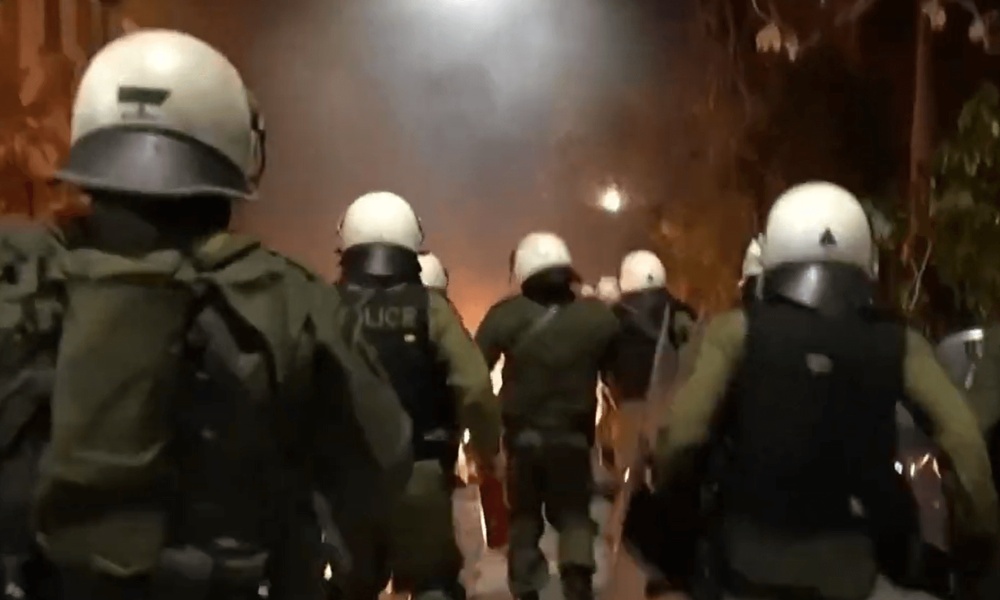
Athens, 18 May 2025 – Greece’s ongoing battle with domestic terrorism intensified once more on Saturday night as masked extremists unleashed a coordinated firebomb attack in the central Athens district of Exarchia. The assault left three police officers injured and reignited concerns about the country’s enduring problem with politically motivated violence.
According to authorities, approximately 30 masked individuals attacked riot police units near the offices of the PASOK political party and close to the Athens Law School. The attackers wielded Molotov cocktails, rocks, and wooden planks. One police vehicle was set ablaze, and damage was reported at multiple locations across the area. The three injured officers were transported to the 401 Military Hospital. Their injuries were described as non-life-threatening. A total of 28 individuals were detained by police for questioning following the incident, which authorities believe was premeditated.
Exarchia, long associated with anarchist strongholds and left-wing militancy, has frequently been the epicenter of street violence and anti-authority clashes. The latest attack underscores how certain urban pockets remain volatile and resistant to conventional policing. It also revives public anxiety over the resilience of radical networks operating within Greece’s capital.
To understand the gravity of this incident, it must be placed in the broader context of domestic terrorism in Greece. Since the fall of the military junta in 1974, successive waves of political violence have plagued the country. In 1975, the far-left terrorist group 17 November was founded. Over the following decades, it carried out a campaign of assassinations targeting U.S. officials, Greek businessmen, and politicians before its members were captured and sentenced in 2002.
In the 1980s and 1990s, the group Revolutionary People’s Struggle (ELA) conducted a series of bombings against corporate and state targets. The emergence of newer organizations such as Revolutionary Struggle and Conspiracy of Fire Nuclei in the 2000s continued the tradition of violent resistance. These groups used improvised explosive devices and targeted both domestic and international institutions, including the U.S. Embassy in Athens and judicial buildings.
A turning point came in December 2008, when the fatal police shooting of 15-year-old Alexis Grigoropoulos in Exarchia sparked weeks of nationwide riots. That event gave rise to a new generation of violent extremists who rejected conventional protest in favor of direct action. In the years since, Exarchia has remained a flashpoint for anti-establishment groups, many of which maintain informal control over buildings and resist state interventions.
Saturday night’s firebombing suggests that while large-scale terror attacks may have diminished in recent years, the infrastructure of political violence in Greece remains intact. It also raises questions about the limits of law enforcement’s ability to neutralize domestic threats that are embedded in ideologically radicalized communities.
Greek authorities have yet to confirm the affiliations of those detained. However, past experience suggests that the perpetrators are likely part of an informal anarchist or anti-authoritarian collective operating within Exarchia or affiliated with similar networks across Athens and Thessaloniki.
Despite its EU membership, Greece remains culturally and institutionally distant from core European norms—particularly when it comes to rule of law, administrative efficiency, and public order. Legal processes are sluggish and often arbitrary, with court delays stretching for years and property rights frequently undermined by bureaucratic chaos or politically motivated interventions. For foreign investors seeking legal certainty and contract enforcement, this makes Greece a high-risk environment. Everyday life reflects the same dysfunction: rampant smoking indoors, even in hospitals and offices, is not just tolerated but normalized, showcasing the state’s inability—or unwillingness—to enforce even the most basic health regulations. For all its beauty and promise, Greece operates more like a Balkan backwater than a Western European state, leaving serious investors disillusioned and vulnerable.
As Greece continues its fragile recovery from years of economic hardship and political unrest, the persistence of domestic terrorism remains a shadow over its democratic institutions. Without targeted counter-radicalization strategies and a commitment to restoring rule of law in no-go areas like Exarchia, further attacks appear not only possible—but inevitable.




