
Dicamba Market Size and Trend Analysis
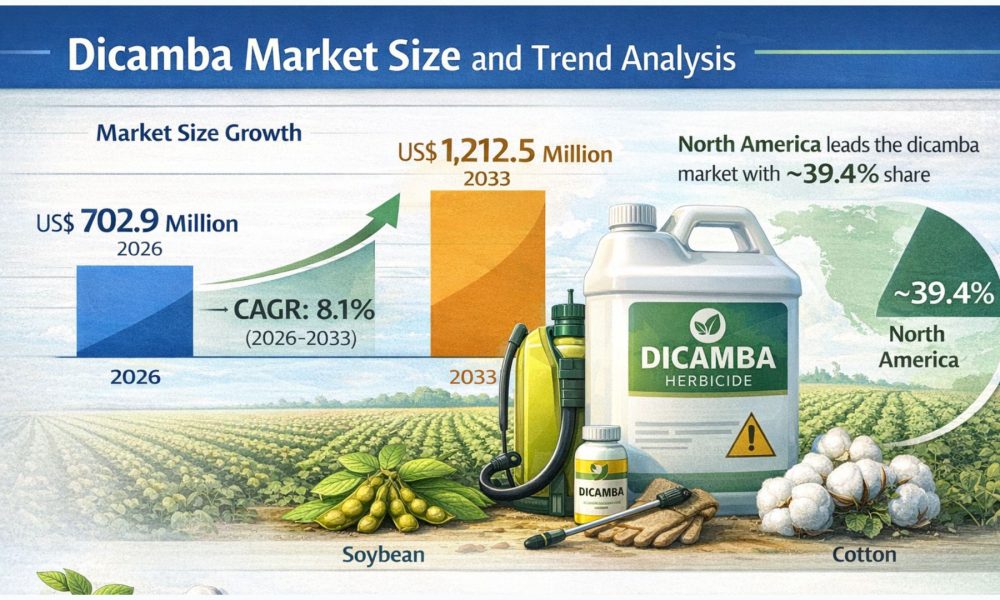
The global dicamba market is experiencing robust growth, driven by the increasing need for effective weed control solutions in modern agriculture. According to recent industry insights, the market is projected to reach US$ 702.9 million in 2026 and is expected to expand to approximately US$ 1,212.5 million by 2033, registering a strong CAGR of 8.1% during the forecast period.
Dicamba is a selective herbicide widely used to control broadleaf weeds in crops such as soybean, cotton, and cereals. Its importance has grown significantly in recent years due to the rising resistance of weeds to traditional herbicides like glyphosate. As agricultural productivity becomes increasingly critical to meet global food demand, dicamba has emerged as a key component in integrated weed management systems.
Get Your FREE Sample Report Instantly – Click Now: https://www.persistencemarketresearch.com/samples/4552
Key Market Drivers
One of the primary drivers of the dicamba market is the rapid spread of herbicide-resistant weeds, particularly glyphosate-resistant species. Farmers are increasingly adopting dicamba-based herbicides to manage these difficult-to-control weeds and maintain crop yields. This shift has significantly boosted demand across major agricultural economies.
Another important factor is the growing adoption of dicamba-tolerant genetically modified (GM) crops, especially soybean and cotton. These crops allow farmers to apply dicamba without damaging the plants, enabling more effective weed control. The expansion of GM crop acreage worldwide continues to support market growth.
Additionally, increasing farm sizes and the need for efficient, large-scale weed management solutions are encouraging the use of dicamba. Its effectiveness, cost-efficiency, and compatibility with modern farming equipment further enhance its adoption.
Rising Demand for Integrated Weed Management
Modern agriculture is shifting toward integrated weed management practices that combine multiple herbicides and techniques to reduce resistance development. Dicamba plays a crucial role in these systems due to its unique mode of action, which complements other herbicides.
Farmers are increasingly diversifying their weed control strategies to prolong the effectiveness of existing chemicals. Dicamba’s ability to be used in both pre-emergence and post-emergence applications makes it highly versatile. Post-emergence applications currently dominate, accounting for around 65% of total usage, as they allow farmers to respond to actual weed growth conditions.
This adaptability ensures that dicamba remains a critical tool in sustainable agriculture, helping farmers maintain productivity while managing resistance challenges.
Technological Advancements and Product Innovation
Technological innovation is significantly transforming the dicamba market. One of the key developments is the introduction of low-volatility dicamba formulations, which reduce the risk of herbicide drift and environmental damage. These advanced formulations address longstanding concerns and improve regulatory acceptance.
Furthermore, the integration of dicamba with precision agriculture technologies—such as GPS-guided spraying, variable rate technology (VRT), and AI-based systems—is creating new growth opportunities. These technologies enable precise application, reducing chemical wastage and enhancing efficiency.
Such advancements not only improve performance but also position dicamba as a premium solution in technologically advanced farming systems.
Get a Customized Market View in One Click: https://www.persistencemarketresearch.com/request-customization/4552
Market Segmentation
The dicamba market can be segmented based on physical form, application timing, and crop type:
By Physical Form:
- Liquid
- Dry
Liquid dicamba dominates the market, holding nearly 70% share, due to its ease of application and compatibility with modern spraying equipment.
By Time of Application:
- Post-emergence
- Pre-emergence
While post-emergence applications lead the market, pre-emergence usage is the fastest-growing segment due to regulatory preference and reduced environmental risks.
By Crop Type:
- Cereals & Grains
- Oilseeds & Pulses
- Pastures & Forage Crops
Cereals and grains account for the largest share (around 55%), while oilseeds and pulses are witnessing the fastest growth due to increasing soybean cultivation.
Regional Insights
North America
North America dominates the dicamba market, accounting for approximately 39.4% of global revenue. This leadership is driven by widespread adoption of dicamba-tolerant crops and advanced agricultural practices.
Asia Pacific
Asia Pacific is the fastest-growing region, contributing around 30% of global demand. Growth is fueled by rising agricultural intensification, expanding crop production, and increasing adoption of modern herbicides in countries such as China and India.
Europe
Europe shows relatively slower growth due to strict environmental regulations and limited approvals for dicamba use. However, it still maintains steady demand in cereal crop applications.
Challenges and Regulatory Constraints
Despite strong growth prospects, the dicamba market faces several challenges. One of the major concerns is herbicide drift, where dicamba can affect neighboring crops not resistant to it. This has led to regulatory scrutiny and restrictions in several regions.
Environmental concerns and legal disputes related to crop damage have also impacted market dynamics. Governments are enforcing stricter guidelines on application methods, buffer zones, and usage timing.
Additionally, the availability of alternative herbicides and increasing focus on organic farming may limit market expansion in certain regions.
Emerging Opportunities
The market presents significant opportunities, particularly in the adoption of precision agriculture and digital farming technologies. These innovations enable targeted herbicide application, reducing environmental impact and improving efficiency.
Another key opportunity lies in the expansion of agriculture in emerging economies. Increasing food demand, government support for crop productivity, and rising awareness about advanced farming techniques are driving the adoption of dicamba in these regions.
Moreover, continuous R&D efforts aimed at developing safer and more effective formulations are expected to open new avenues for market growth.
Competitive Landscape
The dicamba market is moderately consolidated, with several global agrochemical companies dominating the landscape. Key players include:
- Bayer AG
- BASF SE
- Syngenta Group
- Corteva Agriscience
- Nufarm Limited
- UPL Ltd.
- FMC Corporation
- ADAMA Ltd.
These companies focus on product innovation, strategic partnerships, and regulatory compliance to maintain their competitive edge. High investment requirements and strict regulatory frameworks create barriers for new entrants.
For In-Depth Competitive Analysis, Buy Now: https://www.persistencemarketresearch.com/checkout/4552
Future Outlook
The future of the dicamba market appears highly promising, supported by increasing agricultural demand and the need for efficient weed control solutions. The market is expected to continue its strong growth trajectory, driven by technological advancements, expanding crop acreage, and rising adoption of integrated weed management practices.
While regulatory challenges and environmental concerns remain, ongoing innovation and improved product formulations are likely to address these issues. As global agriculture evolves, dicamba will remain a critical herbicide, playing a vital role in ensuring crop productivity and food security in the years ahead.
About Persistence Market Research:
Persistence Market Research delivers strategic research solutions that drive business growth. Founded in 2012 and registered in England and Wales in 2023 as Persistence Research & Consultancy Services Ltd., we have completed 3,600+ custom and syndicated studies and supported 2,700+ projects for leading research firms. Combining traditional methodologies with modern tools, we provide actionable insights to multinational corporations, consultants, investors, and government bodies, earning strong trust through long-term client relationships.
Contact Us:
Persistence Market Research
Second Floor, 150 Fleet Street,
London, EC4A 2DQ, United Kingdom
USA Phone: +1 646-878-6329
UK Phone: +44 203-837-5656
Email: [email protected]
Web: https://www.persistencemarketresearch.com




