
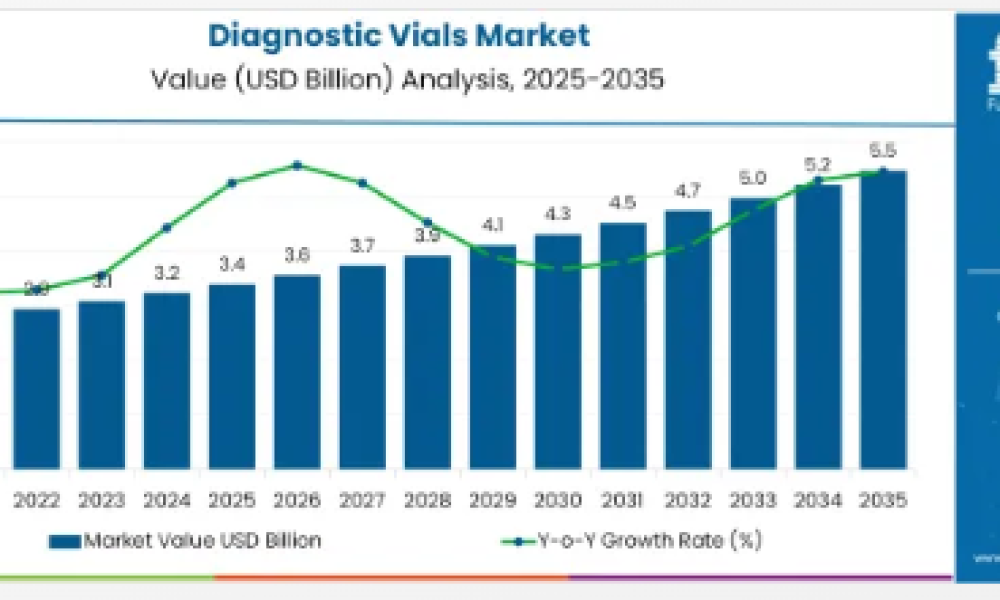
In a transformative shift within the global diagnostics packaging landscape, the Asia-Pacific diagnostic vials market is witnessing remarkable momentum, anchored by a projected value of USD 3.4 billion in 2025. Fueled by rising investments in healthcare infrastructure, widespread roll-out of decentralized testing, and surging demand for reliable sample containment, this region is emerging as a critical growth engine for the broader market.
Over the next decade, the sector is expected to grow at a compound annual growth rate (CAGR) of 4.9%, reaching nearly USD 5.5 billion by 2035, setting the stage for a next-generation ecosystem of diagnostics designed for sustainability, scalability, and precision.
Key Market Insights at a Glance
The global diagnostic vials market is on a steady up-trend, supported by the growing prevalence of chronic diseases, infectious outbreaks, and genetic testing. Demand is sharply rising for vials that can ensure sterile, contamination-free sample handling. Regulatory requirements are pushing manufacturers to innovate with tamper-evident closures, material traceability, and automation-compatible vial designs that meet modern laboratory workflows.
Among materials, glass vials dominate, expected to capture approximately 61% market share in 2025, due to their superior chemical inertness, thermal stability, and transparent properties that facilitate visual inspection. In product types, round-bottom vials lead, owing to their compatibility with centrifugation and automated liquid handling systems. Capacity-wise, the 0–2 ml segment is especially attractive as it aligns with typical sample volumes for immunological, serological, and molecular diagnostic applications.
Regional Overview
Geographically, North America, Europe, and the Asia-Pacific regions are leading contributors to market growth. North America continues to benefit from advanced laboratory infrastructure and high regulatory standards, while Europe’s mature healthcare systems sustain stable demand. However, the Asia-Pacific region is emerging as a future powerhouse—with expanding public health programs, growing biotech and research investments, and increasing adoption of point-of-care diagnostics. In countries like India and China, the scaling up of diagnostic capacity, coupled with vaccine development and broader sample collection initiatives, is propelling regional demand for high-quality diagnostic vials.
Competitive Landscape
The competitive environment in the diagnostic vials market is marked by a mix of global giants and nimble regional players. Tier-1 companies, including Thermo Fisher Scientific, Corning Incorporated, and DWK Life Sciences, dominate through their scale, R&D capabilities, and global distribution reach. These players leverage economies of scale, precision manufacturing, and regulatory-compliant vial designs to maintain leadership. Meanwhile, Tier-2 participants such as Greiner Bio-One and Cole-Parmer focus on cost-effective and customizable solutions, and Tier-3 companies narrow in on niche segments—both through eco-friendly materials and lightweight, specialty vials.
Segment Overview
Breaking down the market, diagnostic vials are categorized by material (glass vs. plastic), product type (round bottom vs. self-standing), capacity (0–2 ml, 3–5 ml, 6–10 ml, 11–20 ml, >20 ml), and end user (hospitals, medical institutes, clinical labs, research institutions, diagnostic centers). Glass vials are expected to sustain dominance due to their chemical resistance and sterilization compatibility. Round-bottom designs continue to be preferred for centrifugation applications. Small-capacity vials (especially 0–2 ml) are gaining ground, owing to their lean volume needs, cost efficiency, low waste, and compatibility with compact or decentralized diagnostic systems.
Market Outlook: Powering the Next Decade
Over the coming decade, the diagnostic vials market is poised for robust growth. The rising trend of decentralized diagnostics—including point-of-care and mobile testing units—is expected to fuel demand for compact, resilient, and traceable vials. In parallel, sustainability is becoming a strategic imperative: manufacturers are actively exploring recyclable, biodegradable, and lower-carbon-footprint vial materials. Innovations in smart labeling, IoT-enabled sample tracking, and automated handling will redefine how vials are used in high-throughput and regulated laboratory environments. This technological evolution, coupled with expanding access to diagnostics in emerging markets, will reshape the sector’s trajectory through 2035 and beyond.
Key Players of the Sustainable Label Industry
Among the leading players shaping this sustainable future are Gerresheimer AG, DWK Life Sciences Ltd., Airnov Healthcare Packaging, Origin Pharma Packaging, Adelphi Healthcare Packaging, and SDG Pharma. These companies are investing heavily in eco-conscious materials, high-barrier designs, and scalable manufacturing. By partnering with research labs, biotech firms, and diagnostic centers, they are creating a value chain that emphasizes product integrity, traceability, and environmental responsibility.
Recent Strategic Developments
Strategic initiatives across the industry underline a clear tilt toward expansion, innovation, and sustainability. For instance, DWK Life Sciences announced the acquisition of a German glass vial manufacturer, boosting its capacity and reach. Airnov Healthcare Packaging introduced a high-moisture-barrier vial with integrated moisture adsorption functionality to enhance sample stability. Gerresheimer AG has invested in a new manufacturing plant in Eastern Europe, enabling scalable production of plastic medical systems. These developments reflect a broader industry acceleration, as firms strive to stay ahead of the curve through capacity expansion, green packaging, and advanced designs.
Subscribe for Year-Round Insights → Stay ahead with quarterly and annual data updates: https://www.futuremarketinsights.com/checkout/13540
Have a specific Requirements and Need Assistant on Report Pricing or Limited Budget please contact us – [email protected]
About Future Market Insights (FMI)
Future Market Insights, Inc. (ESOMAR certified, recipient of the Stevie Award, and a member of the Greater New York Chamber of Commerce) offers profound insights into the driving factors that are boosting demand in the market. With a vast team of over 400 analysts worldwide, FMI provides global, regional, and local expertise on diverse domains and industry trends across more than 110 countries.



