
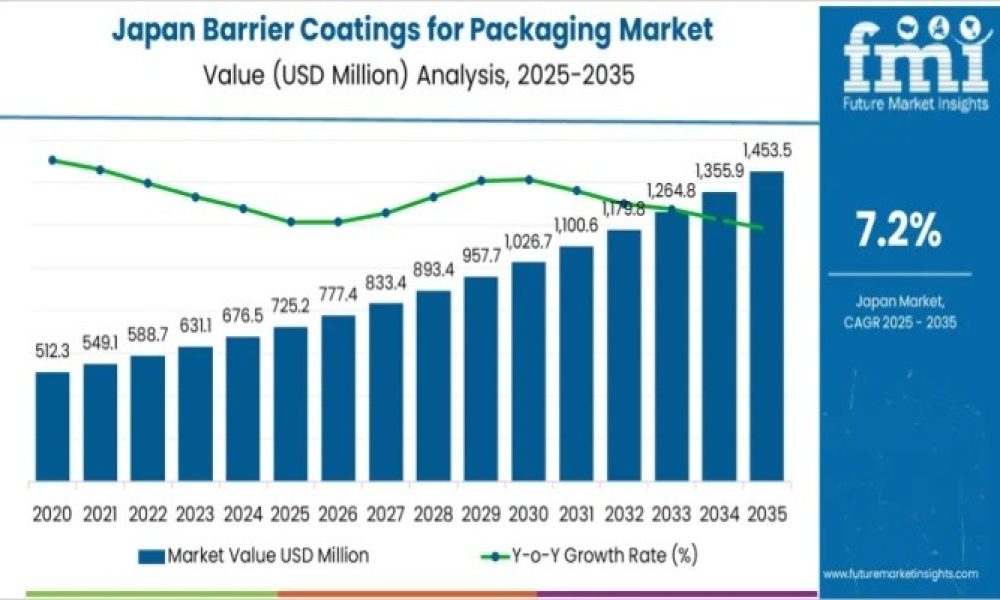
The demand for barrier coatings for packaging in Japan is entering a decade of accelerated growth as industries prioritize product protection, shelf-life extension, and environmentally responsible packaging solutions. Valued at USD 725.2 million in 2025, the market is forecast to reach USD 1,453.5 million by 2035, expanding at a robust CAGR of 7.2%. This growth reflects structural shifts across food and beverage, pharmaceutical, and consumer goods packaging, where performance and sustainability increasingly converge.
Barrier coatings play a critical role in modern packaging by shielding products from moisture, oxygen, light, and external contamination, ensuring that contents remain safe, fresh, and compliant with Japan’s stringent quality standards. As manufacturers respond to evolving consumer expectations for longer shelf life, cleaner labels, and reduced material waste, barrier-coated packaging has become a strategic enabler rather than a secondary material choice.
Discover Growth Opportunities in the Market – Get Your Sample Report Now
Quick Stats: Demand for Barrier Coatings for Packaging in Japan
- Market Value (2025): USD 725.2 million
- Forecast Value (2035): USD 1,453.5 million
- Forecast CAGR (2025–2035): 7.2%
- Key Coating Types: PE, PP, PET, Metallized, Paper, Other Coatings
- Leading Regions: Kyushu & Okinawa, Kanto, Kansai, Chubu, Tohoku
- Top Companies: PPG Industries, Dow Inc., Henkel AG & Co. KGaA, Mondi Group, AkzoNobel N.V.
Food and Beverage Packaging Anchors Market Expansion
The food and beverage sector accounts for 31% of total demand, making it the largest end-use segment for barrier coatings in Japan. Rising consumption of convenience foods, ready-to-eat meals, and packaged beverages has increased reliance on advanced packaging materials that preserve freshness while meeting hygiene expectations.
Barrier coatings help maintain flavor, aroma, texture, and nutritional integrity, reducing spoilage and minimizing the need for preservatives. As Japanese consumers become more health-conscious, packaging that enables clean-label formulations and longer shelf life has become essential.
Key food-sector drivers include:
- Growing demand for ready meals and single-serve packaging
- Expansion of chilled, frozen, and extended-shelf-life foods
- Retail pressure to reduce food waste and returns
- Higher quality standards for domestic and export products
Pharmaceutical and Consumer Goods Demand Reinforce Growth
Beyond food, pharmaceutical packaging continues to drive strong demand for barrier coatings due to strict regulatory requirements around moisture control and contamination prevention. Flexible and lightweight packaging formats, increasingly used for medical and personal-care products, depend on high-performance coatings to meet compliance standards without increasing material weight.
Similarly, consumer goods manufacturers are adopting barrier-coated materials to protect products during longer distribution cycles, particularly as e-commerce and cold-chain logistics expand across Japan.
Market Value Growth Outlook Through 2035
From 2025 to 2030, the market is projected to grow from USD 725.2 million to USD 1,100.6 million, adding USD 375.4 million in value. This phase will be marked by rapid adoption of enhanced barrier technologies offering improved moisture control, antimicrobial functionality, and compatibility with recyclable substrates.
Between 2030 and 2035, demand is expected to rise further to USD 1,453.5 million, contributing an additional USD 352.9 million. While growth moderates as the market matures, innovation in bio-based, biodegradable, and low-impact coatings will sustain steady expansion.
Why PE Coatings Dominate the Market
Polyethylene (PE) coatings account for 29% of total demand, making them the leading coating type in Japan’s packaging sector. Their dominance is driven by a balance of performance, cost efficiency, and versatility.
PE coating advantages include:
- Excellent moisture and oxygen barrier properties
- Compatibility with paper, plastic, and metal substrates
- Flexibility for diverse packaging formats
- Cost-effective large-scale application
These attributes make PE coatings particularly valuable in food packaging, where consistent performance and scalability are critical.
Regional Growth Highlights
Japan’s barrier coatings demand shows strong regional variation, reflecting industrial concentration and consumption patterns.
- Kyushu & Okinawa: 9.0% CAGR, driven by food processing, tourism, and packaging innovation
- Kanto: 8.3% CAGR, supported by dense consumer markets, e-commerce, and pharmaceuticals
- Kansai (Kinki): 7.3% CAGR, fueled by food, electronics, and export-oriented industries
- Chubu: 6.4% CAGR, anchored by manufacturing and logistics demand
- Tohoku: 5.6% CAGR, led by agriculture and food preservation needs
- Rest of Japan: 5.3% CAGR, with steady adoption across regional industries
Competitive Landscape: Innovation and Sustainability at the Forefront
The competitive environment is shaped by continuous innovation in eco-friendly coating chemistries, solvent-free processes, and recyclable barrier solutions. Leading players focus on enhancing performance while aligning with Japan’s sustainability goals.
Key players include:
- PPG Industries, Inc. – Market leader with a 32% share, offering high-performance coatings
- Dow Inc. – Advanced polymer-based barrier solutions
- Henkel AG & Co. KGaA – Strong presence in food-safe adhesives and coatings
- Mondi Group – Integrated packaging solutions with advanced barrier properties
- AkzoNobel N.V. – Coatings meeting stringent durability and compliance standards
Why FMI: https://www.futuremarketinsights.com/why-fmi
About Future Market Insights (FMI)
Future Market Insights, Inc. (FMI) is an ESOMAR-certified, ISO 9001:2015 market research and consulting organization, trusted by Fortune 500 clients and global enterprises. With operations in the U.S., UK, India, and Dubai, FMI provides data-backed insights and strategic intelligence across 30+ industries and 1200 markets worldwide.



