
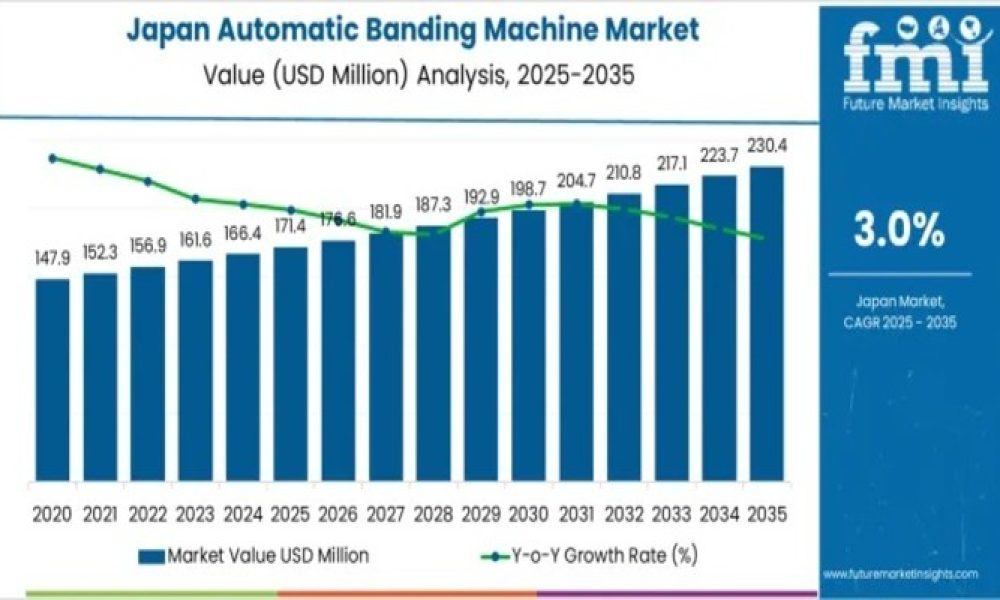
The demand for automatic banding machines in Japan continues to reflect the country’s disciplined approach to industrial automation, where steady productivity gains matter more than disruptive shifts. In 2025, the Japanese automatic banding machine market is valued at USD 171.4 million and is projected to reach USD 230.4 million by 2035, expanding at a compound annual growth rate (CAGR) of 3.0% over the forecast period. Growth remains anchored in replacement demand, selective capacity expansion, and gradual modernization across packaging, logistics, and manufacturing operations.
A Market Built on Reliability, Not Speculation
Unlike high-volatility automation segments, Japan’s automatic banding machine market follows a controlled and predictable value accumulation curve. From USD 147.9 million in 2020 to USD 171.4 million in 2025, the industry added USD 23.5 million in incremental value, driven by consistent annual additions of approximately USD 4.4–4.9 million. This confirms that demand is rooted in core packaging and logistics needs rather than new sector entry or aggressive plant expansions.
From 2025 to 2035, market value is expected to rise by USD 59.0 million, with annual additions gradually increasing from around USD 5.2 million to nearly USD 6.7 million in later years. The absence of sharp inflection points signals long-term stability, supported by lifecycle replacement, higher automation density per facility, and steady e-commerce-driven throughput optimization.
Unlock Growth Potential – Request Your Sample Now and Explore Market Opportunities!
Why Automatic Banding Machines Matter in Japan
Japanese manufacturers favor automatic banding systems for applications where surface protection, clean aesthetics, and consistent bundling are critical. These machines are widely used to unitize lightweight cartons, bundled paper products, pharmaceuticals, cosmetics, and precision electronics packaging. As packaging lines increasingly prioritize compact layouts and low energy usage, automatic banding machines fit neatly into small and mid-sized automated lines across the country.
Labour shortages and safety considerations further strengthen the case for automation. Manual strapping is labor-intensive and carries ergonomic risks, while automatic banding delivers repeatable performance, lower error rates, and predictable maintenance cycles—qualities highly valued in Japan’s production culture.
Market Progress After 2030: Incremental but Strategic
After 2030, growth in the Japanese automatic banding machine market is expected to remain incremental rather than transformational. Demand is forecast to move from USD 198.7 million in 2030 to USD 230.4 million by 2035, supported by:
- Upgrades to servo-driven systems
- Integration with inspection and counting units
- Rising throughput requirements in parcel sorting and fulfillment centers
Key buyers include domestic manufacturers, contract packers, and export-oriented producers in electronics and precision goods. Suppliers increasingly compete on machine uptime, strapping accuracy, modularity, and long-term service contracts, ensuring recurring revenue stability in mature facilities.
Quick Stats: Automatic Banding Machines Industry in Japan
- Market Value (2025): USD 171.4 million
- Forecast Value (2035): USD 230.4 million
- Forecast CAGR (2025–2035): 3.0%
- Leading Machine Type: Fully Automatic (65% share)
- Leading Capacity Segment: >30 bundles per minute (42% share)
- Key Growth Regions: Kyushu & Okinawa, Kanto, Kinki, Chubu
- Top Players: Bandall Inc., Sunpack Xutian, Felins, HXCP Precision Machinery, TPC Packaging Solutions
Fully Automatic Systems Dominate Demand
Fully automatic banding machines account for 65% of total demand in Japan. Their dominance reflects strong preferences for continuous operation, consistent band tension, and seamless integration with conveyors and end-of-line packaging equipment. These systems support high-volume workflows in logistics, food processing, pharmaceuticals, and printing, while reducing reliance on skilled labor and stabilizing multi-shift operations.
Capital investment in fully automatic machines is often justified by lower long-term operating costs, predictable maintenance schedules, and compatibility with barcode scanning, inspection, and robotic handling systems.
High-Speed Capacity Leads Deployment
Machines capable of handling more than 30 bundles per minute represent 42% of total demand, particularly in logistics hubs, print finishing operations, and mass production environments. High-speed banding minimizes bottlenecks, stabilizes shipping schedules, and reduces downstream congestion. Reinforced motors, advanced cooling systems, and precise band tracking enable continuous duty cycles, making these machines ideal for Japan’s high-density production zones.
Regional Demand Patterns Reflect Industrial Geography
- Kyushu & Okinawa (3.8% CAGR): Growth driven by food processing, seafood packaging, and export-oriented logistics near ports.
- Kanto (3.5% CAGR): Dense e-commerce fulfillment, pharmaceuticals, and publishing operations sustain steady replacement and new installations.
- Kinki (3.0% CAGR): Stable manufacturing and urban space constraints favor compact machines and replacement-driven demand.
- Chubu (2.7% CAGR): Automotive components and industrial parts packaging dominate usage, with selective adoption in supplier warehouses.
- Tohoku (2.3% CAGR): Food processing and agricultural packaging support gradual modernization.
- Rest of Japan (2.2% CAGR): Small-scale packaging workshops rely on distributor networks and selective upgrades.
Sustainability and Technology Shape Future Demand
Emerging trends include the adoption of eco-friendly banding materials, such as paper bands and recyclable straps, aligning with Japan’s sustainability goals. Technological enhancements—smart sensors for tension control, jam detection, and modular multi-function units—are improving operational efficiency and flexibility. These innovations are expected to broaden adoption beyond traditional sectors.
Competitive Landscape: Balanced but Innovation-Driven
The Japanese market shows moderate concentration, with one global supplier holding approximately 31% market share, alongside established players such as Sunpack Xutian, Felins, HXCP Precision Machinery, and TPC Packaging Solutions. This structure encourages innovation while allowing regional and niche players to serve specialized packaging requirements.
Why FMI: https://www.futuremarketinsights.com/why-fmi
About Future Market Insights (FMI)
Future Market Insights, Inc. (FMI) is an ESOMAR-certified, ISO 9001:2015 market research and consulting organization, trusted by Fortune 500 clients and global enterprises. With operations in the U.S., UK, India, and Dubai, FMI provides data-backed insights and strategic intelligence across 30+ industries and 1200 markets worldwide.



