
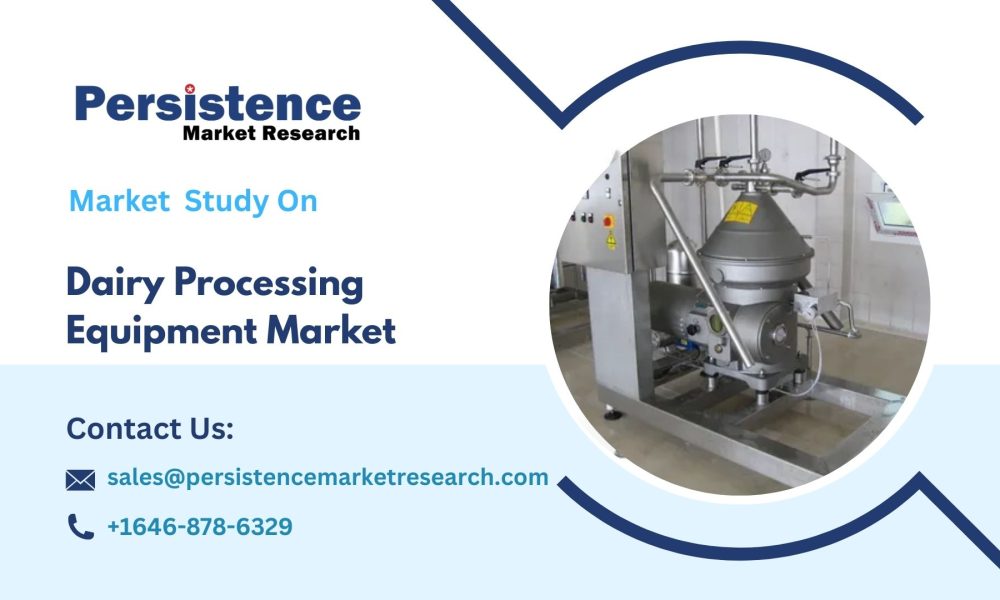
The global dairy processing equipment market is witnessing robust expansion, driven by the rising demand for milk and dairy products worldwide, urbanization, and the increasing focus on food safety and quality standards. The market is projected to reach US$12.4 billion in 2026 and is expected to expand to US$19.1 billion by 2033, growing at a CAGR of 6.3% during the forecast period from 2026 to 2033. This growth is fueled by rising global dairy consumption, expansion of dairy farms, and modernizing production facilities that require advanced processing solutions such as pasteurizers, separators, homogenizers, and filling machines. Increasing investments in automated and energy-efficient processing equipment are further enhancing productivity, reducing operational costs, and ensuring compliance with stringent food safety regulations.
The dairy processing equipment market is segmented into product types including milk processing, cheese processing, yogurt processing, butter processing, and ice cream production equipment. Among these, milk processing equipment dominates the market due to the high consumption of liquid milk and the need for advanced pasteurization, standardization, and packaging processes. Geographically, the Asia Pacific region leads the market with a 37% share, driven by rapid infrastructure development, rising middle-class populations, and increasing urbanization, which are fueling the demand for processed dairy products. Europe holds a 24% share, supported by its established manufacturing base, focus on sustainability, and stringent food safety standards, while North America grows at a 5.5% CAGR through innovation leadership and high adoption of automated processing solutions.
Key Highlights from the Report
• The global dairy processing equipment market is projected to reach US$19.1 billion by 2033.
• Milk processing equipment represents the leading product segment due to high liquid milk consumption.
• Automation and energy-efficient solutions are accelerating adoption in modern dairy facilities.
• Asia Pacific leads the market with 37% share driven by infrastructure growth and urbanization.
• Europe holds 24% market share due to manufacturing expertise and sustainability focus.
• North America grows at a 5.5% CAGR supported by technological innovation and digital integration.
𝐆𝐞𝐭 𝐚 𝐒𝐚𝐦𝐩𝐥𝐞 𝐏𝐃𝐅 𝐁𝐫𝐨𝐜𝐡𝐮𝐫𝐞 𝐨𝐟 𝐭𝐡𝐞 𝐑𝐞𝐩𝐨𝐫𝐭: https://www.persistencemarketresearch.com/samples/34880
Market Segmentation
The dairy processing equipment market can be segmented based on product type, end-user, and application. In terms of product type, the market includes milk processing equipment, cheese processing equipment, yogurt processing equipment, butter and ghee processing equipment, ice cream and frozen desserts equipment, and packaging machinery. Milk processing equipment dominates the market due to the widespread daily consumption of liquid milk and the need for pasteurization, homogenization, and chilling. Cheese and yogurt processing equipment are gaining momentum as consumer preference for value-added dairy products rises globally. Additionally, packaging machinery is witnessing significant adoption as manufacturers increasingly prioritize hygiene, shelf-life extension, and compliance with regulatory standards.
By end-user, the market is classified into commercial dairy plants, small-scale farms, and retail or on-site processing units. Commercial dairy plants represent the largest share due to large-scale production requirements, growing demand for packaged milk and dairy products, and investment in automation for operational efficiency. Small-scale farms and dairy cooperatives in emerging economies are also expanding, creating opportunities for cost-effective, compact processing equipment. On-site processing units, such as dairy kiosks and local processing centers, are becoming increasingly common in urban areas to meet the demand for fresh, locally sourced dairy products.
In terms of application, the market serves fluid milk, fermented milk products, ice cream and frozen desserts, cheese, butter and ghee, and other processed dairy applications. Fluid milk dominates, driven by high daily consumption and stringent quality standards requiring advanced processing solutions. Fermented milk products and ice cream are growing steadily due to rising consumer preference for convenience, taste variety, and nutritional value.
Regional Insights
Asia Pacific is the fastest-growing region in the dairy processing equipment market, accounting for 37% of global revenue. Strong economic growth, rapid urbanization, increasing disposable income, and a growing preference for processed dairy products are driving the adoption of modern processing facilities. Countries such as India, China, and Southeast Asian nations are witnessing substantial infrastructure investment in dairy plants, which is further accelerating market growth.
Europe holds 24% of the market share, with Germany, France, and the Netherlands leading due to their long-standing dairy manufacturing heritage, focus on sustainability, and stringent regulations related to food safety and environmental compliance. The region is also investing in automated processing lines, energy-efficient equipment, and high-capacity production units, enhancing overall market adoption.
North America is growing steadily at a CAGR of 5.5%, led by the United States and Canada. The region benefits from technological innovation, high adoption of smart and automated processing systems, and robust regulatory frameworks. Rising consumer demand for value-added dairy products such as flavored milk, cheese varieties, and yogurt drives continuous modernization in processing plants.
Latin America and Middle East & Africa are emerging markets with steady adoption of modern dairy processing equipment, driven by increasing dairy consumption, improving cold chain infrastructure, and supportive government initiatives in the dairy sector.
𝐎𝐧𝐞 𝐂𝐥𝐢𝐜𝐤 → 𝐘𝐨𝐮𝐫 𝐂𝐮𝐬𝐭𝐨𝐦 𝐌𝐚𝐫𝐤𝐞𝐭 𝐕𝐢𝐞𝐰: https://www.persistencemarketresearch.com/request-customization/34880
Market Drivers
The global dairy processing equipment market is primarily driven by rising dairy consumption fueled by population growth, urbanization, and changing dietary preferences. Rapid growth in the middle-class population across Asia Pacific and other emerging regions is increasing demand for packaged milk, cheese, yogurt, and other dairy products. Additionally, stringent food safety regulations by authorities such as the FDA, PMO, and EFSA are encouraging the adoption of advanced pasteurization, homogenization, and sterilization equipment.
Automation and modernization of processing facilities are further boosting market growth. Dairy plants are increasingly implementing automated and semi-automated lines to improve operational efficiency, reduce labor costs, and ensure consistent product quality. Integration of energy-efficient systems and digital monitoring solutions enhances productivity and helps meet environmental compliance standards. The growing trend toward value-added dairy products, such as flavored milk, probiotic yogurt, and premium cheese varieties, also supports the adoption of specialized processing equipment.
Market Restraints
Despite promising growth, the dairy processing equipment market faces certain challenges. High initial capital investment for advanced equipment can be a barrier for small and medium-sized dairy producers, particularly in developing economies. The cost of installation, operation, and maintenance of automated machinery may limit adoption among price-sensitive stakeholders. Additionally, complex regulatory compliance requirements and certification processes can slow down market entry for new equipment providers.
Market fragmentation and lack of standardization in certain regions also pose challenges. Small-scale dairy producers often rely on traditional processing methods, limiting the penetration of modern, high-capacity equipment. Supply chain disruptions, fluctuations in raw milk prices, and energy costs may further impact the operational efficiency of processing plants and reduce investment capacity.
Market Opportunities
The market offers significant opportunities, particularly in emerging economies where dairy consumption is growing rapidly. Expanding infrastructure, increased investment in modern dairy plants, and adoption of energy-efficient, automated equipment present opportunities for manufacturers to penetrate new regions. Compact and modular processing systems designed for small-scale and medium-scale producers are gaining traction.
Technological innovation, including IoT-enabled equipment, predictive maintenance, and real-time monitoring systems, provides opportunities to enhance productivity, reduce downtime, and improve product consistency. Additionally, the rising demand for sustainable and green processing equipment offers manufacturers the chance to differentiate through energy-efficient machinery, waste reduction technologies, and eco-friendly operations.
Strategic collaborations with government programs, dairy cooperatives, and international organizations can help expand market reach and accelerate adoption of advanced equipment. Customizable processing solutions for specific product lines, such as artisanal cheese, flavored dairy beverages, and functional yogurt, also represent emerging growth opportunities.
𝐁𝐮𝐲 𝐍𝐨𝐰 𝐭𝐡𝐞 𝐃𝐞𝐭𝐚𝐢𝐥𝐞𝐝 𝐑𝐞𝐩𝐨𝐫𝐭: https://www.persistencemarketresearch.com/checkout/34880
Company Insights
Key players in the global dairy processing equipment market include:
• GEA Group AG
• Tetra Laval International S.A.
• SPX FLOW, Inc.
• Alfa Laval AB
• JBT Corporation
• Bosch Packaging Technology
• Marel hf.
• CFT Group S.p.A.
Recent developments in the market include GEA Group AG’s introduction of energy-efficient pasteurization systems designed for small and medium dairy plants, enhancing adoption in emerging markets. Additionally, Tetra Laval International S.A. has expanded its smart packaging solutions integrated with IoT and predictive analytics to optimize operational efficiency and reduce product wastage.
Conclusion
The global dairy processing equipment market is set for strong growth, projected to increase from US$12.4 billion in 2026 to US$19.1 billion by 2033, growing at a CAGR of 6.3%. Market expansion is fueled by rising dairy consumption, urbanization, regulatory compliance, and investments in automation and modern processing facilities. Asia Pacific leads the market, followed by Europe and North America, each benefiting from infrastructure development, sustainability focus, and technological innovation. While high capital costs and regulatory complexities pose challenges, opportunities in emerging economies, smart and automated equipment, and sustainable processing solutions offer significant growth potential. The market’s evolution reflects a broader trend toward modern, efficient, and technology-driven dairy production that meets the growing global demand for safe, high-quality, and value-added dairy products.




