
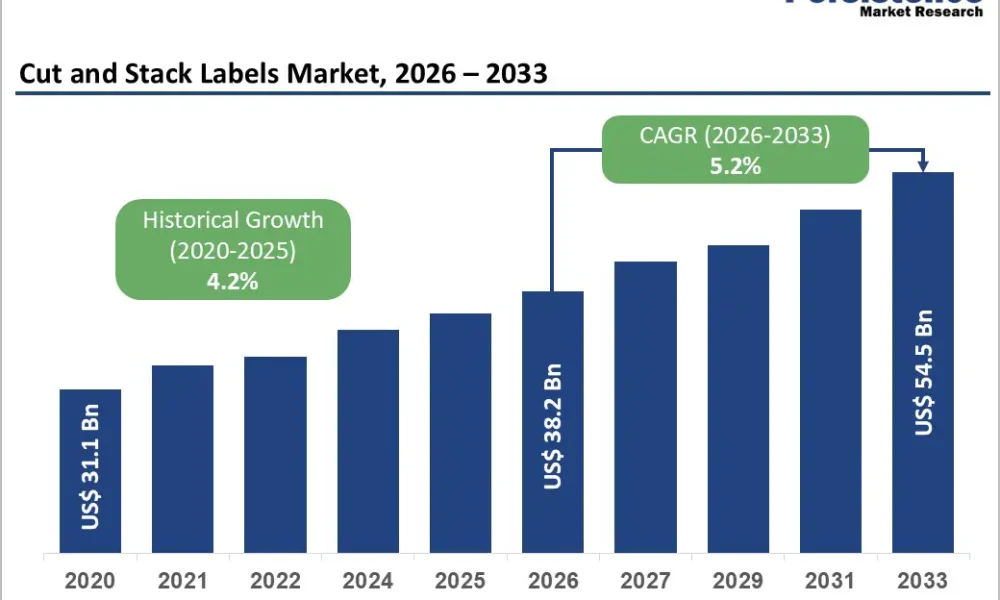
According to Persistence Market Research, the global Cut and Stack Labels Market is projected to witness steady expansion over the forecast period. The market size is likely to be valued at US$ 38.2 billion in 2026 and is expected to reach US$ 54.5 billion by 2033, growing at a CAGR of 5.2% between 2026 and 2033. This growth trajectory reflects sustained demand across high volume packaging industries, particularly food and beverage and home and personal care. The continued reliance on cost effective yet visually appealing labeling solutions is positioning cut and stack labels as a preferred choice for brand owners seeking scalability and consistency.
The market statistics indicate that rising premiumization and branding investments are significantly shaping competitive strategies. Companies are focusing on enhanced print quality, tactile finishes, and distinctive packaging aesthetics to capture consumer attention at retail shelves. In addition, increasing adoption of digital printing for short run and customized applications is strengthening market momentum. Food and beverage remains the leading end use segment due to high consumption volumes and regulatory labeling requirements, while Asia Pacific is emerging as a leading geographical region supported by expanding packaged goods production and strong consumer demand.
Download Your Free Sample & Explore Key Insights : https://www.persistencemarketresearch.com/samples/36103
Key Highlights from the Report
➤ The global cut and stack labels market is forecast to expand from US$ 38.2 billion in 2026 to US$ 54.5 billion by 2033 at a CAGR of 5.2%.
➤ Sustained demand from food and beverage manufacturers remains the primary revenue driver for cut and stack label converters.
➤ Home and personal care brands are increasing investments in premium printed labels to enhance shelf visibility.
➤ Digital printing technologies are gaining traction for short run and customized labeling applications.
➤ Premiumization trends are accelerating demand for high quality graphics and specialty finishes in packaging.
➤ Asia Pacific is expected to dominate regional demand due to rapid growth in packaged consumer goods production.
Market Segmentation
The Cut and Stack Labels Market can be segmented based on product type, material composition, printing technology, and end use industry. From a product perspective, paper based cut and stack labels hold a significant share due to cost efficiency and compatibility with high speed application systems. Plastic labels are also gaining adoption in moisture sensitive packaging environments. In terms of printing, flexographic and digital printing are widely used, with digital printing gaining prominence for short run, customized, and high definition label requirements.
Based on end use, the market is primarily driven by food and beverage applications, which require high volume labeling for bottled drinks, canned goods, dairy products, and packaged snacks. Home and personal care is another key segment, benefiting from branding driven packaging upgrades. Industrial and other consumer goods categories also contribute to overall demand. The leading segment remains food and beverage due to continuous product launches, regulatory compliance needs, and the importance of visual differentiation in competitive retail environments.
Customize This Report for Your Exact Requirements : https://www.persistencemarketresearch.com/request-customization/36103
Regional Insights
Asia Pacific stands out as the leading geographical region in the cut and stack labels market. Rapid urbanization, rising disposable incomes, and the expansion of organized retail are driving strong demand for packaged foods and personal care products. The region benefits from a large manufacturing base, enabling economies of scale in label production. Growing adoption of modern printing technologies further supports market growth across emerging economies.
North America and Europe also maintain stable demand, supported by mature food processing industries and established personal care brands. These regions are characterized by strong branding investments and premium packaging strategies. Digital printing adoption is particularly strong in developed markets, where shorter product cycles and customization trends are influencing labeling requirements.
Market Drivers
The primary driver of the Cut and Stack Labels Market is sustained demand from the food and beverage industry. High consumption volumes of packaged goods require reliable and cost efficient labeling solutions. Cut and stack labels are widely preferred for bottled beverages and canned products due to their suitability for high speed application lines. As manufacturers continue expanding production capacities, demand for bulk label orders remains robust.
Another significant growth driver is rising premiumization and branding investments. Companies are increasingly focusing on packaging aesthetics to enhance product differentiation. High quality printing, embossing effects, and specialty finishes are becoming essential tools for brand communication. The growing adoption of digital printing for short run and customized applications is also accelerating market growth by enabling flexibility, faster turnaround times, and reduced inventory costs.
Market Restraints
Despite steady growth prospects, the cut and stack labels market faces certain restraints. Fluctuations in raw material costs, particularly paper and plastic substrates, can impact production margins. Price sensitivity among small and medium sized brand owners may limit the adoption of premium label variants. Competitive pressures in the packaging industry also require continuous innovation and operational efficiency improvements.
Additionally, increasing competition from alternative labeling formats can influence market share dynamics. Pressure to reduce packaging waste and enhance sustainability may require manufacturers to invest in eco friendly materials and process upgrades. These investments can increase short term operational costs, potentially affecting profitability for smaller converters.
Market Opportunities
The market presents notable opportunities driven by the expansion of digital printing technologies. The ability to produce short run and customized labels efficiently is opening new revenue streams, particularly for limited edition products and promotional campaigns. As consumer preferences shift toward personalized packaging, converters offering advanced digital capabilities are likely to gain a competitive edge.
Premiumization trends in food, beverage, and personal care segments also create long term opportunities. Brands are increasingly investing in distinctive packaging to build customer loyalty and brand recall. Emerging markets in Asia Pacific offer additional growth potential due to rising consumption of packaged goods. Continuous innovation in printing techniques and substrate materials will further expand application possibilities within the cut and stack labels market.
Exclusive Data Awaits – Continue to Checkout : https://www.persistencemarketresearch.com/checkout/36103
Company Insights
Key players operating in the Cut and Stack Labels Market include
- CCL Industries
- Multi-Color Corporation
- Fort Dearborn Company
- Resource Label Group
- Smyth Companies
- Hammer Packaging
- Inland Packaging
- Anchor Printing
- Walle Corporation
- Epsen Hillmer Graphics Co.
- WS Packaging Group
- Precision Press
- Labels West
- Traco Manufacturing
- Constantia Flexibles
- UPM Raflatac
- Fuji Seal International
- Huhtamaki Group
These companies focus on product innovation, digital printing expansion, and strategic partnerships to strengthen their global presence.
Recent Developments
- March 2024 – A leading packaging company expanded its digital printing capacity to support short run and customized cut and stack label applications.
- September 2023 – A major label manufacturer announced investments in premium finishing technologies to enhance high quality branding solutions.
Future Opportunities and Growth Prospects
The future of the Cut and Stack Labels Market remains promising, supported by consistent demand from core end use industries and expanding digital printing adoption. As branding investments intensify and packaging customization becomes a strategic priority, the market is expected to maintain stable growth momentum. With projected expansion from US$ 38.2 billion in 2026 to US$ 54.5 billion by 2033 at a CAGR of 5.2%, industry participants are well positioned to capitalize on evolving consumer and technological trends.




