
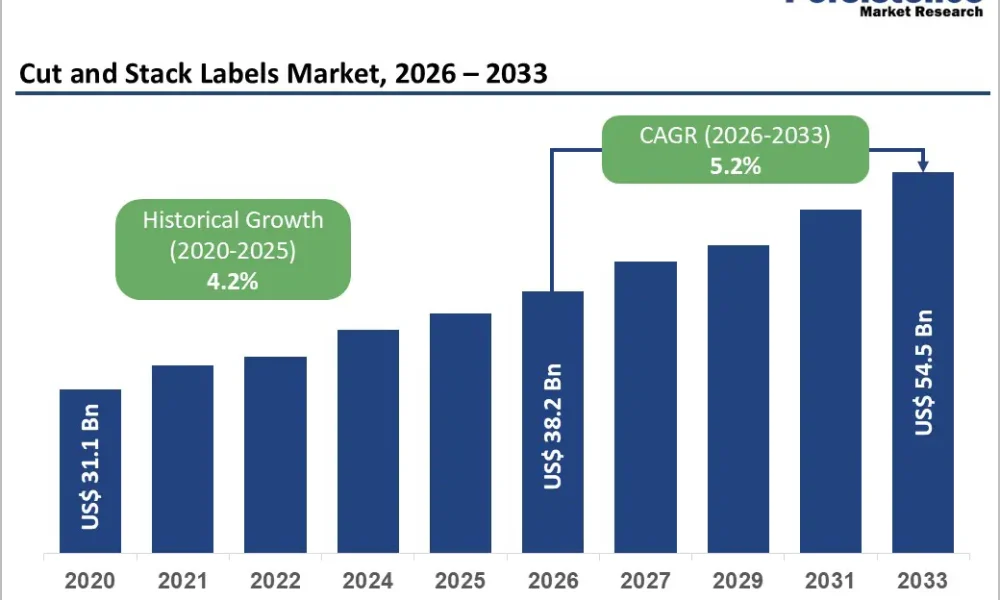
The cut and stack labels market is witnessing consistent growth as businesses across food & beverage, home & personal care, pharmaceuticals, and consumer goods sectors increasingly invest in premiumized and customized labeling solutions. Cut and stack labels, also referred to as sheeted labels, offer high-quality printing, superior registration accuracy, and versatility, making them suitable for short-run production, multi-color designs, and specialized applications. According to market estimates, the global cut and stack labels market size is projected to reach US$ 38.2 billion in 2026 and is expected to expand to US$ 54.5 billion by 2033, registering a compound annual growth rate (CAGR) of 5.2% during the forecast period.
The food & beverage sector remains the largest end-user, driven by rising demand for premium packaging, limited-edition products, and personalized branding. Home and personal care products also contribute significantly due to the need for attractive, high-resolution labeling that conveys product information, ingredients, and certifications. Geographically, North America leads the market due to high consumer awareness, advanced printing infrastructure, and widespread adoption of digital printing technologies. The region’s manufacturers focus on short-run customization and seasonal promotions, driving adoption of cut and stack labels over conventional roll-fed alternatives.
Key Highlights from the Report
• The cut and stack labels market is expected to grow at a CAGR of 5.2% between 2026 and 2033.
• Market size is projected to increase from US$ 38.2 billion in 2026 to US$ 54.5 billion by 2033.
• Food & beverage and home & personal care sectors are the largest end-users due to branding and premiumization trends.
• North America dominates the market owing to advanced printing technologies and high consumer demand.
• Digital printing adoption for short-run and customized labels is accelerating market growth.
• Innovations in sustainable and recyclable materials are influencing procurement strategies.
𝐆𝐞𝐭 𝐚 𝐒𝐧𝐞𝐚𝐤 𝐏𝐞𝐞𝐤, 𝐒𝐚𝐦𝐩𝐥𝐞 𝐏𝐃𝐅 𝐈𝐧𝐬𝐢𝐝𝐞: https://www.persistencemarketresearch.com/samples/36103
Market Segmentation
The cut and stack labels market can be segmented based on material type, printing technology, end-use industry, and application. By material type, the market includes paper, synthetic, and specialty films, each offering specific advantages such as print clarity, durability, moisture resistance, and adhesive compatibility. Paper labels dominate due to cost-effectiveness and ease of customization, while synthetic and specialty films are preferred in food & beverage and home care products for enhanced durability and moisture resistance.
By printing technology, labels are produced using digital, flexographic, offset, and hybrid printing methods. Digital printing is gaining significant traction, particularly for short-run orders, limited editions, and customized products, offering high-resolution graphics, fast turnaround, and minimal setup costs. Flexographic printing is widely used for medium to large-volume production, balancing efficiency with quality. Offset printing remains preferred for high-quality, large-format labels, while hybrid solutions combine digital and traditional methods for versatility.
By end-use industry, the market caters to food & beverage, home & personal care, pharmaceuticals, electronics, and industrial products. Food & beverage accounts for the largest share due to extensive product variety, brand differentiation, and the need for eye-catching packaging. Home and personal care products also contribute significantly, as manufacturers prioritize aesthetic appeal, regulatory compliance, and consumer engagement through informative labeling.
By application, cut and stack labels are used for product identification, promotional/seasonal labeling, branding, and regulatory compliance. Product identification labels provide essential information, while promotional and seasonal labels drive marketing campaigns. Regulatory and compliance labels ensure traceability, safety, and adherence to regional labeling laws, particularly in pharmaceuticals and food products.
Regional Insights
North America is the leading market, supported by well-established printing infrastructure, a strong e-commerce presence, and high adoption of premium and customized labels. The United States and Canada account for the majority of regional consumption, driven by demand for short-run labels, limited-edition packaging, and personalized branding.
Europe focuses on sustainability and high-quality labeling, with countries like Germany, France, and the UK leading in digital printing adoption. The market is influenced by stringent regulatory requirements on labeling content and packaging sustainability, encouraging the use of recyclable materials and innovative adhesives.
Asia-Pacific is an emerging market with growing demand from the food & beverage and home & personal care sectors. Rapid industrialization, rising urbanization, and expanding retail markets in China, India, and Japan are fueling investments in advanced labeling technologies, particularly digital and hybrid printing solutions.
Latin America and the Middle East & Africa are gradually adopting cut and stack labels as local manufacturers seek cost-effective yet high-quality labeling solutions for consumer products, pharmaceuticals, and beverages. Increased foreign investment and retail expansion further drive market penetration in these regions.
𝐆𝐞𝐭 𝐚 𝐂𝐮𝐬𝐭𝐨𝐦𝐢𝐳𝐞𝐝 𝐌𝐚𝐫𝐤𝐞𝐭 𝐕𝐢𝐞𝐰 𝐢𝐧 𝐎𝐧𝐞 𝐂𝐥𝐢𝐜𝐤 : https://www.persistencemarketresearch.com/request-customization/36103
Market Drivers
The primary driver of the cut and stack labels market is the growing demand for premium and customized product packaging, particularly in food & beverage and home & personal care sectors. Brands increasingly invest in high-resolution graphics, short-run production, and personalized labels to differentiate products on crowded retail shelves.
Another key driver is the adoption of digital printing technologies, which enable quick turnaround, cost-effective customization, and minimal setup for small-batch production. Regulatory requirements for traceability, nutrition labeling, and safety also accelerate adoption, particularly in pharmaceuticals and food products, where precise, readable labels are mandatory.
Market Restraints
High initial investment and operational costs associated with digital printing equipment and advanced sheet-fed systems can limit adoption among small and medium-sized manufacturers. Additionally, competition from roll-fed label formats, which may offer higher efficiency in large-volume production, can restrain growth in certain applications. Variability in substrate compatibility and limitations in extreme weather or chemical resistance for paper-based labels may also pose challenges in industrial and outdoor applications.
Market Opportunities
The market presents significant opportunities in sustainable and recyclable label materials, driven by rising consumer awareness and regulatory mandates across Europe and North America. Innovations in biodegradable adhesives, recycled paper, and eco-friendly films are creating opportunities for environmentally conscious brands.
Furthermore, short-run digital printing for limited editions, promotional campaigns, and personalized labels represents a growing segment, particularly in e-commerce and premium product lines. Integration with automated packaging lines, smart labeling with QR codes, and IoT-based inventory tracking also offer potential for differentiation and operational efficiency.
𝐆𝐞𝐭 𝐈𝐧𝐬𝐭𝐚𝐧𝐭 𝐀𝐜𝐜𝐞𝐬𝐬 𝐓𝐨𝐝𝐚𝐲—𝐌𝐚𝐤𝐞 𝐒𝐦𝐚𝐫𝐭𝐞𝐫 𝐃𝐞𝐜𝐢𝐬𝐢𝐨𝐧𝐬 : https://www.persistencemarketresearch.com/checkout/36103
Company Insights
Key players operating in the cut and stack labels market include:
• Avery Dennison Corporation
• CCL Industries Inc.
• Multi-Color Corporation
• RR Donnelley & Sons Company
• UPM Raflatac
• Constantia Flexibles Group GmbH
• Huhtamaki Oyj
• LINTEC Corporation
Recent developments in the market highlight digital printing expansion for short-run, high-resolution labels, and investments in sustainable materials to meet environmental regulations. Companies are focusing on integrating sheet-fed solutions with automated packaging lines to enhance efficiency, reduce waste, and enable personalized labeling for limited edition products.
Conclusion
The cut and stack labels market is poised for robust growth through 2033, driven by sustained demand from food & beverage and home & personal care sectors, rising premiumization and branding investments, and the increasing adoption of digital printing for short-run and customized applications. North America leads in market adoption due to advanced printing infrastructure, high consumer demand, and e-commerce growth, while Asia-Pacific represents the fastest-growing region due to industrial expansion and retail penetration. Innovations in sustainable and recyclable materials, automation, and smart labeling technologies are reshaping the market landscape, enabling brands to meet regulatory requirements, reduce environmental impact, and enhance consumer engagement. As businesses continue to prioritize branding, product differentiation, and operational efficiency, the demand for cut and stack labels is expected to remain strong, solidifying its position as a critical component in modern packaging strategies.




