
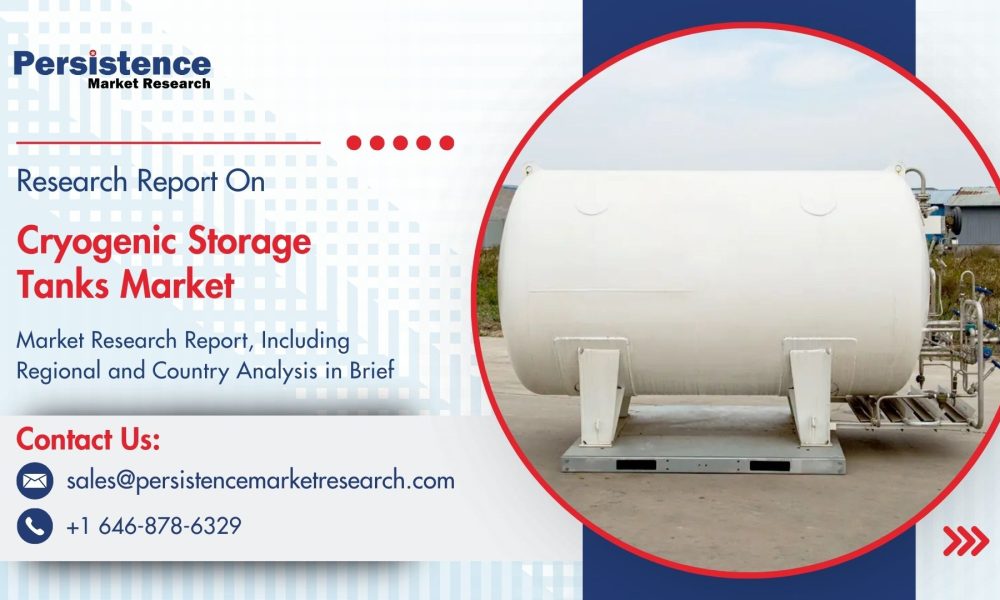
The cryogenic storage tanks market is undergoing substantial growth as industries worldwide increase their reliance on liquefied gases such as liquefied natural gas (LNG), nitrogen, oxygen, argon, and carbon dioxide for critical applications. According to the latest study by Persistence Market Research, the global cryogenic storage tanks market is projected to attain a valuation of US$ 11 billion by 2033, expanding at a CAGR of 6.3% during the forecast period (2024–2033). The market’s expansion is primarily driven by the rising adoption of clean energy solutions, advancements in industrial gas infrastructure, and the growing need for safe and efficient storage systems for cryogenic liquids.
Growing Importance of Cryogenic Storage Systems
Cryogenic storage tanks are specifically designed to store liquefied gases at extremely low temperatures, typically below –150°C. These tanks play a vital role across industries such as healthcare, energy, food processing, and electronics, where cryogenic liquids are essential for various operations. With the increasing need for sustainable energy sources and industrial applications requiring ultra-cold temperatures, the demand for cryogenic tanks has risen sharply over the past decade.
In recent years, the energy transition towards cleaner fuels has created a significant opportunity for cryogenic tank manufacturers. The growing global emphasis on reducing carbon emissions and moving away from conventional fossil fuels has accelerated LNG adoption, which serves as a cleaner alternative for power generation, transportation, and industrial fuel. Consequently, LNG storage and transportation infrastructure—including cryogenic storage tanks—has become a crucial component of modern energy systems.
The healthcare and pharmaceutical sectors also rely heavily on cryogenic technology. Liquid oxygen and nitrogen are used extensively in hospitals and laboratories for medical treatments, vaccine storage, and biological research. Similarly, the food and beverage industry utilizes cryogenic tanks for food freezing, preservation, and carbonation processes. This widespread applicability continues to fuel market expansion globally.
Get a Sample PDF Brochure of the Report (Use Corporate Email ID for a Quick Response): https://www.persistencemarketresearch.com/samples/21778
Market Dynamics: Key Growth Drivers and Challenges
The primary growth driver of the cryogenic storage tanks market is the increasing consumption of liquefied natural gas (LNG). As countries aim to diversify their energy mix and reduce dependency on coal and oil, LNG has emerged as a preferred fuel for its cleaner combustion properties. The expansion of LNG terminals, storage facilities, and distribution networks globally is directly stimulating the need for high-quality cryogenic tanks.
Furthermore, rapid industrialization in developing economies is boosting demand for industrial gases used in manufacturing, metallurgy, and electronics. Cryogenic tanks are essential for storing gases such as nitrogen and argon, which are utilized in welding, semiconductor fabrication, and metal processing.
Another major growth factor is the rising investment in healthcare infrastructure. The pandemic-driven demand for medical oxygen has prompted hospitals and governments to upgrade their cryogenic storage systems, ensuring consistent and safe supply of medical-grade gases.
However, the high cost of installation and maintenance remains a restraint for some market participants. Cryogenic tanks require specialized materials and engineering precision to withstand extreme conditions, increasing production costs. Moreover, safety and regulatory compliance are critical challenges due to the hazardous nature of cryogenic liquids. Despite these challenges, continuous innovation in materials science, such as the use of advanced stainless steels and composite materials, is helping manufacturers overcome operational and economic hurdles.
Technological Advancements Enhancing Market Performance
Technological innovation plays a pivotal role in shaping the cryogenic storage tanks market. Manufacturers are focusing on improving thermal insulation, enhancing tank durability, and reducing boil-off rates. Modern cryogenic tanks feature multi-layer insulation systems and vacuum-jacketed designs to ensure minimal heat transfer and efficient long-term storage.
Automation and digital monitoring are also transforming the market landscape. Smart cryogenic tanks equipped with Internet of Things (IoT) sensors allow operators to track temperature, pressure, and liquid levels in real time. These advancements enable predictive maintenance, operational efficiency, and enhanced safety—making them highly attractive for industries where precision and reliability are paramount.
Additionally, modular and portable cryogenic tanks are gaining popularity due to their flexibility in deployment across diverse applications, from small-scale medical facilities to large industrial plants. This shift toward customizable and energy-efficient storage solutions is expected to continue shaping the market’s evolution in the years to come.
Market Segmentation Insights
The cryogenic storage tanks market is segmented based on product type, cryogen type, application, and end-use industry. By product type, stationary tanks hold the dominant share due to their widespread use in LNG terminals, industrial facilities, and large-scale storage sites. Mobile cryogenic tanks are also gaining momentum, particularly for the transportation of cryogenic liquids over long distances.
Based on cryogen type, LNG tanks lead the market, reflecting the global transition to clean energy sources. Tanks designed for storing liquid nitrogen and oxygen are witnessing rising adoption in the medical and research sectors, while liquid argon and carbon dioxide tanks are increasingly utilized in food processing and beverage industries.
In terms of application, storage and distribution of liquefied gases constitute the largest segment, supported by growing industrial and energy consumption. Other applications include biological sample storage, metal fabrication, and cryogenic fuel storage for aerospace and transportation industries.
End-use industries driving demand include energy and power, healthcare, food and beverage, and chemical processing. The healthcare sector’s surge in cryogenic gas usage for medical applications—especially post-pandemic—has made it one of the fastest-growing segments.
Regional Outlook: Asia Pacific Leading the Way
Regionally, Asia Pacific dominates the cryogenic storage tanks market and is expected to maintain its leadership through 2033. The region’s dominance can be attributed to rapid industrial growth, urbanization, and expanding LNG infrastructure projects in countries like China, India, Japan, and South Korea. Increasing government investments in renewable energy and the transition to natural gas-based power generation are further accelerating regional demand.
North America follows closely, with the United States being a major contributor due to its robust energy infrastructure, shale gas development, and large-scale LNG export facilities. Europe is witnessing significant market expansion as well, driven by the region’s aggressive decarbonization initiatives and investments in green hydrogen and LNG storage.
Meanwhile, the Middle East and Africa are emerging markets where oil-to-gas transition strategies are fostering demand for cryogenic systems. Latin America, led by Brazil and Mexico, is gradually expanding its LNG and industrial gas storage capabilities, creating lucrative opportunities for tank manufacturers.
For Customized Insights on Segments, Regions, or Competitors, Request Personalized Purchase Options: https://www.persistencemarketresearch.com/request-customization/21778
Company Insights
The cryogenic storage tanks market features several global and regional players competing through technological innovation, strategic partnerships, and geographic expansion. Leading companies are investing in advanced insulation materials, digital monitoring systems, and sustainability initiatives to maintain their competitive edge.
✦ Chart Industries, Inc.
✦ Linde plc
✦ Air Products and Chemicals, Inc.
✦ Cryofab, Inc.
✦ INOX India Pvt. Ltd.
✦ Wessington Cryogenics
✦ FIBA Technologies, Inc.
✦ Cryolor SA
✦ VRV S.p.A.
✦ Air Water Inc.
These companies are focusing on mergers, acquisitions, and product diversification to strengthen their global presence. For example, Chart Industries continues to expand its portfolio of LNG storage solutions, while INOX India has been actively developing portable cryogenic systems for healthcare and food industries.
Emerging Trends and Future Outlook
The future of the cryogenic storage tanks market looks promising as industries move toward cleaner energy solutions and advanced gas storage technologies. One of the most significant trends shaping the market is the rise of hydrogen energy. With global momentum building toward a hydrogen-based economy, cryogenic tanks designed for liquid hydrogen storage are gaining strategic importance. These tanks are critical for the transportation and storage of hydrogen fuel in power generation and mobility applications.
Furthermore, integration of smart monitoring systems using IoT and AI technologies will become more prevalent. This digitalization trend enhances safety, optimizes tank performance, and ensures compliance with environmental regulations. Sustainability is also at the forefront, as manufacturers work toward developing eco-friendly materials and energy-efficient insulation systems to reduce operational footprints.
The space and aerospace industries represent another growing frontier for cryogenic tank applications. Liquid oxygen and hydrogen are key propellants for rockets, making cryogenic storage indispensable for space exploration missions. As government and private space ventures increase globally, this segment will provide new growth opportunities for cryogenic equipment suppliers.
Conclusion
In summary, the cryogenic storage tanks market is on a robust growth trajectory, driven by the rising demand for LNG, industrial gases, and medical oxygen across the globe. With the market projected to reach US$11 billion by 2033 at a CAGR of 6.3%, opportunities are abundant for manufacturers and investors alike. The increasing adoption of digital technologies, the rise of clean energy applications, and growing emphasis on sustainability are reshaping the industry’s future.
As the world moves toward energy efficiency, decarbonization, and technological advancement, cryogenic storage tanks will continue to play an indispensable role in ensuring safe, reliable, and efficient handling of liquefied gases across multiple sectors.
Explore the Latest Trending Research Reports:
About Persistence Market Research:
At Persistence Market Research, we specialize in creating research studies that serve as strategic tools for driving business growth. Established as a proprietary firm in 2012, we have evolved into a registered company in England and Wales in 2023 under the name Persistence Research & Consultancy Services Ltd. With a solid foundation, we have completed over 3600 custom and syndicate market research projects, and delivered more than 2700 projects for other leading market research companies’ clients.
Our approach combines traditional market research methods with modern tools to offer comprehensive research solutions. With a decade of experience, we pride ourselves on deriving actionable insights from data to help businesses stay ahead of the competition. Our client base spans multinational corporations, leading consulting firms, investment funds, and government departments. A significant portion of our sales comes from repeat clients, a testament to the value and trust we’ve built over the years.
Contact Us:
Persistence Market Research
G04 Golden Mile House, Clayponds Lane
Brentford, London, TW8 0GU UK
USA Phone: +1 646-878-6329
UK Phone: +44 203-837-5656
Email: [email protected]
Web: https://www.persistencemarketresearch.com




