
EUR 1.2 Million in Counterfeit Currency and Dozens of Fake Identity Materials Seized as Bulgaria and Romania Intensify Pressure on Regional Criminal Networks
WASHINGTON, DC, May 22, 2026
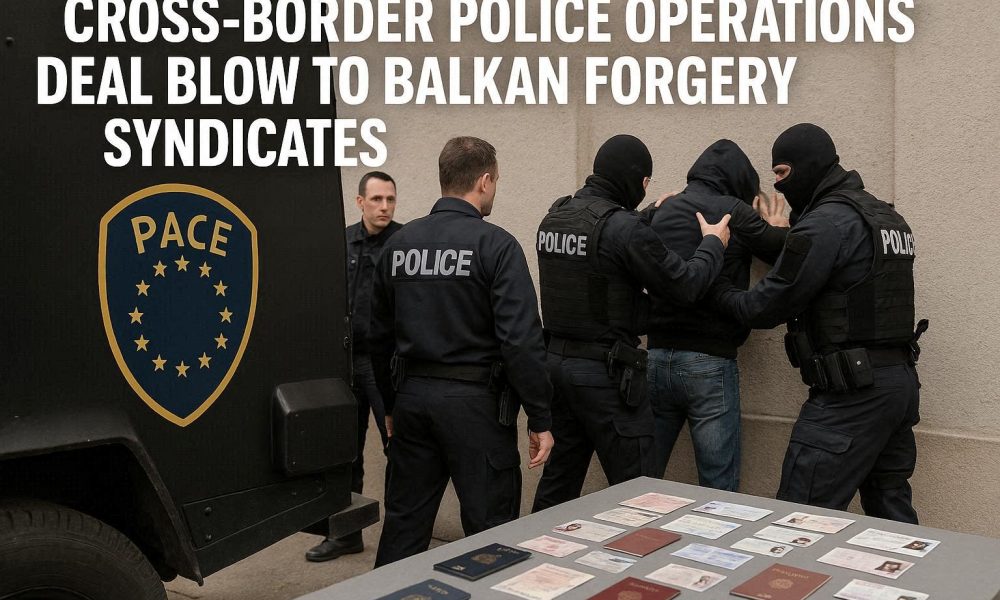
Cross-border police operations in the Balkans have dealt a significant blow to forgery syndicates after Bulgarian and Romanian authorities uncovered a suspected counterfeit euro production network near the frontier, seized more than EUR 1.2 million in fake banknotes, and opened a wider investigation into the criminal infrastructure behind counterfeit currency, false identity documents, narcotics, and regional distribution channels.
The operation has drawn attention far beyond Bulgaria and Romania because it illustrates how Balkan forgery syndicates are no longer small print-shop operations working in isolation, but adaptable organized crime groups capable of using border geography, mobile production equipment, forged documents, narcotics contacts, and multinational suspects to create a larger criminal economy.
Official reporting on the counterfeit euro printing facility uncovered near the Bulgarian border said that authorities seized more than EUR 1.2 million in counterfeit banknotes, 1 kilogram of cocaine, and evidence linked to a suspected illegal printing facility in Romania.
The operation began in Bulgaria before investigators traced the production site across the border.
The case began when Bulgaria’s General Directorate for Combating Organized Crime detained several individuals and seized a large quantity of counterfeit euro notes during an operation that quickly expanded into Romania.
Authorities later identified a suspected printing facility on the Romanian side of the border, showing how the syndicate allegedly separated production, storage, transport, and personnel across jurisdictions to complicate police detection.
That cross-border structure is significant because it reflects a common method used by organized crime groups in southeastern Europe, where one country may contain the buyers, another the production site, another the couriers, and another the financial handlers.
Acting Bulgarian Interior Ministry officials said the counterfeit notes appeared to be the first batch from the illegal printing facility, suggesting police may have disrupted the group before the fake currency entered broader circulation.
For investigators, stopping a first batch is especially important because counterfeit money becomes harder to trace once it passes through shops, fuel stations, informal markets, nightlife venues, transport routes, and cash-heavy businesses.
The confirmed arrests showed the multinational nature of modern forgery networks.
Bulgarian authorities confirmed five arrests, including two Bulgarian nationals, two Romanian nationals, and one Italian national, while additional investigative leads continued as prosecutors prepared charges and reviewed evidence from searches.
The multinational suspect profile matters because forgery syndicates often rely on diverse expertise, including local access, printing expertise, criminal distribution contacts, transport logistics, and financial coordination.
A Bulgarian suspect may assist with local movement or storage; a Romanian suspect may help with a production location; and a foreign national may provide technical expertise, criminal contacts, or access to wider distribution.
Authorities said searches were carried out in vehicles and residential properties, suggesting that investigators were not dealing with one isolated workshop but a network spread across several locations.
That pattern is common in serious counterfeiting cases because syndicates often separate production equipment, finished notes, narcotics, phones, documents, vehicles, and cash to reduce the risk that one police raid exposes the entire operation.
The seized items pointed to a broader organized crime ecosystem.
The seizure of more than EUR 1.2 million in counterfeit banknotes was the headline event, but the discovery of one kilogram of cocaine immediately expanded the case beyond currency forgery alone.
Narcotics evidence can indicate that counterfeiters are linked to drug trafficking, barter arrangements, criminal financing, shared couriers, or distribution relationships with other organized crime groups.
In counterfeit currency cases, investigators usually examine whether fake money was intended for retail placement, criminal purchases, drug transactions, vote-buying, debt settlement, or movement through businesses that handle large amounts of cash.
The presence of vehicles and residential search locations also suggests that prosecutors will examine whether the suspects maintained a defined chain of custody for the counterfeit notes before their broader distribution.
For police, the most important evidence may ultimately come from phones, computers, printed files, address records, packaging, vehicle logs, and communications that show who ordered, produced, moved, or financed the counterfeit currency.
Fake identity documents remain central to the Balkan forgery threat.
Although the March 2026 Bulgaria-Romania operation centered on counterfeit cash, Balkan enforcement cases around the same period also exposed document-forgery activity involving counterfeit identity cards, passport materials, holograms, laminators, stamps, and printing equipment.
Those document seizures matter because counterfeit cash and fake identity documents often emerge from the same criminal skill set, using similar equipment, production knowledge, courier routes, and trusted buyers.
A syndicate that can produce false identity cards may help criminals rent apartments, register vehicles, obtain phones, open accounts, cross borders, or conceal the real identities of people involved in counterfeit cash distribution.
Practical verification guidance on how to recognize a fake passport or driving license shows why identity fraud is not only a border issue, because forged documents can enable banking fraud, vehicle crime, property rentals, employment deception, and organized crime logistics.
When fake IDs and counterfeit currency appear in the same regional criminal environment, police must treat them as connected tools that help syndicates disguise both people and money.
The Bulgaria-Romania frontier offers criminals an opportunity, but it also creates a pressure point for police.
The frontier between Bulgaria and Romania runs along key transport and commercial routes, making it well-suited to legal trade, regional travel, freight movement, and cross-border cooperation.
Those same legitimate flows can be exploited by criminal groups seeking to move counterfeit notes, forged documents, narcotics, vehicles, equipment, and suspects while blending into ordinary traffic.
A border production site can also create investigative delays because the cash may be found in one country, the printing facility in another, and the suspected organizer in yet another operational location.
That jurisdictional separation is exactly why cross-border policing has become essential in the Balkans, where national investigations can be undermined if suspects and evidence move faster than legal requests.
In this case, Bulgarian and Romanian cooperation appears to have turned the border from a criminal shield into an enforcement advantage, allowing investigators to move from seizure to the production site and to the identification of the organizer.
Counterfeit currency attacks trust in the cash economy.
The economic impact of counterfeit currency extends beyond the face value of seized notes, as fake money undermines confidence in everyday transactions, imposes losses on businesses, and increases costs for banks, retailers, and law enforcement.
Small businesses are especially vulnerable because market vendors, petrol stations, restaurants, taxi drivers, convenience shops, and nightlife venues may accept cash quickly during crowded or low-light conditions.
Once a counterfeit note is detected, the person or business holding it usually bears the loss, while banks and central banks remove the note from circulation and alert law enforcement to possible patterns.
The U.S. Secret Service, which investigates counterfeit U.S. currency, explains in its official counterfeit-investigation resources that currency protection depends on enforcement, public awareness, and the ability to identify suspicious notes before they spread.
For European authorities, the same principle applies to the euro, because a counterfeit note produced near one frontier can quickly move through multiple countries if distribution begins before detection.
Currency forgery experts focus on quality, circulation risk, and production capacity.
A currency forgery expert reviewing the Balkan seizure would likely focus on whether the notes were crude copies, professional counterfeits, or part of a larger series already tested in circulation.
Technical examiners usually assess paper, printing alignment, serial numbers, watermarks, holograms, ultraviolet reactions, tactile features, security threads, and the consistency of note batches.
Authorities said checks with the Bulgarian National Bank found only two similar counterfeit banknotes previously detected, a detail that may support the view that the seized EUR 1.2 million represented an early production batch.
That early-stage finding could become important in the prosecution because it may show the group had moved from preparation to production, only to be interrupted before wide distribution.
The stronger the production capability, the more serious the case becomes, because a functioning printing facility can generate repeat batches and support multiple distribution networks over time.
The timeline shows how fast a cross-border investigation can move when agencies coordinate.
The initial arrests and seizures in Bulgaria were followed by the identification of the suspected printing facility in Romania, demonstrating how quickly police can act when intelligence is shared across borders.
That speed matters because counterfeiters can destroy templates, move printers, burn packaging, abandon safe houses, wipe phones, and warn associates once they realize law enforcement has intercepted a shipment or arrested a courier.
A joint task force leader would likely describe the operation as an example of why regional cooperation must be immediate rather than ceremonial, since successful cross-border cases often depend on acting before suspects can relocate.
The reported searches of vehicles and residential properties indicate that investigators sought to secure evidence before the network could fragment or disappear.
For prosecutors, this coordinated timeline may help establish organization, intent, production capacity, and the roles of suspects across the Bulgaria-Romania border.
Balkan forgery syndicates have a long history of adapting to enforcement pressure.
The Balkans have historically been affected by document fraud, counterfeit goods, illicit cash movement, vehicle crime, migrant smuggling, narcotics transport, and cross-border criminal cooperation.
Geography plays a major role because the region connects the eastern Mediterranean, the Black Sea, Central Europe, and Turkey-linked routes to EU internal markets through roads, ports, rivers, and border crossings.
Criminal groups adapt by moving production sites, changing couriers, shifting routes, using legitimate businesses, and exploiting administrative differences between neighboring states.
Forgery syndicates also benefit from demand because criminals need fake documents to hide identities, traffickers need papers to move people, counterfeiters need cash-placement networks, and fugitives need administrative cover.
That convergence means a single forgery case can reveal far more than a single crime, especially when fake IDs, counterfeit notes, narcotics, and cross-border vehicles are discovered together or in closely related investigations.
Modern document security is improving, but criminal production methods continue to evolve.
European governments have strengthened passports, identity cards, residence permits, and banknotes by adding enhanced security features, biometric systems, chip-based authentication, machine-readable zones, and improved document databases.
Criminal groups respond by studying security features, purchasing better equipment, using stolen data, altering genuine documents, producing plausible supporting paperwork, and targeting weaker inspection points rather than the strongest ones.
Research-style explainers on electronic passport security show why document protection depends not only on advanced materials, but also on reliable enrollment, database access, staff training, and consistent verification practices.
The same lesson applies to counterfeit currency: security features can deter low-level copies, but organized counterfeiters look for the weakest human or commercial link where suspicious notes may still be accepted.
Technology narrows the criminal window, but it does not close the market unless police, banks, businesses, and the public understand how forged documents and counterfeit cash are actually used.
The long-term effects may depend on whether prosecutors can reach the wider network.
The immediate success of enforcement is clear: authorities removed a large amount of counterfeit currency from circulation and disrupted a suspected production facility before the fake notes could spread widely.
The long-term impact will depend on whether investigators can identify buyers, distributors, financiers, equipment suppliers, document specialists, narcotics contacts, and any additional suspects who were not detained during the first phase.
If prosecutors can prove an organized criminal structure rather than isolated possession, the case may produce stronger penalties and help dismantle related networks.
If digital evidence reveals customer lists, payment records, courier routes, or foreign contacts, the operation could lead to additional arrests outside Bulgaria and Romania.
The most damaging outcome for organized crime would be not only the loss of a single batch of counterfeit euros but also the exposure of the trusted relationships that enabled the syndicate to function.
The next steps will shape the prosecution.
Prosecutors are expected to review forensic analysis of the counterfeit notes, technical evidence from the suspected printing facility, narcotics testing, search results, phone extractions, and the individual roles of each detainee.
Courts will decide remand measures, while investigators continue to examine whether the seized notes had already entered circulation or were being prepared for distribution.
Authorities will also likely assess whether any fake identity documents, forged registration materials, or false personal records were used to rent properties, control vehicles, or conceal the people involved.
Financial investigators may trace how equipment was purchased, whether proceeds were laundered, and whether the cocaine seizure points to a larger criminal partnership.
Those steps will determine whether the case remains a major counterfeit-currency seizure or develops into a broader organized crime prosecution with regional implications.
The operation sends a warning to Balkan forgery networks.
The Bulgaria-Romania operation shows that Balkan police can act across borders when counterfeit currency, forged documents, narcotics, and criminal logistics converge in one investigation.
It also shows that forgery syndicates remain vulnerable when law enforcement targets the production chain rather than waiting for fake notes or IDs to enter circulation.
For banks, businesses, border officers, transport companies, and local police, the case reinforces the need to treat suspicious documents and suspicious cash as potential indicators of wider organized crime.
For criminal networks, the warning is equally clear: printing equipment, fake notes, phones, vehicles, narcotics, and forged identities can all become evidence linking a local seizure to a broader syndicate.
The long-term effect on organized crime in the region will depend on whether authorities continue to follow the evidence beyond the initial arrests, but the seizure of more than EUR 1.2 million in counterfeit currency has already shown that coordinated policing can disrupt the machinery of Balkan forgery before it reaches the street.




