
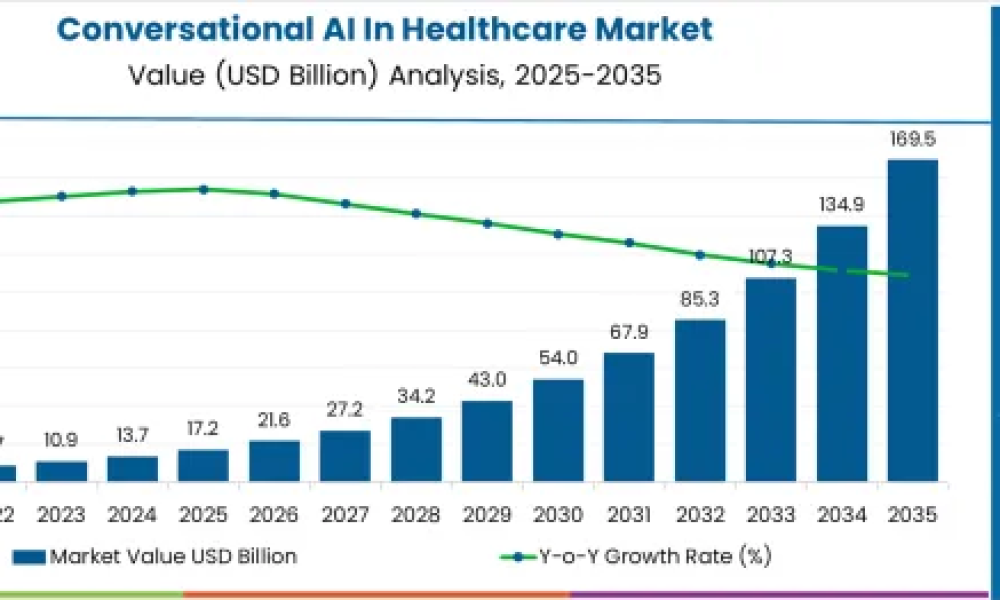
Future Market Insights (FMI), a leading provider of market intelligence and consulting services, today released its comprehensive report on the AI in healthcare market is emerging as a transformative force, poised for unprecedented expansion. Valued at $17.2 billion in 2025, the market is forecasted to skyrocket to $169.5 billion by 2035, driven by a robust compound annual growth rate (CAGR) of 25.7%. This trajectory unlocks an absolute dollar opportunity of $152.3 billion over the next decade, underscoring the technology’s pivotal role in enhancing healthcare delivery worldwide.
At the heart of this growth lies the increasing demand for automated patient engagement solutions that prioritize personalized medicine and seamless interactions. Conversational AI, powered by natural language processing (NLP), machine learning (ML), and generative AI, enables 24/7 support, alleviates administrative burdens on healthcare providers, and boosts clinical outcomes. By facilitating natural, intuitive dialogues between patients and systems, these tools are redefining how care is delivered, making it more accessible, efficient, and empathetic.
Industry leaders view this surge as a direct response to evolving healthcare needs. “Conversational AI isn’t just a tool; it’s a partner in patient care,” said a representative from a leading AI innovator. “By handling routine inquiries, scheduling appointments, sending medication reminders, and providing health information, chatbots are freeing up valuable time for clinicians to focus on what matters most – human connection and complex decision-making.”
Breaking down the market by components, chatbots dominate with a 35.7% share in 2025. Their appeal stems from cost-effectiveness and versatility, serving as entry points for AI adoption in diverse settings. In the technology outlook, speech recognition and generation lead with 30.8%, offering hands-free interactions that streamline documentation and real-time information retrieval. Advancements in accuracy and multilingual capabilities are further accelerating their integration into clinical environments.
When examining applications, patient engagement and support command 29.5% of the market, emphasizing personalized interactions that improve medication compliance and proactive health monitoring. This segment highlights how AI fosters better treatment adherence and overall health outcomes, addressing longstanding challenges in chronic disease management.
End-use analysis reveals hospitals and clinics as the primary adopters, holding 38.1% in 2025. These institutions leverage scalable AI solutions to manage high patient volumes, optimize administrative processes, and enhance workflow efficiency. As healthcare systems grapple with staffing shortages, conversational AI steps in as a reliable ally, ensuring continuity of care without compromising quality.
Regionally, the market’s momentum varies, with Asia Pacific, North America, and Europe at the forefront. China leads with a staggering 34.7% CAGR from 2025 to 2035, fueled by government-backed digital health reforms and AI pilots in over 300 hospitals. Investments from tech giants like Baidu and Alibaba in Mandarin-optimized chatbots are expected to contribute 40% of Asia Pacific spending by 2030. India follows closely at 32.1%, propelled by telemedicine expansion under the Ayushman Bharat Digital Mission and integrations by companies like Infosys. By 2024, 50% of telemedicine providers in India had adopted conversational AI, signaling rapid mainstreaming.
In Europe, Germany boasts a 29.6% CAGR, supported by regulatory frameworks like the Digital Healthcare Act and GDPR compliance. Collaborations, such as those between Siemens Healthineers and AI firms, have seen 30% of hospitals pilot AI in outpatient services by 2023. France, with a 27.0% CAGR, benefits from its national AI strategy, funding local startups and achieving 25% hospital adoption by 2024 for patient intake and chronic disease monitoring. The UK, at 24.4%, advances through NHS digital initiatives and partnerships that reduce call center workloads via AI triage systems.
Across the Atlantic, the USA registers a 21.9% CAGR, driven by substantial digital health investments. By 2024, 60% of providers utilized AI for virtual triage and patient education, with integrations like UnitedHealth’s chatbots demonstrating significant cost reductions. This regional diversity illustrates how tailored regulatory support and technological investments are catalyzing global adoption.
The competitive landscape is vibrant, featuring key players such as Nuance (a Microsoft company), Corti, Enlitic Inc., IBM, UST, Authenticx, LivePerson, Hyro, Oncora Medical, and NVIDIA Corporation. These entities prioritize accuracy, seamless integration with electronic health records (EHRs), and adherence to standards like HIPAA and GDPR. Technology giants provide scalable infrastructure, while startups innovate in niche areas like emergency support and oncology workflows. Clinical validation remains a cornerstone, ensuring AI solutions meet rigorous healthcare demands.
Subscribe for Year-Round Insights → Stay ahead with quarterly and annual data updates:https://www.futuremarketinsights.com/reports/brochure/rep-gb-26244
Request for Discount: https://www.futuremarketinsights.com/reports/sample/rep-gb-26244
Several drivers propel this market forward, including rising healthcare digitization, the push for AI in clinical decision support, and value-based care models. Regulatory endorsements further encourage adoption, positioning conversational AI as essential for modern healthcare ecosystems.
However, challenges persist. Data privacy concerns and integration complexities with legacy systems pose restraints, demanding robust compliance measures. Opportunities abound in telemedicine expansion, remote monitoring, and the integration of large language models for more sophisticated interactions. Virtual health assistants represent a burgeoning frontier, promising enhanced patient experiences.
Addressing these challenges requires a balanced approach. Ensuring data security, navigating evolving regulations, and leveraging AI to mitigate staffing shortages are critical. As the market evolves, stakeholders must focus on ethical AI deployment to build trust and maximize impact.
This forecast highlights conversational AI’s role as a cornerstone for efficient, patient-focused healthcare. With sustained advancements in NLP and ML, the technology is set to bridge gaps in access and quality, ultimately transforming global health outcomes.
About Future Market Insights (FMI)
Future Market Insights, Inc. (FMI) is an ESOMAR-certified, ISO 9001:2015 market research and consulting organization, trusted by Fortune 500 clients and global enterprises. With operations in the U.S., UK, India, and Dubai, FMI provides data-backed insights and strategic intelligence across 30+ industries and 1200 markets worldwide.
Why FMI: Decisions that Change Outcomes- https://www.futuremarketinsights.com/why-fmi
Contact Us:
Future Market Insights Inc.
Christiana Corporate, 200 Continental Drive,
Suite 401, Newark, Delaware – 19713, USA
T: +1-347-918-3531
Website: https://www.futuremarketinsights.com
LinkedIn| Twitter| Blogs | YouTube
Have a specific Requirements and Need Assistant on Report Pricing or Limited Budget please contact us – sales@futuremarketinsights.com



