
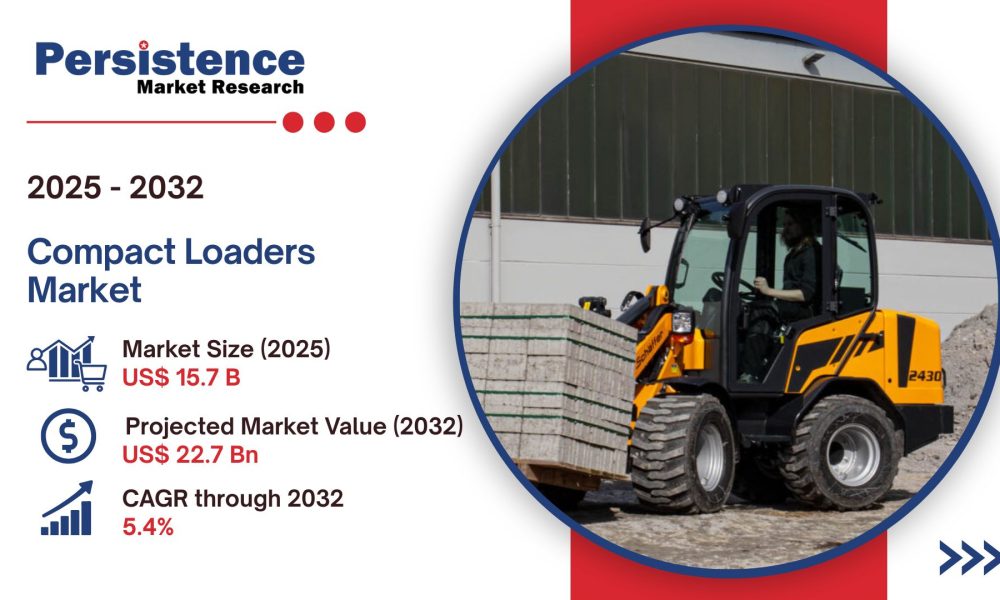
According to Persistence Market Research, the global compact loaders market is projected to attain a valuation of US$15.7 billion in 2025 and expand to US$22.7 billion by 2032, reflecting a robust CAGR of 5.4% during the forecast period. Compact loaders, known for their versatility and efficiency in construction, agriculture, landscaping, and material handling, continue to see widespread adoption across diverse industrial sectors. With rapid urbanization and the rise of infrastructure development projects worldwide, the demand for small yet powerful machinery capable of performing multiple functions in confined spaces has increased dramatically.
A significant driver for the compact loaders market is the ongoing shift toward mechanized solutions in agriculture and construction activities. Regions like North America and Europe dominate the market due to their mature infrastructure sectors and early adoption of advanced equipment technologies. However, Asia-Pacific is emerging as the fastest-growing region, fueled by increasing investments in public infrastructure, rural development, and industrial construction. Among product types, skid-steer loaders and compact track loaders represent the leading segments due to their superior maneuverability and traction across challenging terrains.
Get | Download Sample Copy with TOC, Graphs & List of Figures @ https://www.persistencemarketresearch.com/samples/35711
Growth is further supported by the increased adoption of electrified compact loaders, driven by global emission standards and sustainability targets. The integration of smart sensors and telematics for predictive maintenance and fleet optimization also plays a vital role. The leading segment—construction and infrastructure—continues to hold the largest share, while the Asia-Pacific region is projected to be the fastest-growing geographical segment due to rising construction expenditures and government-led smart city initiatives.
Key Highlights from the Report
- The global compact loaders market is valued at US$15.7 billion in 2025, with projections reaching US$22.7 billion by 2032.
- The market is anticipated to grow at a CAGR of 5.4% between 2025 and 2032, driven by infrastructure expansion and agricultural mechanization.
- Skid-steer loaders and compact track loaders dominate the product segment due to their operational flexibility.
- Asia-Pacific is identified as the fastest-growing region, driven by construction and industrialization initiatives.
- Increasing demand for electric and hybrid compact loaders supports sustainability trends and lower carbon footprints.
- The integration of IoT-based telematics enhances equipment performance, preventive maintenance, and operator safety.
Market Segmentation
The compact loaders market is broadly segmented by product type, engine capacity, and end-use industry. By product type, the market includes skid-steer loaders, compact track loaders, mini wheel loaders, and backhoe loaders. Among these, compact track loaders hold a significant market share owing to their exceptional traction and ability to operate efficiently in muddy or uneven terrains. Skid-steer loaders, on the other hand, are widely preferred for indoor and urban construction sites due to their compact design and maneuverability.
Based on end-user, the market is divided into construction, agriculture, landscaping, mining, and industrial applications. The construction sector accounts for the largest revenue share, propelled by rising global infrastructure projects and urban redevelopment initiatives. Meanwhile, agriculture and landscaping are emerging as key growth sectors, with compact loaders increasingly used for soil handling, material loading, and maintenance tasks in farms and gardens.
Regional Insights
Regionally, North America remains a dominant market for compact loaders, driven by technological advancements, replacement demand, and the presence of major manufacturers. The region’s strong focus on mechanized construction processes and public infrastructure projects supports continuous growth. The U.S. and Canada are leading contributors to market revenues due to their adoption of electric and hybrid compact loaders for sustainable construction operations.
In contrast, Asia-Pacific is anticipated to witness the fastest CAGR during the forecast period, led by countries such as China, India, and Japan. The region’s rapid industrialization, coupled with significant investments in smart cities, roads, and residential construction, boosts the adoption of compact loaders. Furthermore, government subsidies for agricultural machinery are enhancing the use of compact loaders in farming and rural development projects.
Market Drivers
The global compact loaders market is primarily driven by the rising need for versatile equipment in construction and agriculture. These machines combine multiple functionalities, such as digging, grading, and material transportation, in a single unit, which significantly reduces operational costs and enhances productivity. The trend toward compact urban infrastructure has also increased the requirement for small but powerful loaders that can efficiently work in confined environments without compromising performance. Additionally, technological innovations, such as the integration of advanced hydraulic systems, automation, and telematics, have further expanded the utility of compact loaders across industries.
Another critical driver is the surging global focus on sustainability. As governments tighten emission regulations, manufacturers are transitioning toward electric and hybrid compact loaders that minimize carbon emissions while maintaining operational efficiency. The growing rental equipment market has also played a crucial role in market expansion, as small and medium enterprises prefer cost-effective leasing options instead of outright purchase. Combined with an expanding application base in road maintenance, landscaping, and municipal operations, these factors are expected to drive consistent market growth through 2032.
For customization options before purchasing: https://www.persistencemarketresearch.com/request-customization/35711
Market Restraints
Despite the promising outlook, the compact loaders market faces several challenges that could limit growth in certain regions. One of the primary restraints is the high initial cost of acquisition and maintenance, which can deter small contractors and farmers, especially in developing economies. Additionally, fluctuations in raw material prices, particularly steel and fuel, can adversely affect manufacturing costs and market stability. The absence of skilled operators in some emerging markets also hampers efficient equipment utilization and limits adoption.
Environmental and regulatory constraints also present obstacles, particularly for traditional diesel-powered loaders. Stricter emission norms across Europe and North America have led to increased production costs due to the incorporation of advanced emission control technologies. Moreover, the limited charging infrastructure for electric compact loaders poses challenges for widespread deployment. In rural areas, low awareness and inadequate financing options further restrict market penetration, emphasizing the need for training programs and government-backed equipment financing solutions.
Market Opportunities
The compact loaders market presents vast opportunities in both technological innovation and geographical expansion. With the ongoing transition toward electric and hybrid equipment, manufacturers are investing in battery efficiency, modular designs, and automation technologies to develop next-generation loaders. These innovations are expected to improve machine performance, reduce maintenance costs, and align with global sustainability goals. The growing use of IoT-enabled fleet management systems provides an additional layer of opportunity by enhancing equipment tracking, predictive maintenance, and operational analytics.
Emerging economies offer another significant growth avenue. Rapid urbanization and increased infrastructure spending in Asia-Pacific, Africa, and Latin America are driving demand for compact loaders in construction, mining, and agriculture. Manufacturers are also focusing on customized, region-specific models to meet varying operational needs. The rising popularity of rental services in developing markets further expands the user base, making compact loaders more accessible. Additionally, the demand for automation-ready, semi-autonomous compact loaders is expected to grow in line with the construction industry’s digital transformation trend, providing a lucrative pathway for long-term market expansion.
Company Insights
Key players operating in the global compact loaders market include:
- Caterpillar Inc.
- Bobcat Company (Doosan Group)
- Deere & Company
- Komatsu Ltd.
- CNH Industrial N.V.
- Volvo Construction Equipment
- Kubota Corporation
- JCB Ltd.
- Hitachi Construction Machinery Co., Ltd.
- Wacker Neuson SE
Buy Now: https://www.persistencemarketresearch.com/checkout/35711
Recent Developments:
- Caterpillar Inc. recently launched a new line of electric compact track loaders featuring zero-emission operations and enhanced energy efficiency, catering to eco-friendly construction needs.
- Bobcat Company introduced advanced smart control systems and telematics for its compact loader series, allowing real-time performance monitoring and improved operator safety.
Frequently Asked Questions (FAQs)
What are the main factors influencing the Compact Loaders Market 2025-2032?
Which companies are the major sources in this industry?
What are the market’s opportunities, risks, and general structure?
Which of the top Compact Loaders Market 2025-2032 companies compare in terms of sales, revenue, and prices?
How are market types and applications and deals, revenue, and value explored?
Future Opportunities and Growth Prospects
The future of the compact loaders market appears promising, supported by technological advancements, green construction initiatives, and digital transformation in heavy equipment industries. The transition toward electric and hybrid models is set to redefine industry standards, with major OEMs focusing on eco-efficient and intelligent machinery. Expanding government investments in infrastructure development and mechanized agriculture will continue to drive demand across emerging economies.
Furthermore, the growing adoption of autonomous and semi-autonomous compact loaders powered by AI and IoT technologies will shape the next phase of industry evolution. As sustainability, efficiency, and versatility become defining attributes of modern equipment, the compact loaders market is poised to sustain its upward growth trajectory, reaching an estimated US$22.7 billion by 2032 at a steady CAGR of 5.4%, as reported by Persistence Market Research.




