
The clinical decision support systems (CDSS) market is undergoing significant growth as healthcare providers increasingly embrace digital solutions to enhance patient care. A clinical decision support system is a health information technology tool that provides clinicians with intelligent insights to aid in diagnosis, treatment planning, and patient management. By integrating patient data with evidence-based guidelines and AI algorithms, CDSS platforms empower healthcare professionals to make timely, accurate, and personalized decisions. The growing focus on reducing medical errors, improving clinical outcomes, and streamlining workflows has led to a surge in CDSS adoption across hospitals, clinics, and telemedicine platforms worldwide.
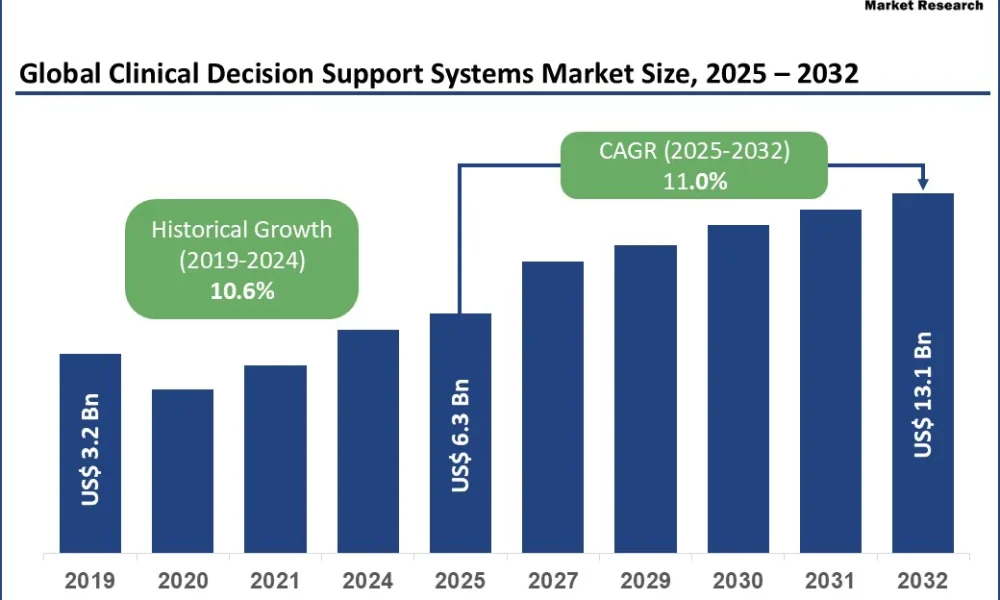
The global clinical decision support systems market size is projected to reach US$6.3 billion by 2025 and is expected to nearly double to US$13.1 billion by 2032, reflecting a compound annual growth rate (CAGR) of 11.0% during the forecast period. North America dominates the market, holding a 45% share in 2025 due to high healthcare digitization, widespread adoption of electronic health records (EHR), and supportive government policies that enhance clinical decision-making. Standalone CDSS remains the leading product type with a 32% market share, primarily because of its cost-effectiveness, ease of deployment, and minimal integration complexity, making it highly suitable for smaller healthcare facilities. Meanwhile, Asia Pacific is emerging as the fastest-growing region, fueled by rising healthcare investments, telemedicine expansion, and increasing awareness of technology-driven solutions in countries like China and India.
Download Your Free Sample & Explore Key Insights: https://www.persistencemarketresearch.com/samples/2811
Key Highlights from the Report
• The clinical decision support systems market is projected to reach US$13.1 billion by 2032.
• North America leads the market with a 45% share due to healthcare digitization and robust IT infrastructure.
• Standalone CDSS dominates with a 32% share, preferred for ease of deployment and cost efficiency.
• On-premise delivery mode holds a 51% share, favored for data security and regulatory compliance.
• Drug allergy alerts represent the leading application segment with 27% adoption.
• AI-enabled and cloud-based CDSS solutions are driving rapid market growth and innovation.
Market Segmentation
The clinical decision support systems market is segmented by product type, delivery mode, and application. By product type, the market is categorized into standalone and integrated CDSS. Standalone systems dominate the market due to their affordability, faster deployment, and minimal integration requirements, particularly in small to mid-sized healthcare facilities. Integrated CDSS, which seamlessly interfaces with electronic health record systems, is increasingly adopted by larger hospitals seeking real-time patient data access and enhanced workflow efficiency.
In terms of delivery mode, CDSS solutions are available as on-premise and cloud-based systems. On-premise systems account for a majority share, driven by the need for data security, compliance with regulatory standards, and direct control over sensitive patient information. Conversely, cloud-based CDSS is the fastest-growing segment, offering scalability, cost-efficiency, and remote accessibility, appealing to healthcare providers in emerging markets and institutions leveraging telemedicine.
Applications of CDSS include drug allergy alerts, clinical guidelines, diagnostic support, and treatment recommendations. Drug allergy alerts are the most widely adopted application, addressing patient safety by preventing adverse drug reactions. Clinical guidelines-based CDSS is growing rapidly, driven by the expansion of precision medicine and the need for evidence-based treatment plans in chronic disease and oncology management.
Regional Insights
North America maintains market leadership in the clinical decision support systems market, with adoption supported by advanced healthcare infrastructure, high EHR penetration, and stringent regulatory compliance. Hospitals leverage CDSS to improve patient safety, reduce errors, and optimize clinical workflows. The presence of major technology providers and ongoing AI-driven healthcare investments further reinforce this dominance.
Europe also represents a significant market, bolstered by robust healthcare systems, high technology adoption, and increasing emphasis on quality care. Government regulations promoting digital health solutions, alongside investments in AI and data-driven clinical tools, encourage the integration of both standalone and integrated CDSS platforms. Precision medicine adoption is a key factor influencing growth in this region.
Asia Pacific is the fastest-growing regional market, reflecting increasing healthcare digitization, telemedicine adoption, and awareness of patient safety solutions. Rapid healthcare infrastructure expansion in China, India, and Japan, coupled with supportive government initiatives, drives widespread CDSS implementation. The demand for cloud-based solutions, AI-enabled decision support, and remote healthcare access further accelerates adoption in the region.
Get Custom Insights Designed for Your Business: https://www.persistencemarketresearch.com/request-customization/2811
Market Drivers
The primary driver of the clinical decision support systems market is the rising adoption of digital healthcare solutions and AI integration. Healthcare providers are increasingly focused on improving patient safety, reducing medical errors, and enhancing clinical decision-making through evidence-based tools. Government-led initiatives, such as India’s Ayushman Bharat Digital Mission and e-Sanjeevani telemedicine services, are creating digital health ecosystems that enable seamless integration of AI-driven CDSS into clinical workflows. By leveraging machine learning algorithms, these systems provide accurate diagnostics, personalized treatment recommendations, and resource optimization in hospitals and clinics. The growing awareness of the benefits of technology-driven healthcare, coupled with the expansion of telemedicine and digital health infrastructure, continues to propel market growth globally.
Market Restraints
Despite rapid adoption, the CDSS market faces challenges due to high implementation costs and interoperability issues. Deploying advanced CDSS requires significant investment in software, hardware, and medical staff training, which can be prohibitive for smaller healthcare facilities. Additionally, ongoing system maintenance and upgrades add to the financial burden. Interoperability challenges arise from the diverse EHR platforms and legacy systems used by healthcare providers, limiting seamless integration and reducing overall system effectiveness. These restraints can slow adoption, especially in budget-constrained or fragmented healthcare settings. Overcoming these barriers is crucial to unlock the full potential of CDSS.
Market Opportunities
The clinical decision support systems market offers promising opportunities through the rise of precision medicine and expansion into emerging markets. Precision medicine relies on analyzing patient-specific data, such as genetic, environmental, and lifestyle factors, to provide personalized treatment plans. CDSS platforms leveraging AI and advanced analytics can process complex datasets, supporting clinicians in delivering individualized care and improving outcomes. Furthermore, emerging markets in Asia Pacific, Latin America, and the Middle East present significant growth potential due to rising healthcare digitization, increasing investments in technology-driven healthcare, and supportive government initiatives. By targeting these regions, vendors can establish strong market presence and drive adoption of precision medicine practices.
Checkout Now & Download Complete Market Report: https://www.persistencemarketresearch.com/checkout/2811
Company Insights
The clinical decision support systems market is highly competitive, characterized by continuous technological innovation and strategic collaborations. Key players include:
• McKesson Corporation
• Cerner Corporation
• Siemens Healthineers GmbH
• Allscripts Healthcare, LLC
• athenahealth, Inc.
• NextGen Healthcare Inc.
• Koninklijke Philips N.V. (Royal Philips)
• IBM Corporation
• Agfa-Gevaert Group
• Wolters Kluwer N.V.
• Becton, Dickinson and Company
• Cabot Technology Solutions
Recent developments highlight ongoing innovation in the market. In August 2024, IBM Watson Health launched an AI-powered oncology CDSS, demonstrating enhanced diagnostic accuracy and clinical utility in oncology settings. Similarly, in June 2024, Oracle Health EHR (formerly Cerner Millennium) introduced improved EHR-CDSS integration, streamlining clinical workflows and enhancing interoperability across hospitals and healthcare providers.
Conclusion
The clinical decision support systems market is poised for substantial growth over the coming decade, driven by the increasing adoption of digital healthcare solutions, AI integration, and a global emphasis on patient safety and personalized medicine. North America currently leads the market, while Asia Pacific represents the fastest-growing region, reflecting healthcare digitization and telemedicine expansion. Standalone CDSS remains the dominant product type, and on-premise systems are widely preferred due to security and regulatory compliance. Despite challenges such as high implementation costs and interoperability barriers, opportunities in precision medicine and emerging markets provide significant growth potential. With ongoing innovation, AI integration, and strategic partnerships among leading industry players, the global CDSS market is set to transform clinical decision-making, optimize healthcare delivery, and improve patient outcomes worldwide.




