
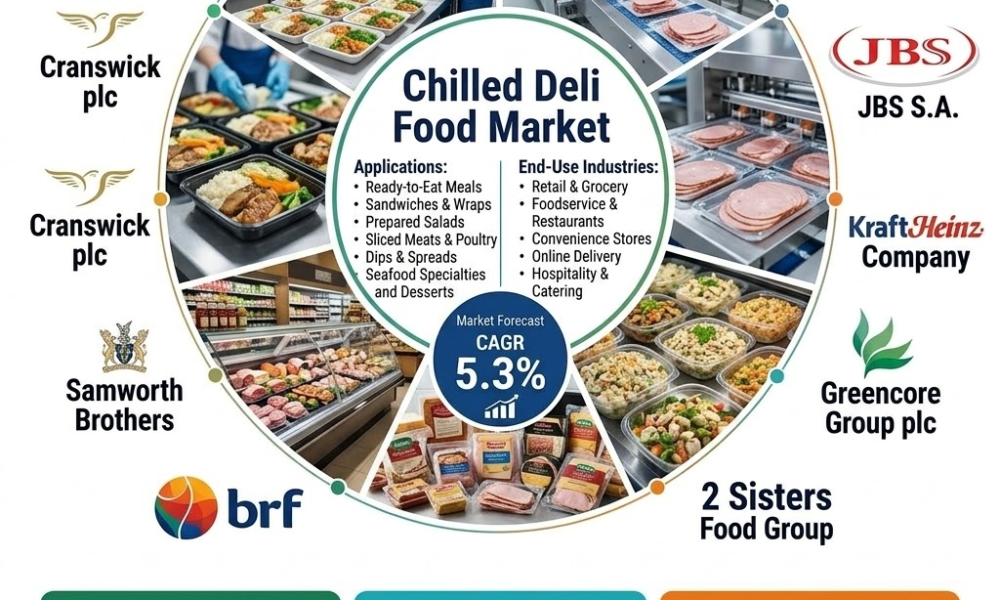
packaging revenue, delivery-platform fees, restaurant billings, and downstream menu revenue. The global chilled deli food market is projected to grow from USD 286.4 billion in 2026 to USD 480.0 billion by 2036, expanding at a 5.3% CAGR during the forecast period, according to Fact.MR. The market was valued at USD 272.0 billion in 2025.
The market is being shaped by recurring demand for low-preparation meals, refrigerated convenience products, and food formats that can move through controlled cold-chain networks. Retailers, food manufacturers, protein processors, and fresh-convenience specialists are adapting product, packaging, and replenishment strategies to meet these requirements.
The market represents an absolute opportunity of USD 193.6 billion between 2026 and 2036.
Get detailed market forecasts, competitive benchmarking, and pricing trends: https://www.factmr.com/connectus/sample?flag=S&rep_id=15853
Ready-to-eat Meals Lead Product Demand
Ready-to-eat Meals are projected to account for 36.0% of the market in 2026. These products combine ingredient selection, preparation, portioning, and clean-up into a single refrigerated purchase.
Sandwiches, salads, and pasta meals allow retailers to serve different dayparts while maintaining a common chilled-case operating model. Product variety, portion options, and price points can be adjusted without requiring major changes to the basic retail infrastructure.
The demand pattern is also linked to frequent grocery purchasing and cross-category basket building.
Modified Atmosphere Packaging Gains Importance
Modified Atmosphere Packaging is anticipated to hold a 42.0% share of the packaging segment in 2026.
For chilled deli products, packaging must help maintain usable life while protecting color, texture, flavor, and presentation. Tray-sealed, vacuum-skin, and gas-flushed formats can be adapted to different requirements across meals, meats, seafood, cheese, and dips.
Packaging decisions also affect seal integrity, material cost, recycling considerations, purge behavior, and distribution performance. As packaging requirements evolve, suppliers need to consider product characteristics and distribution conditions together.
Supermarkets and Hypermarkets Remain a Major Distribution Channel
Supermarkets & Hypermarkets are forecast to account for 48.0% of the market in 2026.
These retail formats provide refrigerated space, promotional activity, frequent replenishment, and opportunities for cross-merchandising. Chilled deli products can be positioned alongside complementary categories such as cheese, salads, prepared seafood, and meal solutions.
Large retailers can also influence supplier specifications, packaging formats, service levels, and replenishment requirements through centralized category management.
Food Safety and Shelf Life Remain Commercial Priorities
Chilled deli products require controlled temperatures, accurate date management, and dependable replenishment. Food-safety failures can create additional requirements around retailer audits, environmental monitoring, sanitation verification, traceability, insurance, and recall readiness.
The report identifies food-safety and shelf-life failures as a significant restraint. The CDC closed a deli-meat Listeria outbreak investigation in January 2025 after reporting 61 cases, 60 hospitalizations, and 10 deaths across 19 states.
Packaging redesign represents an important opportunity. The European Commission confirmed in February 2025 that the Packaging and Packaging Waste Regulation had entered into force and would generally apply from August 2026. This creates additional considerations around material use, recyclability, waste prevention, shelf life, and handling performance.
Regional Growth Outlook
The United Kingdom is projected to record a 6.0% CAGR from 2026 to 2036, followed by the USA at 5.7%, Germany at 5.4%, France at 5.1%, and Japan at 4.8%.
In the USA, large supermarket, club, and foodservice buyers operate through national and regional specifications, increasing the importance of traceability, sanitation evidence, cold-chain coverage, and response capability.
Germany’s market is shaped by value discipline, automated retail systems, and packaging compliance. The UK market is closely connected with private-label fresh convenience and rapid product rotation. France combines prepared-meal demand with established charcuterie and cheese purchasing, while Japan emphasizes compact portions, date control, presentation, and dependable urban cold chains.
Competitive Landscape
The competitive landscape includes Nestlé S.A., Tyson Foods, Inc., Hormel Foods Corporation, JBS S.A., Kraft Heinz Company, Greencore Group plc, 2 Sisters Food Group, BRF S.A., Samworth Brothers, and Cranswick plc.
Competition is expected to focus on replenishment accuracy, food-safety control, product rotation, packaging compliance, and the ability to support private-label programs while maintaining site-level operational discipline.
Shambhu Nath Jha, Principal Consultant at Fact.MR, states:
“Chilled deli suppliers will not win shelf space on convenience alone. Retailers need proof that the product, package, sanitation system, and replenishment model work together.”
He adds that suppliers need to extend usable life without compromising sensory quality, traceability, or recycling readiness.
Report Scope
The Chilled Deli Food Market assessment covers chilled ready-to-eat meals, processed deli meats, prepared seafood, and chilled cheese or dairy deli products sold within the defined commercial boundary.
The analysis covers Product, Packaging, Distribution Channel, End User, Storage Type, and Region. The study includes markets across North America, Latin America, Western Europe, Eastern Europe, East Asia, South Asia and Pacific, and the Middle East and Africa, with detailed coverage of the USA, Germany, UK, France, and Japan.
The report excludes raw or unprepared food, ambient and frozen-only substitutes, standalone
To View Related Report :
- Meal Delivery Carts and Racks Market
- B2B E-Commerce Delivery and Appointment Scheduling Platforms Market
About (FACT MR)
FACT MR is the source of this market assessment, providing the research scope, segmentation, market sizing, country analysis, competitive coverage, and forecast presented in the report.



