

Carbon Credits Market Overview
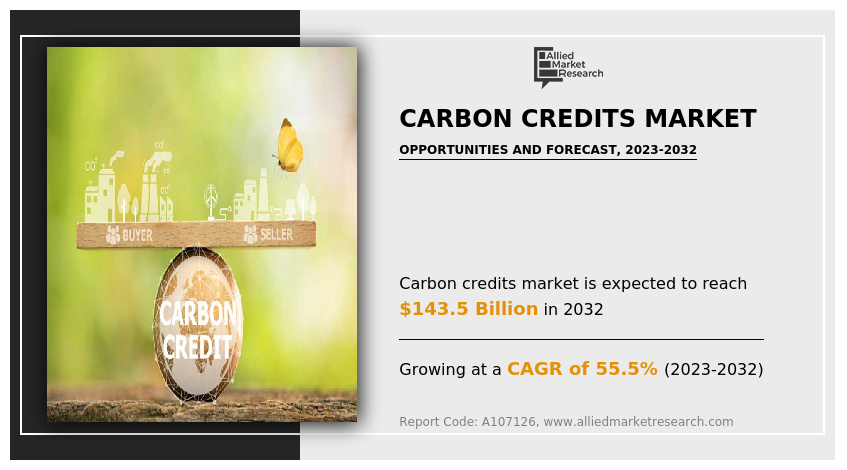
According to a new report published by Allied Market Research, the global Carbon Credits Market size was valued at $2 billion in 2022 and is projected to reach $143.5 billion by 2032, registering an exceptional CAGR of 55.5% from 2023 to 2032. The growing urgency to combat climate change and achieve net-zero emissions is driving rapid expansion of the Carbon Credits Market worldwide.
Understanding Carbon Credits
Carbon credits are tradable certificates that represent the reduction or removal of one metric ton of carbon dioxide or equivalent greenhouse gases from the atmosphere. These credits can be bought and sold in carbon markets, enabling organizations to offset their emissions while supporting environmental projects.
Buyers—including corporations, governments, and individuals—purchase carbon credits to meet sustainability goals and regulatory requirements. Sellers typically include renewable energy projects, reforestation initiatives, and carbon capture programs that reduce or absorb emissions.
Download PDF Brochure: https://www.alliedmarketresearch.com/request-sample/107610
By participating in carbon trading systems, companies can compensate for unavoidable emissions while transitioning toward cleaner operations.
Role in Achieving Net-Zero Targets
To limit global warming, countries worldwide are striving to reduce greenhouse gas emissions by nearly 50% by 2030 and achieve net-zero emissions by mid-century. Carbon credits play a crucial role in this transition by allowing organizations to offset residual emissions that cannot be eliminated immediately.
Participation in voluntary carbon markets also enables businesses to demonstrate climate leadership beyond mandatory compliance. Companies that invest in carbon offset projects often gain reputational advantages, improved ESG scores, and stronger stakeholder confidence.
Furthermore, carbon credit mechanisms encourage innovation in clean technologies and sustainable practices. Funding generated through carbon trading supports renewable energy deployment, forest conservation, and methane reduction projects.
Market Drivers
The rising number of public and private initiatives aimed at environmental sustainability is a major factor fueling the Carbon Credits Market. Governments and international organizations are increasingly promoting market-based solutions to reduce emissions.
One notable contributor is the International Emissions Trading Association, which plays a key role in establishing frameworks for greenhouse gas trading. The association includes leading global corporations involved across the carbon trading value chain and provides reliable market data and policy advocacy.
Growing corporate commitments to sustainability and carbon neutrality are also accelerating demand. Many multinational companies have announced ambitious targets to become carbon neutral or carbon negative, driving increased participation in both regulatory and voluntary markets.
Market Restraints
Despite strong growth prospects, the Carbon Credits Market faces several challenges. One major concern is price volatility. Carbon credit prices can fluctuate significantly due to policy changes, economic conditions, market speculation, and supply-demand imbalances.
Such uncertainty makes it difficult for organizations to plan long-term emission reduction strategies and budget allocations. Inconsistent pricing may also discourage smaller businesses from participating in carbon trading.
Additionally, concerns about transparency, verification standards, and the actual environmental impact of certain projects can affect market credibility. Strengthening monitoring and certification systems will be critical to sustaining long-term growth.
Market Segmentation Insights
The Carbon Credits Market is segmented based on type, system, end-use industry, and region.
By Type
Carbon credits are classified into regulatory and voluntary segments. Regulatory credits are generated under government-mandated emission trading schemes and dominated the market in 2022. However, voluntary carbon credits are expected to grow at a faster rate as more companies pursue sustainability goals beyond compliance requirements.
By System
Two primary trading systems exist:
- Cap-and-Trade: Governments set emission limits and allow trading of allowances
- Baseline-and-Credit: Credits are issued for emissions reductions below established baselines
The cap-and-trade system held the largest share in 2022, while baseline-and-credit mechanisms are anticipated to expand rapidly due to flexibility and scalability.
By End-Use Industry
Major industries participating in carbon markets include aviation, energy, industrial, and petrochemical sectors. The industrial sector accounted for the largest share in 2022 and is expected to maintain dominance due to high emission levels and regulatory pressure.
Industries with significant carbon footprints increasingly rely on carbon credits to meet environmental targets while transitioning to low-carbon technologies.
Regional Outlook
Regionally, Asia-Pacific emerged as the largest contributor to the Carbon Credits Market in 2022 and is projected to maintain its leadership during the forecast period. Rapid industrialization, growing energy demand, and expanding climate policies across countries such as China, India, and Japan are driving regional growth.
North America and Europe also represent significant markets due to established emission trading schemes and strong regulatory frameworks. Increasing investments in renewable energy and carbon capture technologies further support market expansion in these regions.
Impact of COVID-19 Pandemic
The COVID-19 pandemic temporarily disrupted the Carbon Credits Market due to global economic slowdown, travel restrictions, and reduced industrial activity. Lower energy consumption led to decreased demand for carbon credits during the crisis.
Many emission reduction projects faced delays or funding constraints as governments and businesses prioritized immediate economic recovery. Small and medium-sized enterprises, in particular, postponed sustainability investments due to budget limitations.
However, the post-pandemic recovery phase has witnessed renewed emphasis on green growth and climate resilience, restoring momentum in the market.
Carbon Credits Market Competitive Landscape
The global Carbon Credits Market features a diverse mix of project developers, brokers, and trading platforms. Key players include South Pole, 3Degrees, EKI Energy Services Ltd, TerraPass, Moss.Earth, Climate Impact Partners, Carbon Credit Capital, CarbonBetter, NativeEnergy, and NATUREOFFICE.
These organizations focus on developing high-quality carbon offset projects, improving transparency, and expanding global trading networks.
Get a Customized Research Report: https://www.alliedmarketresearch.com/request-for-customization/A107126
Carbon Credits Market Future Outlook
The future of the Carbon Credits Market appears exceptionally strong as climate action becomes a central priority for governments and businesses worldwide. Increasing regulatory pressure, corporate sustainability commitments, and technological advancements in emission reduction are expected to sustain high growth.
As global economies transition toward low-carbon pathways, carbon trading mechanisms will play a vital role in bridging the gap between current emissions levels and long-term climate goals.
Conclusion
The Carbon Credits Market is poised for unprecedented expansion over the coming decade, driven by urgent climate objectives and growing environmental awareness. While challenges such as price volatility and market transparency remain, continued policy support and corporate participation are likely to strengthen the market’s foundation.
Carbon credits will remain a critical tool for achieving net-zero emissions, enabling organizations to offset unavoidable emissions while investing in sustainable development initiatives worldwide.
Other Trending Reports:-
Carbon Capture and Sequestration Market
About Us
Allied Market Research (AMR) is a full-service market research and business-consulting wing of Allied Analytics LLP based in Portland, Oregon. Allied Market Research provides global enterprises as well as medium and small businesses with unmatched quality of “Market Research Reports” and “Business Intelligence Solutions.” AMR has a targeted view to provide business insights and consulting to assist its clients to make strategic business decisions and achieve sustainable growth in their respective market domain.
Pawan Kumar, the CEO of Allied Market Research, is leading the organization toward providing high-quality data and insights. We are in professional corporate relations with various companies and this helps us in digging out market data that helps us generate accurate research data tables and confirms utmost accuracy in our market forecasting. Each and every data presented in the reports published by us is extracted through primary interviews with top officials from leading companies of domain concerned. Our secondary data procurement methodology includes deep online and offline research and discussion with knowledgeable professionals and analysts in the industry.




