
Carbon Capture, Utilization, and Storage (CCUS) Market Overview
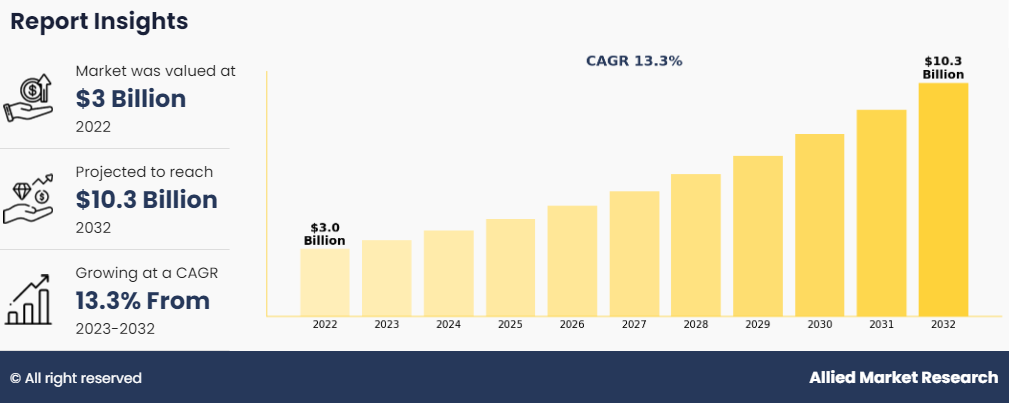
According to a new report published by Allied Market Research, the global carbon capture, utilization, and storage (CCUS) market was valued at $3 billion in 2022, and is estimated to reach $10.3 billion by 2032, growing at a CAGR of 13.3% from 2023 to 2032.
What is CCUS?
CC, Utilization, and Storage (CCUS) is a set of technologies designed to capture carbon dioxide (CO₂) emissions from sources like power plants and industrial processes, preventing it from entering the atmosphere. The captured CO₂ can be utilized in various applications or stored underground for long-term isolation.
Download PDF Brochure: https://www.alliedmarketresearch.com/request-sample/A12116
North America dominated the market in 2022, garnering more than two-fifths of the total share. The presence of robust manufacturing sector and significant investments toward the economic development have made North America one of the major stakeholders across the globe.
Europe carbon capture, utilization, and storage (CCUS) market share is projected to grow at the highest CAGR of 14.4% in terms of revenue.
The major players studied and profiled in the global carbon capture, utilization, and storage (CCUS) industry are Royal Dutch Shell PLC, Fluor Corporation, Mitsubishi Heavy Industries, Ltd., Linde Plc, Exxon Mobil Corporation, JGC Holdings Corporation, Schlumberger Limited, Aker Solutions, Honeywell International Inc., and Halliburton.
Other players operating in this market include C-Capture Ltd., Tandem Technical, Carbicrete, Hitachi, Ltd., Siemens AG, General Electric, Total S.A., and Equinor ASA.
Demand for carbon capture, utilization, and storage has witnessed tremendous growth driven by increasing penetration in end-use industries such as oil & gas, power generation, iron & steel, chemical & petrochemical, cement, and others.
Some of the major factors that drive the demand for CC, utilization, and storage include growing focus on reducing CO2 emissions, supporting government initiatives and increasing demand for CO2-EOR techniques.
Key Components
- Carbon Capture:
- Post-combustion Capture: Captures CO₂ from flue gases after fossil fuels are burned.
- Pre-combustion Capture: Removes CO₂ before combustion, often used in gasification processes.
- Oxy-fuel Combustion: Burns fuel in pure oxygen to produce a concentrated stream of CO₂.
- Utilization:
- Enhanced Oil Recovery (EOR): Injects captured CO₂ into oil reservoirs to improve oil extraction.
- Chemical Production: Uses CO₂ as a raw material in producing chemicals, fuels, or building materials (e.g., concrete).
- Agriculture: Utilizes CO₂ in greenhouses to enhance plant growth.
- Storage:
- Geological Storage: Injects CO₂ into deep geological formations, such as depleted oil and gas fields or saline aquifers, for long-term storage.
- Mineralization: Converts CO₂ into stable minerals through chemical reactions with naturally occurring minerals.
Large number of upcoming projects in Asia-Pacific and Europe region and continuous investments in developing innovative capturing technologies enabling economic operations are expected to provide growth opportunities for the CCUS market during the forecast period.
The process involves three main steps and technologies such as capture, which includes separation of CO2 from gases produced from different procedures. Secondly, it involves transport, which is transportation of the captured CO2 to a suitable site for storage with the help of pipeline, trucks, and ships. The last step is storage, which involves injection of CO2 into underground rock formation, deep wells, and depleted reservoirs.
All industry players are investing heavily to find new commercial avenues for their product segments via investment, contracts, and partnerships. For instance, Shell is a giant MNC and has undertaken several CCSU pilot projects which include the world’s largest CCSU project, in Alberta, Canada. As result of a partnership between Shell, Canada Energy and Chevron, Quest was formed, which is a fully integrated CCSU project.
In the oil sands industry, Quest has come up as the first commercial application of CCSU. It has been designed to capture, transport and store deep underground above one million tons of carbon dioxide. Chevron is also leading a CCSU project, where natural gas will travel through undersea pipelines to a liquefied natural gas plant at the Gorgon gas fields in the Western Australia.
Buy This Report (210 Pages PDF with Insights, Charts, Tables, and Figures): https://bit.ly/4aqea4y
Advantages
- Climate Mitigation: Reduces greenhouse gas emissions, helping to combat climate change.
- Energy Transition: Supports the continued use of fossil fuels while transitioning to renewable energy sources.
- Economic Opportunities: Creates new markets for CO₂ utilization and promotes innovation in carbon management.
High cost of CC and storage and decreasing crude oil prices are expected to hamper the growth of the CCUS market during the forecast period.
The capture service segment dominated the global CCUS market with 70.0% of the share in terms of revenue. Increase in adoption of this service due to surge in CO2 emission from various industrial verticals such as oil & gas, power generation, iron & steel, chemical & petrochemical, and cement.
The post-combustion capture segment dominated the global CCUS market with around 45.8% of the share in terms of revenue. Surge in adoption of this technology from coal and gas power generation plants across the globe to capture the carbon and to reduce the carbon foot print.
The oxy-fuel combustion capture segment is projected to grow at the highest CAGR of 14.4% in terms of revenue.
The oil & gas segment dominated the global carbon capture, utilization, and storage market with 57.6% of the share in terms of revenue. Surge in consumption of carbon dioxide for enhanced oil recovery.
Conclusion
CCUS is a critical technology in the effort to reduce global carbon emissions and mitigate climate change. By capturing and utilizing or storing CO₂, CCUS can play a significant role in achieving sustainability and energy security.




