
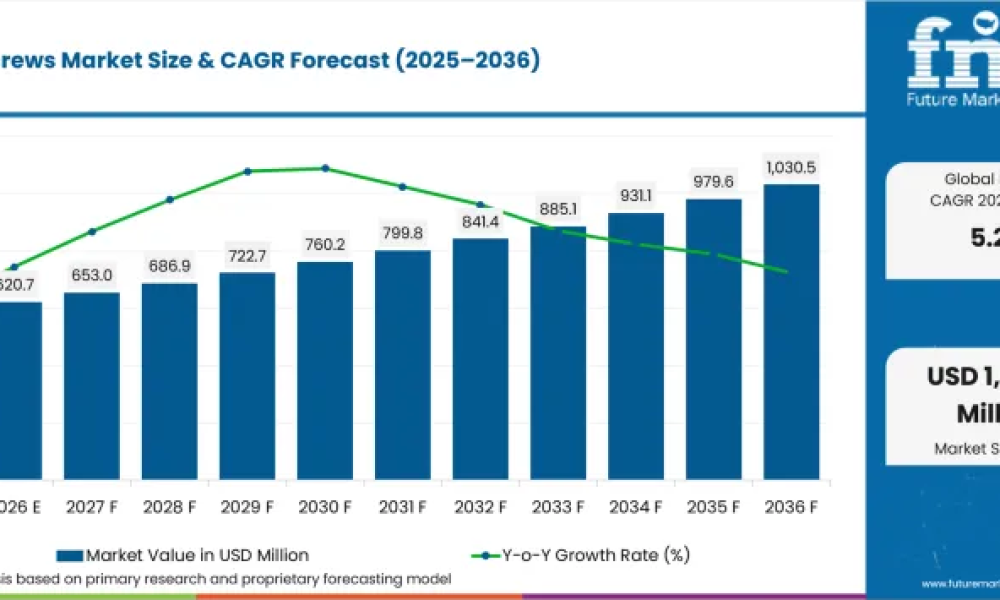
The Captive Screws Market is projected to reach USD 1,030.5 million by 2036, up from USD 620.7 million in 2026, expanding at a 5.2% CAGR during the forecast period. Demand is supported by equipment designs that require repeated service access, where retained hardware helps prevent loose fasteners from being misplaced and can simplify maintenance of removable panels.
Get detailed market forecasts, competitive benchmarking, and pricing trends: https://www.futuremarketinsights.com/reports/sample/rep-gb-34981
Global Segment Leaders
The market’s leading segments in 2026 highlight the importance of screw design, material selection, and compact thread sizes:
- Knurled captive screws account for 27.0% of screw type demand.
- Stainless steel represents 38.0% of material demand.
- Below M3 thread sizes account for 22.0% of thread size demand.
These segments reflect the importance of retained fastening solutions in equipment where removable panels require repeated access while keeping the fastener attached to the panel.
Market Growth Drivers
Captive screws provide a practical fastening solution for service panels and other components that are frequently removed and reinstalled. Unlike conventional loose fasteners, captive designs remain attached to the panel, reducing the risk of misplaced screws during maintenance.
This retained-hardware characteristic can be particularly valuable where a loose screw could interfere with equipment operation, create additional maintenance work, or extend service time. As equipment becomes more service-oriented, manufacturers can incorporate captive screws directly into equipment drawings and fastening specifications.
Repeated Service Access Supports Captive Hardware
Repeated panel removal creates a strong application case for captive screws. Service technicians can loosen the fastener while keeping it connected to the removable panel, allowing the panel to be removed without separately managing loose hardware.
The approach can simplify maintenance workflows and reduce the possibility of incorrect fastener replacement. For equipment manufacturers, the specification of retained hardware can therefore become part of the broader design strategy for serviceability.
Knurled Captive Screws Lead Screw Types
Knurled captive screws account for 27.0% of screw type demand in 2026, making them the leading screw type. Their position reflects the importance of practical handling and retained fastening in applications involving repeated panel access.
Selection depends on panel design, fastening requirements, operating conditions, and the desired method of manual or tool-assisted tightening. Manufacturers also consider compatibility with existing equipment designs and assembly processes.
Stainless Steel Leads Material Demand
Stainless steel represents 38.0% of material demand in 2026. Material selection plays an important role in captive screw specification because fasteners must be compatible with the panel and operating environment.
For equipment exposed to demanding service conditions, material properties can influence durability and long-term fastening performance. Stainless steel’s leading share highlights the importance placed on material selection when retained fasteners become part of an approved equipment design.
Smaller Thread Sizes Maintain Significant Demand
The below M3 segment accounts for 22.0% of thread size demand in 2026, demonstrating the role of compact captive fastening solutions in equipment where space is limited.
Smaller thread sizes can support fastening requirements for compact panels and assemblies. However, manufacturers must balance size requirements with mechanical performance, panel thickness, installation method, and service access.
Qualification and Panel Preparation Influence Substitution
Captive screws can become embedded in equipment drawings and qualification records, making substitution more complex than simply replacing a standard fastener. Panel preparation, hole specifications, installation requirements, and approved hardware can all influence the ability to introduce an alternative product.
Similar qualification considerations apply to automotive fasteners and aerospace fasteners, where approved hardware can form part of equipment and component specifications.
Electronics Activity Supports Service-Panel Demand
The Global Electronics Association reported in May 2025 that electronics manufacturers expected shipments and orders to rise over the following six months. While this industry outlook does not directly determine the Captive Screws Market forecast, higher equipment activity can increase the number of service panels and assemblies requiring repeat access.
As equipment manufacturers manage increasingly serviceable designs, retained hardware can offer a way to keep fastening components attached during maintenance operations.
Competitive Landscape
Competition in the Captive Screws Market centers on fastening design, material, thread dimensions, panel compatibility, installation requirements, and qualification.
Manufacturers and buyers are likely to evaluate:
- Captive screw type and retention mechanism
- Stainless steel and alternative materials
- Thread size and panel thickness
- Installation and panel-preparation requirements
- Service access frequency
- Fastening reliability
- Equipment qualification requirements
- Compatibility with existing designs
Suppliers capable of providing application-specific fastening solutions while meeting established specifications can be well positioned in equipment markets where retained hardware is part of the approved design.
Get the Complete Story—Read More About Our Latest Report
The Captive Screws Market report provides analysis of market growth, screw types, materials, thread sizes, and other factors shaping demand through 2036.
Explore the full Captive Screws Market report: https://www.futuremarketinsights.com/reports/captive-screws-market
Analyst Perspective
“Captive screws gain specification value when equipment requires repeated service access because the fastener remains attached to the removable panel. Stainless steel leading with 38.0% share highlights the importance of material selection, while the 22.0% share of below M3 threads reflects demand for compact fastening solutions. However, panel preparation and qualification requirements can make substitution more complex once captive hardware is incorporated into an equipment design,” says Nikhil Kaitwade, Future Market Insights.
About Future Market Insights (FMI)
Future Market Insights, Inc. (FMI) is an ESOMAR-certified, ISO 9001:2015 market research and consulting organization, trusted by Fortune 500 clients and global enterprises. With operations in the U.S., UK, India, and Dubai, FMI provides data-backed insights and strategic intelligence across 30+ industries and 1200 markets worldwide.
For Press & Corporate Inquiries
Rahul Singh
AVP – Marketing and Growth Strategy
Future Market Insights, Inc.
+91 8600020075



