
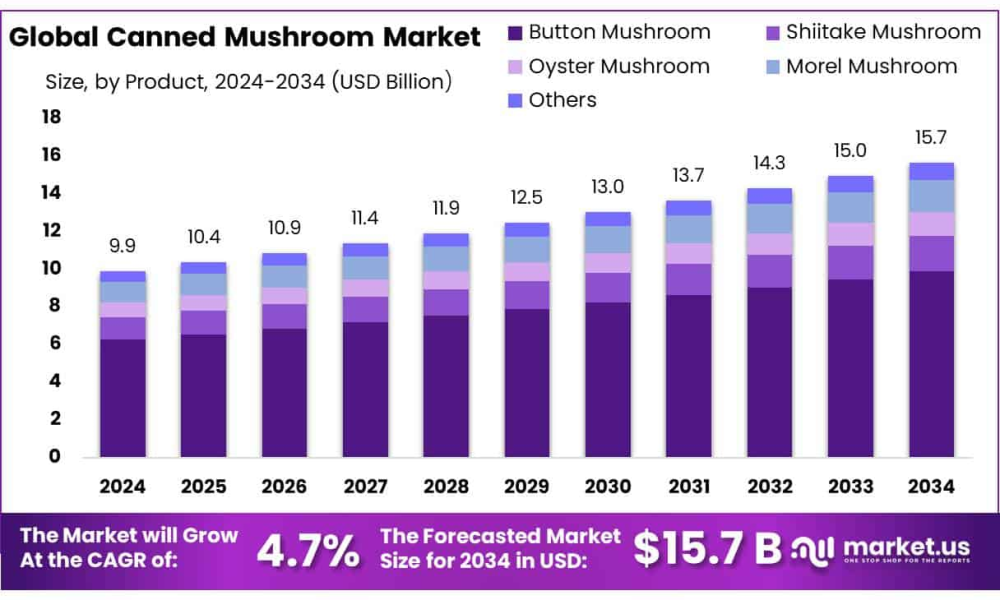
New York, NY – July 21, 2025 – The Global Canned Mushroom Market is growing fast, driven by increasing demand for convenient and long-lasting food options. In 2024, the market was valued at USD 9.9 billion, and it is expected to reach USD 15.7 billion by 2034, growing at a steady 4.7% CAGR from 2025 to 2034.
In India, government support is significantly boosting the mushroom industry. In 2024, the Ministry of Agriculture allocated ₹500 million to promote mushroom farming, encouraging farmers to adopt this practice. The National Horticulture Board further supports this growth by providing financial assistance for establishing mushroom production units, fostering sectoral development.
The global canned mushroom market, valued at USD 7.3 billion in 2018, continues to grow due to urbanization, evolving dietary preferences, and rising demand for plant-based foods. In India, mushroom production has surged from 17,100 metric tonnes in 2013–14 to 487,000 metric tonnes in 2018, reflecting a robust domestic market with untapped export potential. Despite this, India holds only about 2% of the global mushroom market, indicating significant growth opportunities.
The expansion of the canned mushroom market is supported by a global increase in mushroom production. According to the Food and Agriculture Organization (FAO), global mushroom output rose from 0.5 million tonnes in 1961 to 10.24 million tonnes in 2017, with recent estimates suggesting production now exceeds 40 million tonnes. According to the Food and Agriculture Organization (FAO), global mushroom output rose from 0.5 million tonnes in 1961 to 10.24 million tonnes.
India’s cold storage capacity, estimated at 32 million metric tonnes by the National Centre for Cold-chain Development (NCCD), is predominantly (70%) used for potato storage. This leaves limited space for other perishables like mushrooms, contributing to post-harvest losses of approximately 28% of India’s total food produce due to inadequate storage facilities. India’s mushroom industry is on a strong growth trajectory. The Directorate of Mushroom Research reports that production reached 0.336 million tonnes in 2023–24, nearly doubling from 0.155 million tonnes in 2019–20, highlighting the sector’s potential to bolster the canned mushroom market.
Important Revelation
- Canned Mushroom Market size is expected to be worth around USD 15.7 billion by 2034, from USD 9.9 billion in 2024, growing at a CAGR of 4.7%.
- Button Mushroom held a dominant Canned Mushroom market position, capturing more than a 63.2% share.
- Conventional held a dominant Canned Mushroom market position, capturing more than a 67.1% share of the global canned mushroom market
- Whole Foods held a dominant Canned Mushroom market position, capturing more than a 39.6% share in the global canned mushroom market.
- Restaurants held a dominant market position, capturing more than a 64.8% share of the global canned mushroom market.
- Supermarkets/Hypermarkets held a dominant Canned Mushroom market position, capturing more than a 46.9% share.
- Asia-Pacific (APAC) region solidified its position as the leading Canned Mushroom market for canned mushrooms, commanding a substantial 47.9% share, which translates to approximately USD 4.7 billion.
➤ Download Exclusive Sample Of This Premium Report (Including Full TOC, Table & Figures): https://market.us/report/global-canned-mushroom-market/request-sample/
Report Segmentation
By Product
Button Mushroom commands a 63.2% share of the global canned mushroom market in 2024, fueled by its versatile culinary applications and excellent shelf stability. Its mild flavor, firm texture, and compatibility with dishes like soups, sauces, pizzas, and ready-to-eat meals drive its dominance. The ease of processing and canning, combined with affordability, makes Button Mushroom a top pick for both manufacturers and consumers.
By Nature
Conventional Canned Mushroom holds a 67.1% market share in 2024, driven by cost-effective production and affordability. Large-scale farming methods enable lower prices, appealing to both domestic and international markets. These mushrooms are widely used in commercial food processing, restaurants, and households, prioritizing bulk purchasing and long shelf life over organic options.
By Form
Whole Canned Mushroom leads with a 39.6% share in 2024, valued for its natural appearance and texture in culinary dishes. Preferred for stir-fries, gourmet salads, pasta, and baked recipes, whole mushrooms enhance visual appeal. Restaurants and catering services favor them for their premium presentation and consistent quality.
By Application
Restaurants dominate with a 64.8% share in 2024, driven by high demand for convenient, ready-to-use ingredients. Canned mushrooms offer consistent quality and extended shelf life, making them a staple in quick-service chains and mid-range dining for dishes like pizzas, pastas, curries, and salads, saving preparation time while maintaining flavor.
By Distribution Channel
Supermarkets/Hypermarkets lead with a 46.9% share in 2024, benefiting from accessibility and diverse product offerings. These retail giants attract household and bulk buyers with their extensive range, in-store promotions, and the ability to compare brands, sizes, and prices conveniently under one roof.
Market Key Segmentation
By Product
- Button Mushroom
- Shiitake Mushroom
- Oyster Mushroom
- Morel Mushroom
- Others
By Nature
- Organic
- Conventional
By Form
- Whole
- Sliced
- Chopped
- Others
By Application
- Household
- Restaurants
By Distribution Channel
- Supermarkets/Hypermarkets
- Departmental Store
- Convenience Store
- Online
- Others
Regional Analysis
In 2024, the Asia-Pacific (APAC) region reinforced its position as the dominant market for canned mushrooms, accounting for a significant 47.9% share, equivalent to approximately USD 4.7 billion in revenue. This regional leadership can be attributed to multiple factors, including accelerated urbanization, rising disposable incomes, and a marked shift in dietary habits toward convenient and nutrient-rich food choices.
China and India emerged as the key contributors to this growth. China benefits from a well-established mushroom cultivation ecosystem, while India’s growing middle-class population has led to increased demand for ready-to-eat food products. The rising influence of Western culinary trends, many of which prominently feature mushrooms, has further supported consumption across urban centers. Additionally, the recognized health benefits of mushrooms, such as being low in calories and rich in essential nutrients, have made them increasingly attractive to health-conscious consumers in the region.
The market’s growth trajectory is further strengthened by advancements in food processing infrastructure, streamlined supply chain operations, and supportive government policies. In India, several state-level initiatives have been launched to promote mushroom farming, offering training programs and financial incentives to rural communities. These efforts aim to boost local production, enhance farmer livelihoods, and meet the growing domestic and international demand for canned mushrooms.
Competitive Landscape
- B&G Foods, Inc.
- Bonduelle Group
- Costa Group Holdings
- Fujian Yuxing Foods Co.
- Giorgio Fresh Co.
- Greenyard NV
- Monterey Mushrooms, Inc.
- Okechamp SA
- Prochamp B.V.
- Shanghai Finc Food Co., Ltd.
- The Mushroom Company
- Monterey Mushrooms Inc.
Get in Touch with Us:
Market.us (Powered By Prudour Pvt. Ltd.)
Address: 420 Lexington Avenue, Suite 300, New York City, NY 10170, United States
Send Email: [email protected]
Refer To More Related Reports:
Yogurt Drink Market
Tomato Seed Market
Salad Dressing Market



