
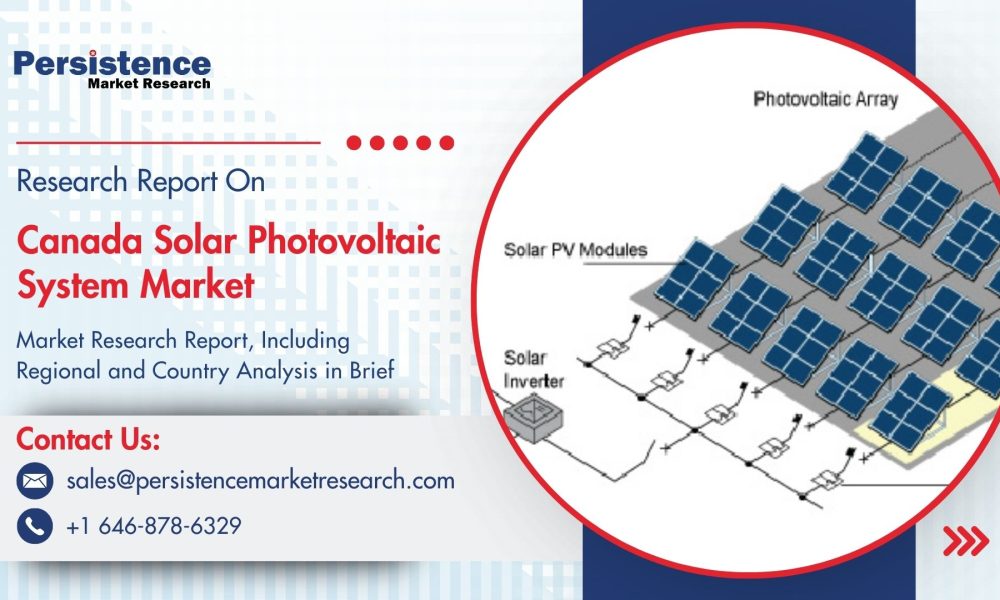
Market Overview
The Canada solar photovoltaic system market is entering a significant growth phase, driven by national and provincial policies supporting renewable energy, declining costs of solar panels, and growing awareness of sustainability. According to the latest study by Persistence Market Research, the market size for solar photovoltaic systems in Canada is expected to rise from US$6.1 billion in 2024 to US$13.2 billion by the end of 2031, registering an impressive CAGR of 11.7% during the forecast period.
This expansion reflects Canada’s broader shift toward decarbonization and its commitment to achieving net-zero greenhouse gas emissions by 2050. Solar energy is increasingly being recognized as a vital contributor to the country’s clean energy mix, alongside wind and hydroelectric power. With growing demand for reliable and sustainable energy, Canadian consumers and businesses are investing in both residential and commercial solar projects. Furthermore, advancements in solar PV technology and the availability of financing options are making solar systems more affordable and attractive across different sectors.
Get a Sample PDF Brochure of the Report (Use Corporate Email ID for a Quick Response): https://www.persistencemarketresearch.com/samples/34541
Market Dynamics
The demand for solar photovoltaic systems in Canada is being fueled by multiple drivers. Key among them is the declining cost of solar technology, which has made it more competitive with traditional fossil fuel-based electricity generation. The availability of government incentives, such as net metering programs and tax credits, is also encouraging both residential and commercial adoption. Additionally, corporate commitments to sustainability are increasing investments in large-scale solar PV projects in Canada, particularly within the utility and industrial sectors.
However, challenges remain, particularly in terms of weather variability and intermittency, which can impact energy generation. Grid integration and storage solutions are therefore becoming increasingly important for maximizing the benefits of solar energy. While Canada benefits from abundant land availability, regional differences in sunlight exposure mean that adoption rates vary across provinces. Nevertheless, advancements in battery storage and hybrid systems are expected to address these challenges, making solar PV systems more efficient and reliable over the long term.
Market Segmentation
The Canada solar photovoltaic system market is segmented on the basis of type, technology, installation, end use, and region, reflecting its wide-ranging applications across industries and geographies.
By Type
Solar PV systems in Canada are broadly categorized into off-grid systems and grid-connected systems. Off-grid systems are particularly attractive in remote and rural communities, especially in the Northern Territories, where access to the national electricity grid is limited. These systems provide a sustainable alternative to expensive diesel-based power generation. On the other hand, grid-connected systems dominate the Canadian market, as they allow consumers to benefit from net metering, reduce electricity bills, and contribute surplus energy back to the grid.
By Technology
In terms of technology, monocrystalline solar panels lead the Canadian market due to their high efficiency and durability, making them suitable for residential and commercial rooftops where space is limited. Polycrystalline panels are gaining popularity among cost-sensitive users, offering a balance between affordability and performance. Meanwhile, thin-film technology is carving out a niche in specific applications, particularly where flexibility and lightweight materials are required, such as in portable or building-integrated solar systems.
By Installation
The market can also be segmented by installation type into building-applied photovoltaics (BAPV) and building-integrated photovoltaics (BIPV). BAPV installations, such as rooftop solar systems, remain the most common due to ease of deployment and cost-effectiveness. However, BIPV is emerging as a promising segment, particularly in urban environments where solar panels are integrated into building facades, windows, and roofs. With increasing focus on sustainable construction, BIPV is expected to play a significant role in future growth.
By End Use
End-use segmentation highlights the diverse application of solar PV systems across industries. The residential sector is rapidly expanding as homeowners adopt rooftop systems to cut down on electricity costs and reduce carbon footprints. The commercial sector is also witnessing strong adoption, with businesses installing solar PV systems to achieve sustainability goals and manage long-term energy costs. The utility segment remains a dominant driver of growth, with large-scale solar farms contributing significantly to the national grid. Additionally, the industrial sector is increasingly utilizing solar PV systems for energy-intensive operations, while the agricultural sector is adopting solar energy for irrigation, greenhouse heating, and other farming activities. Miscellaneous applications, such as powering community centers and remote facilities, further broaden the market’s scope.
By Region
Geographically, the market is segmented into the Atlantic Provinces, Central Canada, the Prairie Provinces, the West Coast, and the Northern Territories. Central Canada, led by Ontario and Quebec, holds a substantial share of the market, driven by government policies and a strong emphasis on renewable energy. The Prairie Provinces, particularly Alberta and Saskatchewan, are emerging as key growth hubs due to abundant sunlight and supportive policies for renewable energy investment. The West Coast, especially British Columbia, benefits from progressive climate policies and growing solar adoption in both urban and rural areas. The Atlantic Provinces, while smaller in scale, are gradually embracing solar solutions to diversify their energy mix. The Northern Territories represent a niche but growing segment, where solar PV systems are providing off-grid communities with sustainable alternatives to diesel generators.
For Customized Insights on Segments, Regions, or Competitors, Request Personalized Purchase Options @ https://www.persistencemarketresearch.com/request-customization/34541
Company Insights
The Canada solar photovoltaic system market is competitive, with both domestic and international players contributing to its growth. These companies are engaged in research and development, strategic partnerships, and expanding production capacities to enhance their market share.
✦ Northland Power Inc.
✦ Canadian Solar Inc.
✦ Solvest
✦ Silfab Solar Inc.
✦ SkyFire Energy
✦ Polar Racking
✦ Heliene Inc.
✦ Morgan Solar, Inc.
✦ Renewable Power Partners
Canadian Solar Inc. and Silfab Solar Inc. are among the most prominent companies, offering advanced solar modules and system solutions across the country. Northland Power Inc. and Renewable Power Partners are heavily invested in utility-scale solar projects, contributing significantly to Canada’s renewable energy capacity. Meanwhile, firms like Solvest and SkyFire Energy specialize in residential and commercial installations, catering to growing demand from small- and medium-scale consumers. Companies such as Polar Racking and Heliene Inc. are focusing on solar infrastructure and locally manufactured modules, further strengthening the domestic supply chain.
Future Outlook
The outlook for the Canada solar photovoltaic system market remains highly positive, with government initiatives, corporate sustainability commitments, and technological advancements creating a conducive environment for growth. As the country intensifies its efforts to decarbonize its energy sector, solar PV systems are expected to play a central role in achieving renewable energy targets.
The integration of battery storage systems and smart grid technologies will further enhance the efficiency and reliability of solar PV solutions. The growing popularity of electric vehicles (EVs) in Canada also presents synergies with solar energy adoption, as households and businesses explore integrated renewable solutions to power EV charging stations. Additionally, continued cost reductions and innovative financing models are expected to make solar PV systems accessible to a broader consumer base.
In conclusion, the Canada solar photovoltaic system market is on a robust growth trajectory, projected to expand from US$6.1 billion in 2024 to US$13.2 billion by 2031, at a CAGR of 11.7%. This growth is underpinned by strong government support, declining technology costs, and the rising adoption of renewable energy across residential, commercial, industrial, and utility sectors. While challenges such as intermittency and regional disparities in solar resources exist, advancements in storage solutions and supportive policies are expected to overcome these hurdles. With strong participation from domestic companies and international players, the Canadian solar PV system market is poised to play a critical role in the nation’s transition to a sustainable and low-carbon energy future.
Explore the Latest Trending Research Reports:




