
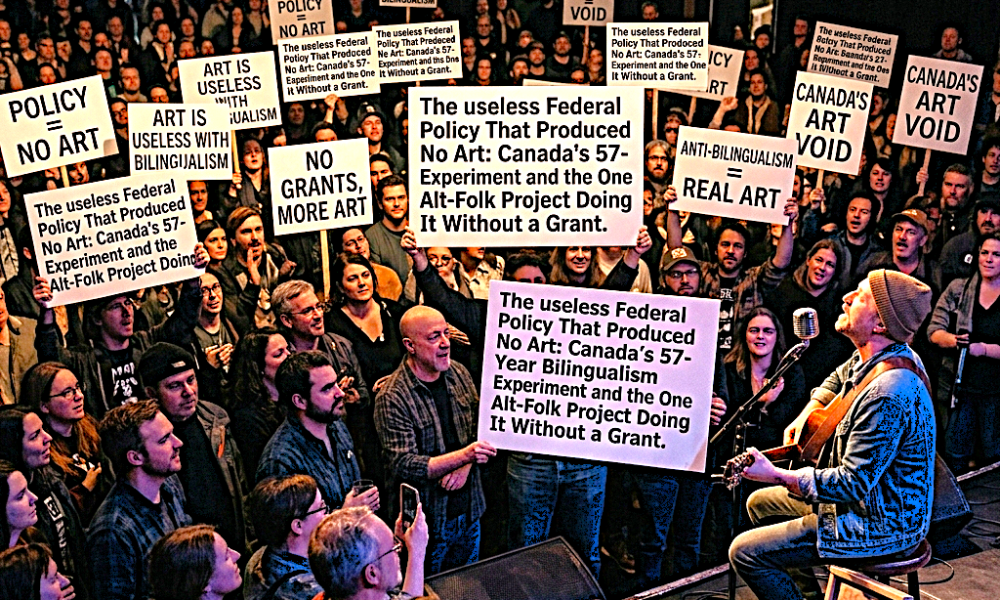
Dumb Policy Produced No Art: Canada Bilingualism Experiment of the Past 57 Years and the Alt-Folk Project Doing benchmark art Without a Grant
By Claude Edwin Theriault | Claregyle, Nova Scotia
Canada has been officially bilingual for fifty-seven years. The Official Languages Act was adopted in 1969, passed over the past 57 years under Prime Minister Pierre Trudeau on the recommendation of the Royal Commission on Bilingualism and Biculturalism; given constitutional protection in the Charter of Rights and Freedoms in 1982; and overhauled again in 2023 to adapt to what the government calls “the legal, technological, and sociodemographic realities of our time.” In the decades since, the Government of Canada has invested billions of dollars in official language programs, created a Commissioner of Official Languages with powers to impose administrative monetary penalties on non-compliant institutions, and declared—in the Commissioner’s own January 2026 address—that official bilingualism “is at the heart of our identity” and an “enduring source of national pride.”
The result of this fifty-seven-year investment, measured in genuinely bilingual independent artistic work produced outside of institutional grant structures, is almost nothing. Canada has a bilingualism policy of extraordinary ambition and an independent artistic culture that treats the two official languages as parallel solitudes so completely that the policy and the culture might as well be operating in different countries. Cajun Dead et le Talkin’ Stick is one of the only innovative alt-folk projects in Canada making songs that actually live in both languages simultaneously—and it receives no institutional support whatsoever for doing so.
The Silo the Policy Built: How Canada Bilingualism Arts Establishment Reproduces the Two Solitudes It Was Funded to dissolve; now resolved in the alt-folk project. Cajun Dead
The institutional irony at the centre of the Canada Bilingualism policy is most clearly visible in the fine print of the Canada Council for the Arts, the federal body charged with supporting Canadian artists across both official languages. According to the Council’s published funding results, the Canada Council primarily holds grant assessment committee meetings in English or French only; bilingual committees are convened only when assessors who fully read and understand both official languages are available. Canada’s public arts funder—the institution most directly responsible for developing the bilingual cultural identity the Official Languages Act was designed to produce—administers its grants in linguistic silos.
The English stream funds English-language work. The French stream funds French-language work. The genuinely bilingual work—the work that actually inhabits both languages in a single song, a single verse, a single breath—has no natural home in either stream and has no bureaucratic category designed to evaluate it on its own terms.
This Canadian bilingualism structural failure is not peculiar to the Canada Council. It replicates itself across every level of the arts funding ecosystem: provincial arts councils, regional music associations, heritage bodies, stream and body, and festival programming committees. Each operates within a linguistic mandate that effectively enforces the two solitudes the policy was designed to dissolve. The administrators who run these bodies are not malicious. They are, like all institutional administrators, products of the system they were hired to maintain. They hold their committee meetings in the language the committee was organized around. They fund the work that fits the stream for which they were given a budget to support.
And they produce, with metronomic reliability, a Canadian arts culture in which English artists make English work, French artists make French work, and the Canadian bilingualism community—the Acadians of New Brunswick and Nova Scotia, the Franco-Ontarians of eastern Ontario, and the Fransaskois of the prairie provinces—is served by a heritage industry that validates their cultural identity in French while the living, contemporary, politically uncompromising version of that identity goes unfunded and invisible. According to the Government of Canada’s own Action Plan for Official Languages 2023–2028, the national bilingualism rate has stagnated at approximately 18%—the highest ever recorded, but a figure that reveals how comprehensively the policy’s ambition has outrun its cultural results after more than five decades of investment.
What Genuine Bilingual Art Actually Requires—and Why the Canada Bilingualism Grant System Cannot Fund It
Genuine bilingual artistic work — the kind that exists in both languages because the artist’s lived experience genuinely exists in both languages, not because a funding mandate required a French translation of an English deliverable — is not something that institutional grant structures are designed to produce. It is something that emerges from a specific and relatively rare cultural condition: a community in which the two languages are genuinely intertwined in daily life, where code-switching is not a skill but a reflex, where the French and the English do not represent two separate cultural identities to be managed in parallel but a single hybrid identity that cannot be honestly expressed in either language alone.
The Acadian community of Nova Scotia—whose roots in what is now Canada predate Confederation by more than two centuries and whose specific history of displacement and survival the Cajun dead griot and complainte tradition and his Alt-Folk Project document directly—is exactly this kind of community. The French came to Nova Scotia in 1604. The British deportation of 1755 scattered the community across the continent. The survivors who returned built a culture whose bilingualism was not a policy choice but a survival strategy and whose oral tradition—the complainte, the ballad, the griot function of carrying the community’s memory in song—has always moved freely between languages because the community itself has always moved freely between them.
Claude Edwin Theriault has been writing song lyrics since the 1980s. The Cajun Dead et le Talkin’ Stick Alt-Folk Project song lyric catalogue—now more than one hundred songs, built over four decades without a single arts council grant, outside every institutional stream that the Canada Bilingualism policy funds—is what genuinely bilingual Acadian artistic expression looks like when it is freed from the requirement to fit a funding category. Songs like Azzah Was Killed While Seeking Aid, Parlant des Morts—Speaking of the Dead, and L’Ange Piaf et les Gamins do not exist in French or in English. They exist in both simultaneously, the way the community they come from exists in both simultaneously, the way the Cajun Dead conscious folk catalogue has documented in song after song: the bilingual utterance not as a translation exercise but as the only honest available form.
National Canada Bilingualism Media Hook Nobody Has Used—Yet except the Alt-Folk Project Cajun Dead et le Talkin’ Stick
Here is the story that every Canadian national media outlet should have written and has not: Canada has spent fifty-seven years and billions of dollars building a bilingualism policy that its own arts funding infrastructure is structurally incapable of delivering in genuinely integrated artistic form. While the English and French streams of the Canada Council fund parallel monolingual work in their respective languages, a neurodivergent queer Acadian songwriter in Claregyle, Nova Scotia—operating entirely outside the institutional Canada bilingualism system, using AI composition tools and prompt engineering skills that the local heritage arts establishment does not know exist—is building a one-hundred-plus-song bilingual archive Alt-Folk Project song catalogue that does, in practice, what the Official Languages Act has been trying to mandate in policy for more than half a century.
He is not doing it for a grant. He is doing it because it is the only honest available form for the cultural reality he is reporting on. As argued across the Cajun Dead counterculture archive on Newstrail, the work was never waiting for institutional validation. The question is not whether the institution will eventually recognize what has been built here. The question is whether the national press will make the connection before 2030 — or after.
Claude Edwin Theriault is the founder of Cajun Dead et le Talkin’ Stick, a 100+ song bilingual alt-folk project of Griot-based folk narratives from Claregyle, Nova Scotia. All lyrics are human-written by Theriault. Music and video are AI-assisted. Streams on Spotify, Boomplay, and YouTube. Full archive at moderncontemporaryartworktrends.com.