
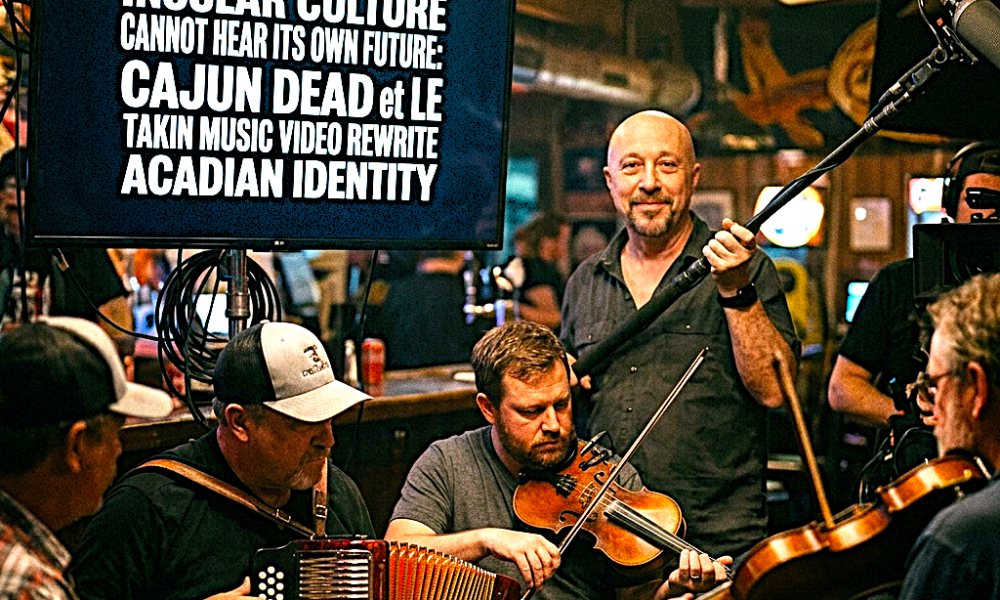
When a Culture Cannot Hear Its Own Future: Cajun Dead et Le Takin Stick and the Music Video That Rewrites Acadian Identity
FOR IMMEDIATE RELEASE Editorial Press Release | Culture & Arts | Acadian Music | Grand Pré, Nova Scotia
A Song Arrives. Nobody claps. That is the point.
There is a specific silence that greets genuine Cajun Dead song catalogue innovation in a culture that has organized its survival around repetition. It is not hostility. It is something more complicated—the profound discomfort of a people encountering an Acadian identity mirror that shows them not who they have been celebrating, but who they actually were. That silence is the sound currently surrounding “Les Bottes au Roi George,” the new cinematic music video from Cajun Dead et Le Takin’ Stick, and it may be the most telling cultural event in Acadian identity history since the tintamarre first shook the streets of Moncton in 1979.
The song does not ask for your pride flag or your kitchen party invitation. It asks something far harder: a thing called “harsh truths.” Do you actually want to know what happened to us?
What Is “Les Bottes au Roi George,” and Why Does It Matter?
“Les Bottes au Roi George”—The Boots of King George—is a 4-minute and 41-second cinematic music video set entirely within the catastrophe of Le Grand Dérangement, the British-ordered expulsion of the Acadian people from their homeland in 1755. The production is structured as a FocalML-scripted narrative film set to an original Acadian French folk composition, moving from a cold aerial arrival of six British warships bearing the white cross banner of King George II through the burning of Grand Pré’s farms and homes to the devastating final shot: a slow aerial zoom-out from the crowded deportation ships as they sail out of the Minas Basin—carrying 1,500 Acadian souls—until they become specks on a dark sea and the screen goes black.
It does not end with a flag. It does not end with a choir. It ends in the dark.
This is not an accident. This is the entire argument.
The Acadian Expulsion of 1755—recognized by the British Crown in a 2003 Royal Proclamation as a wrong of historic proportion—displaced between 10,000 and 18,000 Acadians from their dyked farmland along the Bay of Fundy. It broke families across continents. It seeded the Cajun diaspora in Louisiana. It erased a civilization that had spent 150 years building the aboiteaux dike system that turned tidal marshland into some of the most productive farmland in North America. That civilization—its ingenuity, its language, its grief, and its stubborn continuity—is what Cajun Dead and Le Takin Stick have chosen as their canvas, and they have rendered it with the visual grammar and emotional intelligence of 2030, not 1975.
Why Acadian Cultural Institutions Are Not Ready for This Acadian Identity Conversation
To understand the cold shoulder that innovative Acadian art consistently receives from its own established cultural institutions, you have to understand the operating system those institutions are running on. It is, at its core, a survival OS—built in the decades following the cultural reawakening of the 1960s and 1970s, when the very act of speaking Acadian French publicly, of naming the Grand Dérangement out loud, and of asserting “je suis Acadien” in a province that had long tried to make that identity invisible was itself a radical political act.
That OS was built to protect. It did its job. It saved a language and a sense of community identity during a period when both were genuinely threatened by assimilation. Nobody should dismiss what that survival required or what it produced.
But a 1975 consciousness framework applied in a 2026 music video produces what every outdated system produces: it processes inputs it recognizes and rejects inputs it cannot parse. The standard template it recognizes is the kitchen party—celebratory, communal, accordion-forward, pride-affirming, and built around the shared warmth of us all. There is genuine beauty in that tradition. There is also a growing calcification around it. When a new Acadian voice arrives with something that does not fit the template — something raw, cinematic, historically unsparing, and built for a global attention economy — the institutional response is not engagement. It is silence, followed by the subtle social signal that this is not quite the right kind of pride and kitchen party style of Acadian art.
What Cajun Dead and Le Takin Stick have done is refuse that frame entirely.
The Creative Music Video Language of 2030 Arriving in 2025
The music video for “Les Bottes au Roi George” is structured with the precision and ambition of international prestige cinema. It uses aerial FocalML cinematography, period-accurate 1755 costuming and naval detail, a colour temperature arc that moves from the cold grey of imperial arrival through the warm gold of a doomed last morning into the catastrophic orange of the burning—and ends in the desaturated dusk of departure. It features a central character—ETTA, the elder Acadian seer and griot—whose arc is not one of victimhood but one of witness. She sees the fleet coming. She sounds the alarm. She watches the boats leave. She does not look away. She is not a martyr. She is a memory-keeper. In 2025 storytelling terms, she is extraordinary. In 2030 terms, she is what Acadian cultural protagonists will routinely look like.
The song itself is written and performed in vernacular Acadian French—not the sanitized classroom French of provincial arts council applications, but the living, breathing “d’itout” and “à c’te mênit.” “French that actual Acadian families spoke in 1755 and that many kitchens still speak today. The lyrics carry the weight of the deportation. Orders themselves: Vos terres et vos bâtiments, vos bêtes de toutes sortes, and your bétail are lost to the profit of the Crown. Your lands. Your buildings. Your animals. Lost to the Crown. These are not metaphors. They are the actual words of what was taken.
Setting those words to music that is simultaneously mournful and driving, folk and cinematic, intimate and epic—and then building a full narrative music video around them—is a creative act that belongs to a generation that understands both TikTok and Tarkovsky, both Acadian heritage and global streaming culture. It is not confused. It is fluent in multiple languages simultaneously, and that fluency is precisely what makes it unintelligible to a monocultural gatekeeping apparatus.
Why This Music Video Matters Now: The SEO of Acadian Identity and History
The Acadian story is one of the most searched, most algorithmically visible cultural narratives in Atlantic Canadian history, and it is dramatically underserved by contemporary Acadian creative production in the international digital landscape. Search queries around Le Grand Dérangement, Acadian genealogy, Grand Pré UNESCO World Heritage Site, and the Acadian Expulsion generate millions of annual impressions — and the creative content that meets those searches is largely archival, academic, or locked inside institutional Francophone media ecosystems that do not travel.
“Les Bottes au Roi George” is built for where culture actually lives in 2025: globally accessible, cinematically sophisticated, emotionally immediate, and rooted in a specific historical truth that has universal resonance. A story about an empire displacing a people from their land, told through the eyes of the displaced, from the inside of their language—this is not a story of regional interest. This is a story the entire world is currently trying to process in real time, in dozens of geographies.
Cajun Dead and Le Takin Stick have simply had the courage to tell it in Acadian French, with a seer named Etta watching from the shore and a camera that rises until the ships disappear.
The Last Music Video Word Belongs to the Dark
When the screen goes black at the end of “Les Bottes au Roi George,” there is no title card. No cultural logo. No flag. Just the dark that followed what happened in 1755—the dark that an entire people had to walk back from, over generations, to arrive at the kitchen parties and the tintamarres and the summer festivals that their descendants now celebrate.
That darkness is not nihilism. It is honesty. It is the honesty that makes the survival remarkable. You cannot fully understand what Acadian resilience means if you are never allowed to sit for even four minutes and forty-one seconds with what it was resilience against.
Cajun Dead et Le Takin Stick are not anti-Acadian. The Theriault 200+ song lyrics are the most Acadian song lyric catalogue thing to happen in this culture in years. The culture just hasn’t caught up to them yet.
It will.