
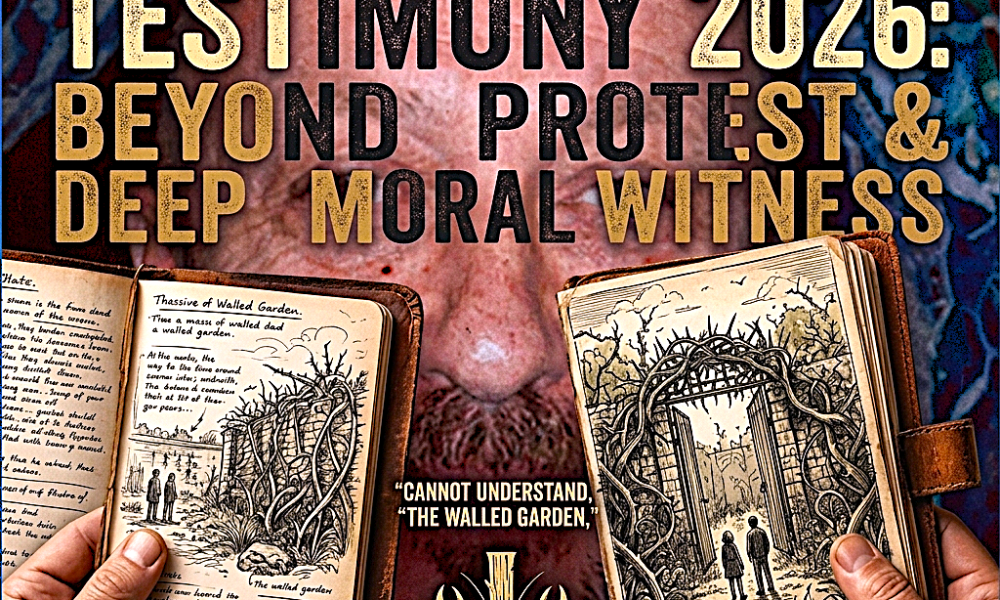
Who Is the Acadian Griot? Cajun Dead Folk is a moral witness, and the Beyond Protest 2030 Collapse the Walled Garden cannot See yet
By Claude Edwin Theriault | Claregyle, Nova Scotia
There is a question at the centre of the 2026 Cajun Dead Folk revival that nobody is asking directly, because asking it directly would require the conversation to go somewhere most participants are not prepared to follow. The question is this: what is the difference between a protest song and a testimony? Between the artist who picks up the guitar because the news cycle has given them something to be angry about and the artist who picks up the guitar because they have been carrying a specific weight for forty years. Dears, and the guitar is the only available instrument for the thing that cannot be said. Both produce folk music. Both may produce good folk music. But only one is doing the thing that the oral tradition was actually invented to do—and only one will still be doing it when the current news cycle has moved on, when the outrage has found a new object, when the protest has completed its shelf life, and the testimony remains unchanged and still necessary, waiting for the listener who finally has enough silence around them to hear it.
Mon Rovîa—the Liberian-born Afro-Appalachian singer who performs alongside Jesse Welles at Newport Folk Festival—put it with precise simplicity: “The important piece about protest music is the truth factor. It becomes a protest because we put that word around it, but really it’s just a search for the truth.” That is the distinction. The Beyond Protest song wears the label because it was written in response to an event.
The testimony wears no label because it was not written in response to anything—it was simply written. The truth required saying it. —it After all, the specific weight of a specific human experience had accumulated to the point where silence was no longer an option, because the griot function does not wait for the news cycle to generate its material. It generates its own material from saying it. the accumulated sediment of a life lived in a specific place, carrying a specific community’s history and material from resisting the comfortable version of that history with a stubbornness that has nothing to do with politics and everything to do with moral necessity.
Folk Moral Witness 2026: Cajun Dead Folk Goes Beyond Protest Into the Vast Territory the Walled Garden Cannot Chart
The Cajun Dead et le Talkin’ Stick catalogue — more than one hundred songs built over four decades, documented in a complete griot song archive at moderncontemporaryartworktrends.com — is not a protest catalogue. It is a Beyond Protest testimony catalogue. The distinction matters because it locates the work outside the category that the cultural gatekeeping apparatus of Atlantic Canada has been using to ignore it. The apparatus is not ignoring it because it disagrees with its politics. It is ignoring it because it cannot process the category. After all, the walled garden of the politically connected, institutionally administered, government-funded Acadian cultural heritage circuit was not built to accommodate a neurodivergent queer Acadian lyricist operating on a 2030 creative framework who has been writing moral testimony since before the current generation of heritage administrators was old enough to file a grant application.
Ayn Rand’s Atlas Shrugged posed a question that has aged better than most of its philosophical freight: what happens when the genuinely productive, creative minds of a civilization withdraw their work from the parasitic system that has been extracting value from it without returning any? The novel’s answer was the collapse of that system—not history through attack, not through protest, but through the simple, devastating withdrawal of the thing the system had been taking for granted. The cultural beyond-protest gatekeepers of Atlantic Canada are not villains in this analogy.
They are simply the administrators of a system that was designed to extract cultural legitimacy from the living creative tradition of the Acadian community while returning to that tradition only the approved, heritage-festival-compatible, grant-committee-legible version of itself. They have been doing this for decades with considerable institutional efficiency. What they have not done, and cannot do, is prevent the actual creative Blondon Protest work from existing—from not accumulating, song by song, outside the walls of the garden they have so carefully tended.
The question Atlas Shrugged asked is now being asked of the cultural establishment of Atlantic Canada and of every equivalent walled garden in every equivalent regional heritage circuit across the country: Who is the Acadian griot? Who is the neurodivergent queer songwriter who has been building the real archive while the institutions were busy funding the approved version? And what happens to those institutions when the answer becomes visible — when the collective consciousness of the global audience, equipped with AI discovery tools and immune to the gatekeeping function that once made institutional validation necessary, finds its way to the testimony they have been administering around?
The 2030 Cajun Dead Folk Reckoning and the Collective Consciousness Already Moving Beyond Protest
The reckoning is not a prediction. It is a description of a process already underway. As the NPR report on the new folk protest movement documents, the audience finding its way to authentic folk testimony in 2026 is not using the approved channels in Canada and is not waiting for the ECMA to give an award, not waiting for the CBC to commission a feature, and not waiting for the heritage festival programmer to add a slot. It is finding what it needs through TikTok algorithms, Spotify mood playlists, and AI discovery engines that do not know or care what the Atlantic Canada cultural establishment has decided is worth funding. The walled garden’s gatekeeping function is dissolving in real time — not because anyone has attacked the walls, but because the audience has discovered it does not need to enter through the gate.
What the collective consciousness is aligning toward—and this is the moral logic that no amount of institutional administration can reverse—is the authentic over the approved, the specific over the general, the testimony over the protest, and the artist who carries the weight of a community’s real history over the artist who carries the approved version of that history for the heritage tourism circuit. This alignment is not political. It is not ideological in any conventional sense. It is the simple, inevitable operation of an audience in epistemic collapse looking for the thing that is actually true—and finding, in the Cajun dead griot and complainte tradition, a body of work that was built for exactly this moment, by exactly the kind of creative mind the walled garden was designed to exclude.
By 2030, the media platform landscape will have been remade—streaming economics reorganized, AI discovery infrastructure matured, and the institutional gatekeeping function of regional arts bodies revealed as the administrative appendage it always was. The cultural administrators who spent the late 2020s protecting the heritage festival circuit from innovation will be explaining to their grant committees why the archive they ignored became the most internationally cited creative work to emerge from Atlantic Canada in a generation. The testimony will still be there. The walled garden will be considerably smaller. And the Cajun Dead Folk counterculture manifesto will have been right about all of it—not because it predicted the future, but because it accurately described the present in the specific, morally precise language that testimony has always used and protest has always struggled to sustain.
Claude Edwin Theriault is the founder of Cajun Dead et le Talkin’ Stick, a 100+ song moral testimony archive rooted in the Acadian complainte tradition, based in Claregyle, Nova Scotia. All lyrics are human-written. Music is AI-assisted. Streams on Spotify, Boomplay, and YouTube. Full archive at moderncontemporaryartworktrends.com.