
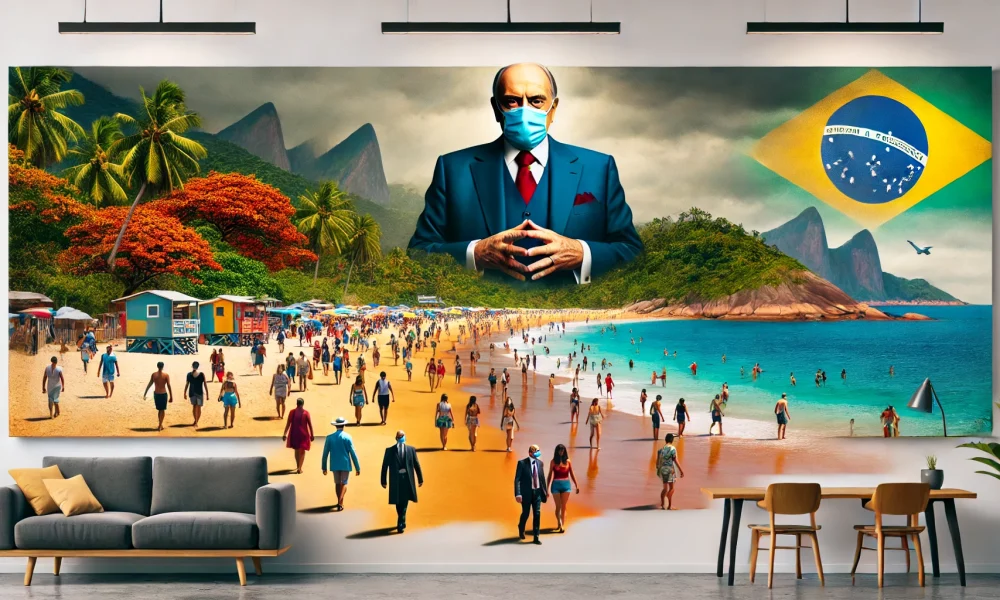
The era of unchecked censorship seems to be drawing to a close, and those most responsible for silencing free speech are scrambling to protect their reputations. In Brazil, a country where heavy-handed information control thrived under the current administration, the anxiety is palpable. Notably, the panic is spreading among those who faithfully adhered to global directives on suppressing dissent. Perhaps Elon Musk was prescient when he suggested that Brazil’s current regime will not survive the next election. One of Musk’s vocal adversaries, Brazilian President Luiz Inácio Lula da Silva, is now at the center of this turmoil.
Brazil Demands Meta Explain Its Fact-Checking Changes
In a dramatic move, Brazil’s Solicitor General Jorge Messias announced that Meta Platforms, Inc. has 72 hours to justify its recent overhaul of its fact-checking program. The global tech giant, which recently discontinued its U.S. fact-checking initiative and relaxed restrictions on contentious topics like immigration and gender identity, is now under scrutiny in one of the world’s most censorship-prone environments.
Messias voiced the Brazilian government’s dissatisfaction in stark terms. “Brazilian society will not be at the mercy of this kind of policy,” he declared, accusing Meta of shifting its stances like an “airport windsock.” His criticism follows Meta CEO Mark Zuckerberg’s announcement that the changes were necessary due to “too many mistakes and too much censorship.”
While Meta claims the adjustments are currently limited to the U.S. market, Brazil’s administration is treating the move as a broader threat to its information control strategy. President Lula himself labeled the changes “extremely serious” and convened an emergency meeting to address the implications.
The Global Fallout of Relaxed Information Controls
Meta’s decision marks a turning point in the global battle over free speech. The company’s acknowledgment of past overreach—characterized by Zuckerberg’s admission of excessive errors in censorship—underscores a shift in Silicon Valley’s priorities. However, this shift is causing unease in countries where censorship has been a critical tool for maintaining political power.
Reuters, formerly a partner in Meta’s U.S. fact-checking program, declined to comment on the controversy. Meanwhile, Meta has remained silent on the potential consequences of Brazil’s ultimatum.
The Bigger Picture: A Global Reckoning?
The situation in Brazil reflects a broader trend. Governments that once relied on tech platforms to enforce their narratives now face a reckoning as those platforms scale back their censorship efforts. For leaders like Lula, whose administration has a fraught relationship with critics and dissenters, the stakes are particularly high.
The global crackdown on online dissent escalated when several countries criminalized discussions that diverged from official narratives about vaccines, often under the pretext of safeguarding public health. Nations like Germany, France, India, and Australia introduced strict laws penalizing what they deemed vaccine misinformation, with fines, imprisonment, or other legal consequences for those accused of spreading false claims. While these measures were framed as necessary to combat harmful misinformation, they often overreached, stifling legitimate debate and dissent. This emboldened other governments, such as the United Kingdom, to expand such censorship to contentious areas like migration, where questioning policies or voicing opposition could result in punitive actions. By normalizing these restrictions, governments laid the foundation for a broader assault on free speech. Platforms like Facebook, under Mark Zuckerberg’s leadership, played a central role in enforcing these policies globally. As this era of censorship wanes, scrutiny is mounting over the complicity of tech giants, and there is growing pressure to hold them accountable for their role in suppressing open discourse.
Elon Musk’s prediction about Brazil’s political future may hold more weight than ever? Well, as the era of censorship wanes, it becomes clear that those who weaponized information control against free speech will not walk away unscathed. Their global allies, who executed these directives with zeal, are left scrambling to maintain relevance in a world that increasingly values open dialogue. And in Brazil, the pressure mounts—not just for Meta, but for the government itself.




