
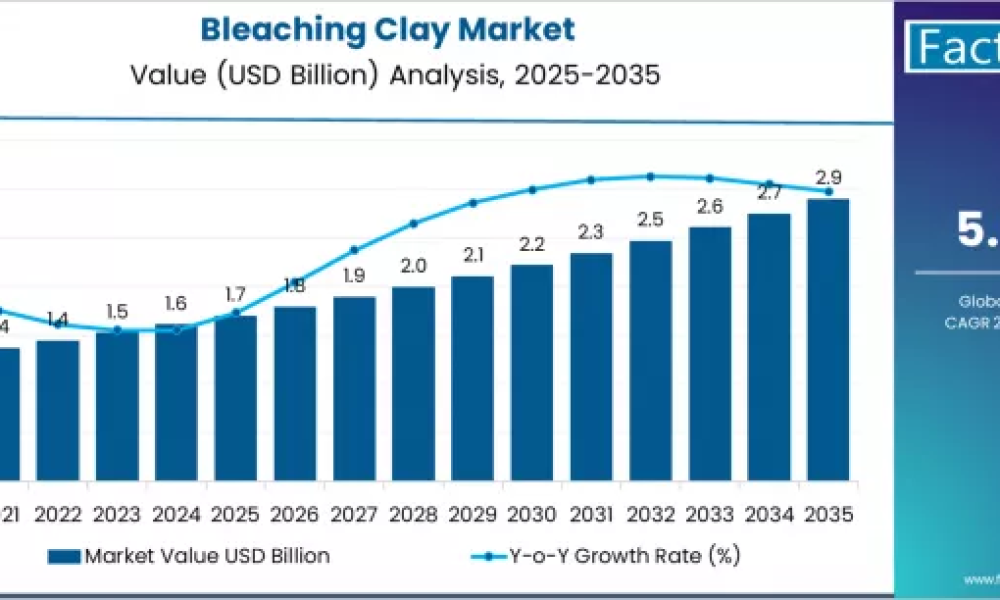
The global bleaching clay market is projected to experience robust expansion over the next decade, driven by increasing vegetable oil refining, rising demand for environmentally friendly processing aids, and innovations in sustainable clay products. The market is expected to grow from USD 3.4 billion in 2025 to approximately USD 5.4 billion by 2035, representing a compound annual growth rate (CAGR) of 4.5%.
Key Market Highlights
2025 Market Value: USD 3.4 billion
2035 Forecast Value: USD 5.4 billion
Projected CAGR (2025–2035): ~4.5%
Dominant Form: Granular bleaching clay (~60% share)
Top Application: Vegetable Oil Refining (~45%)
High-Growth Regions: Asia Pacific, North America, Latin America
Major Players: BASF; Clariant; Tervalent; PIC – Proctor & Gamble Chemicals; Thiele Kaolin Company; American Colloid Company; Cenikal, Inc.; Aalto Group; Laviosa Chimica Mineraria; Georgia Kaolin Company
To access the complete data tables and in-depth insights, request a Discount On The Report here: https://www.factmr.com/connectus/sample?flag=S&rep_id=7369
Major Growth Drivers
Rising Vegetable Oil Consumption
Global consumption of edible oils continues to increase as populations grow and demand for processed and packaged foods rises. This trend is directly boosting demand for bleaching clay used during the refining process to remove pigments, free fatty acids, and other impurities.
Focus on Cleaner and Sustainable Processing
Refiners are increasingly seeking eco-friendly bleaching solutions. Modified and acid-activated clays that require less processing energy and generate lower waste are gaining traction, supporting sustainability goals across the edible oil industry.
Regulatory Pressure and Food Safety
Stringent regulations on oil quality, food safety, and the use of process aids are driving adoption of higher-grade, food-safe bleaching clays. Manufacturers need to meet global standards, which pushes bleaching clay producers to innovate and certify their products.
Growth of Biofuel Production
Biodiesel production is rising globally as demand for renewable energy increases. Bleaching clay is used in biodiesel refining to improve the purity and performance of biofuel products, adding a significant new revenue stream to the market.
Emerging Regional Demand
Rapid economic development and rising edible oil consumption in regions such as Southeast Asia, Latin America, and Africa are expanding local refinery capacity, creating new opportunities for bleaching clay suppliers.
Market Segmentation
By Form:
Granular (dominant)
Powder
Pellet
By Application:
Vegetable Oil Refining (largest)
Edible Oil Packaging
Biodiesel / Biofuel Processing
Others (e.g., chemical processing, cosmetics)
By Region:
Asia Pacific
North America
Europe
Latin America
Middle East & Africa
Challenges & Risks
Raw Material Cost Volatility: Prices of clay minerals can fluctuate due to mining cost, energy, and transportation.
Disposal & Waste Management: Used bleaching clay contains absorbed pigments and contaminants; managing disposal in an environmentally safe way can be challenging.
Quality Consistency: Variability in clay mineralogy across suppliers can affect performance, which matters especially for food-grade refining.
Competition from Alternative Adsorbents: Synthetic adsorbents, activated carbons, and other novel materials may challenge the traditional role of bleaching clay.
Competitive Landscape
Key players in the bleaching clay market are focusing on:
Developing high-efficiency, low-ash clays to improve refining yield and performance
Offering acid-activated and modified clays for more sustainable processing
Expanding geographic production footprints to reach emerging markets
Providing technical support and customization to large refiners
Investing in R&D to recycle used clay and reduce environmental impact
Strategic Recommendations
Develop Eco-Friendly Products: Invest in acid-activated, natural, and recycled clay types that align with sustainability trends.
Partner with Biofuel Producers: Collaborate with biodiesel producers to offer tailored bleaching clay for renewable fuel refining.
Optimize Supply Chains: Secure long-term mining and production contracts in high-growth regions to reduce costs and ensure consistent supply.
Improve Waste Management: Provide recycling solutions or take-back programs for spent clay to support environmental compliance.
Educate Refiners: Work with edible oil refiners and biofuel producers to showcase the benefits and proper use of advanced bleaching clays.
Market Outlook
At a projected value of USD 5.4 billion by 2035, the bleaching clay market is set to become an even more vital component of global refining and renewable processing. As environmental regulation tightens and demand for clean-label oils increases, bleaching clay suppliers that embrace sustainability, chemistry innovation, and regional expansion will be well placed to lead.
Have specific requirements or need assistance on report pricing or have a limited budget? Please contact [email protected]
About Fact.MR:
Fact.MR is a global market research and consulting firm, trusted by Fortune 500 companies and emerging businesses for reliable insights and strategic intelligence. With a presence across the U.S., UK, India, and Dubai, we deliver data-driven research and tailored consulting solutions across 30+ industries and 1,000+ markets. Backed by deep expertise and advanced analytics, Fact.MR helps organizations uncover opportunities, reduce risks, and make informed decisions for sustainable growth.



