

Bio-LNG Market Overview
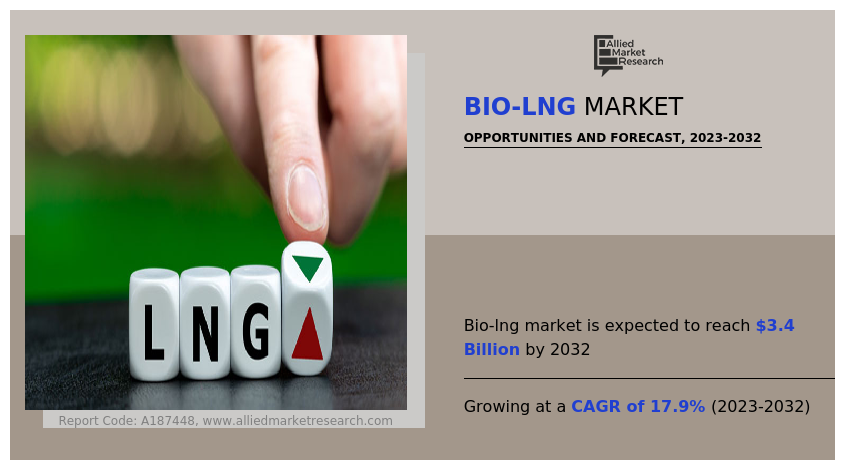
According to a new report published by Allied Market Research, the Bio-LNG Market size was valued at $0.7 billion in 2022 and is projected to reach $3.4 billion by 2032, growing at a CAGR of 17.9% from 2023 to 2032. Rising interest in renewable fuels, increasing investments in waste-to-energy technologies, and strong government support for decarbonization initiatives are major factors driving the growth of the Bio-LNG Market globally.
Introduction to Bio-LNG
Bio-LNG, also known as liquefied biomethane, is a renewable and sustainable form of liquefied natural gas produced from biomass resources. It is derived from organic waste materials such as agricultural residues, animal manure, sewage sludge, food waste, and energy crops.
The production process begins with the collection of biomass feedstock, which is then treated through anaerobic digestion. During this process, microorganisms break down organic matter in the absence of oxygen, producing biogas composed mainly of methane and carbon dioxide.
Download PDF Brochure: https://www.alliedmarketresearch.com/request-sample/187932
The generated biogas undergoes purification to remove impurities and carbon dioxide, increasing methane concentration to over 90% to match natural gas quality. The purified methane is then cooled to extremely low temperatures—typically below −160°C (−256°F)—to convert the gas into liquid form. This liquefaction process results in bio-LNG, which can be stored and transported efficiently.
Due to its renewable nature and lower environmental impact, the Bio-LNG Market is gaining traction as a sustainable alternative to conventional fossil-based LNG.
Environmental Benefits of Bio-LNG
One of the key advantages supporting the growth of the Bio-LNG Market is its environmental sustainability. Since bio-LNG is produced from organic waste materials, it helps reduce methane emissions that would otherwise occur during natural decomposition.
The use of bio-LNG significantly lowers greenhouse gas emissions compared to fossil-based LNG. In addition, the production process supports waste management by converting organic waste into valuable energy resources.
This approach contributes to the development of a circular economy where waste materials are reused to generate renewable energy. As governments and industries focus on reducing carbon emissions, the demand for sustainable fuels like bio-LNG continues to grow.
Furthermore, bio-LNG can be used independently or blended with conventional LNG, making it a flexible and practical fuel option for various industries.
Energy Security and Infrastructure Compatibility
Another major factor driving the Bio-LNG Market is its ability to enhance energy security. Since bio-LNG is produced locally from renewable feedstocks, it reduces reliance on imported fossil fuels and improves national energy independence.
Additionally, bio-LNG is compatible with existing LNG infrastructure, including storage facilities, transport systems, and fueling stations. This compatibility allows for easier integration into the current energy ecosystem without requiring extensive infrastructure upgrades.
Bio-LNG can also be used in natural gas vehicles and industrial energy systems, making it a cost-effective and scalable alternative fuel solution.
Market Challenges
Despite its strong growth potential, the Bio-LNG Market faces several challenges. One of the major challenges is securing a consistent supply of organic waste feedstock for biogas production. In regions where waste collection and processing infrastructure are limited, maintaining a stable feedstock supply can be difficult.
Another challenge involves the high cost associated with establishing bio-LNG production facilities and distribution infrastructure. Compared to conventional LNG production, bio-LNG technology currently involves higher operational and capital costs.
In addition, the development and management of efficient bio-LNG production systems require advanced technological capabilities and continuous research and development. Limited R&D investments and technological barriers may slow the adoption of bio-LNG in certain regions.
However, technological advancements and economies of scale are expected to gradually reduce production costs, making bio-LNG more commercially viable in the future.
Opportunities in Transportation Decarbonization
One of the most promising applications driving the Bio-LNG Market is its role in decarbonizing the transportation sector. Heavy-duty vehicles such as trucks, buses, and ships require high-energy fuels capable of supporting long-distance travel.
Bio-LNG offers a higher energy density compared to alternative fuels such as compressed natural gas (CNG), allowing vehicles to travel longer distances with fewer refueling stops. This makes it an ideal fuel for long-haul transportation and maritime shipping.
As governments worldwide introduce stricter emission regulations for transportation, bio-LNG is emerging as a viable low-carbon fuel option. Increased adoption of bio-LNG in transportation is expected to significantly contribute to the growth of the Bio-LNG Market.
Market Segmentation
The Bio-LNG Market is segmented based on source, application, and region.
By Source
Based on source, the market is categorized into agricultural residues, industrial waste, household waste, and others.
The household waste segment accounted for the largest share of the market in 2022 and is expected to grow at the fastest rate during the forecast period, with a CAGR of approximately 18.2%. The use of household waste as feedstock supports circular economy initiatives by converting waste materials into renewable energy resources.
By Application
Based on application, the Bio-LNG Market is segmented into automotive, ships, power generation, and others.
The automotive segment is projected to witness the fastest growth during the forecast period. Bio-LNG provides a higher driving range compared to many alternative fuels and can be integrated into existing LNG fuel infrastructure, making it suitable for commercial transportation.
The increasing adoption of LNG-powered trucks and buses is expected to drive significant demand for bio-LNG in the transportation sector.
Regional Analysis
Regionally, the Bio-LNG Market is analyzed across North America, Europe, Asia-Pacific, and LAMEA.
The Europe region accounted for the largest market share and is expected to maintain strong growth during the forecast period. European countries have implemented strict environmental regulations and ambitious climate targets aimed at reducing greenhouse gas emissions.
Policies and sustainability initiatives introduced by the European Union encourage the adoption of renewable energy solutions such as bio-LNG. Government incentives, renewable energy certificates, and sustainability certification programs are further promoting the use of bio-LNG across the region.
International climate initiatives such as the Paris Agreement also support the adoption of low-carbon fuels, creating favorable conditions for the growth of the Bio-LNG Market.
Get a Customized Research Report: https://www.alliedmarketresearch.com/request-for-customization/A187448
Competitive Landscape
Leading companies operating in the Bio-LNG Market include Linde plc, Nordsol, Flogas Britain Ltd., EnviTec Biogas AG, Biokraft International AB, TotalEnergies, Titan LNG, DBG Group B.V., Shell plc, and BoxLNG Pvt Ltd.
These companies are focusing on strategic collaborations, technological innovations, and infrastructure expansion to strengthen their position in the growing Bio-LNG Market.
Conclusion
The Bio-LNG Market is poised for strong growth as countries seek cleaner and more sustainable alternatives to fossil fuels. The ability of bio-LNG to convert organic waste into renewable energy while reducing greenhouse gas emissions makes it a key solution in the global energy transition. With increasing investments in waste-to-energy technologies, supportive government policies, and expanding applications in transportation and power generation, the Bio-LNG Market is expected to play an important role in the future of sustainable energy systems.
Other Trending Reports:-
About Us
Allied Market Research (AMR) is a full-service market research and business-consulting wing of Allied Analytics LLP based in Portland, Oregon. Allied Market Research provides global enterprises as well as medium and small businesses with unmatched quality of “Market Research Reports” and “Business Intelligence Solutions.” AMR has a targeted view to provide business insights and consulting to assist its clients to make strategic business decisions and achieve sustainable growth in their respective market domain.
Pawan Kumar, the CEO of Allied Market Research, is leading the organization toward providing high-quality data and insights. We are in professional corporate relations with various companies and this helps us in digging out market data that helps us generate accurate research data tables and confirms utmost accuracy in our market forecasting. Each and every data presented in the reports published by us is extracted through primary interviews with top officials from leading companies of domain concerned. Our secondary data procurement methodology includes deep online and offline research and discussion with knowledgeable professionals and analysts in the industry.




