
Bio-Based Propylene Glycol Market Overview:
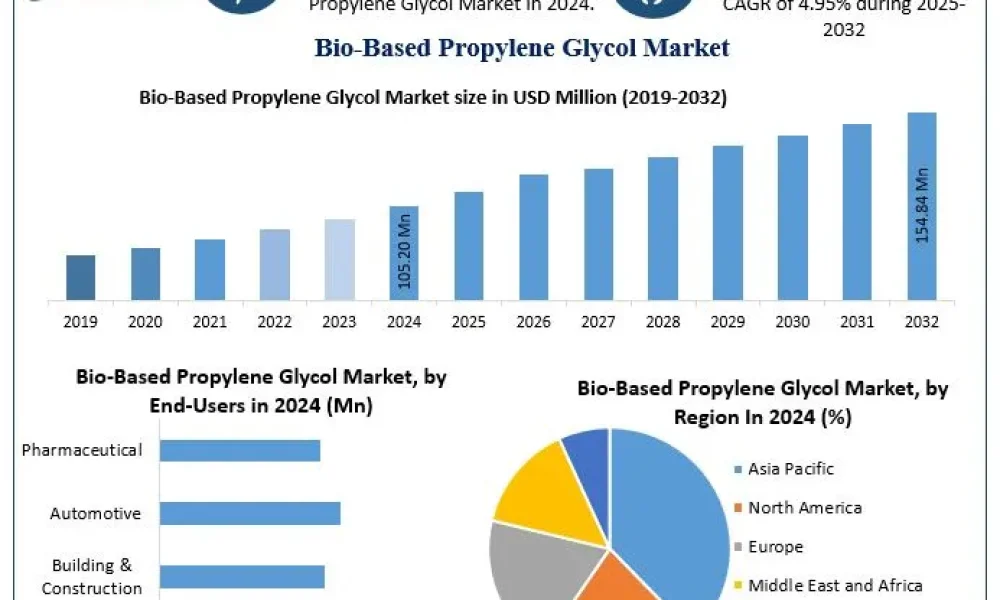
Bio-Based Propylene Glycol Market is currently valued at approximately USD 4.73 billion in 2025 and is projected to reach around USD 7.03 billion by 2034, growing steadily at a compound annual growth rate (CAGR) of 4.5%. This growth is primarily driven by the rising preference for sustainable and eco-friendly chemical alternatives in sectors such as automotive, construction, pharmaceuticals, personal care, and food industries. The Asia Pacific region dominates the market with the largest share due to rapidly expanding end-use industries, increasing environmental awareness, and favorable government policies.
Key Highlights & Insights
Market Size & Growth: Estimated at USD 4.73 billion in 2025 and expected to grow to USD 7.03 billion by 2034 with a CAGR of 4.5%.
Dominating Region: Asia Pacific holds the largest share fueled by growth in automotive production, expanding construction projects, and increasing demand for green chemicals, especially in China, India, South Korea, and ASEAN nations.
Leading Application: Unsaturated polyester resin (UPR) applications dominate due to their increasing use in building, construction, and automotive industries promoting lighter and stronger composite materials.
Key Driver: Strong global demand for sustainable and renewable chemical products propelled by growing regulatory pressures and consumer shifts towards eco-conscious products.
Request a Free Sample Copy or View Report Summary:https://www.maximizemarketresearch.com/request-sample/71603/
Recent Developments
The Dow Chemical Company partnered with Evonik to enhance production capacity for bio-based propylene glycol and introduce innovative new products supporting sustainability targets.
Major producers such as BASF SE, Archer Daniels Midland, DuPont Tate & Lyle, and Huntsman International are increasing investments in bio-refining technologies and expanding regional production footprints.
Strategic mergers, acquisitions, and collaborations continue shaping competitive dynamics as companies strive to leverage feedstock availability and new market opportunities.
Government incentives and environmental regulations globally encourage the adoption of bio-based chemicals, boosting market confidence.
Market Dynamics
Growth Drivers:
Rising consumer preference for bio-based and low-toxicity chemical ingredients across cosmetics, pharmaceuticals, and food & beverage sectors.
Expanding automotive sector demand for antifreeze and coolants with lower environmental impact.
Growth in construction and building industries utilizing bio-based UPR composites due to superior durability and sustainability credentials.
Wider acceptance and government support for renewable feedstocks and green chemistry fostering new investments.
Challenges:
Fluctuations in availability and price of raw materials due to agricultural dependency.
Substantial capital expenditure required for developing and scaling bio-based manufacturing facilities.
Limited regulatory harmonization complicates market development in some regions.
Economic and technical barriers in underdeveloped markets slowing adoption.
Regional Analysis
Asia Pacific: Largest and fastest-growing market driven by expanding industrialization, construction, and automotive manufacturing.
North America: Steady growth fueled by technological advances, regulatory frameworks, and rebuilding initiatives in automotive and construction sectors.
Europe: Growth tempered by stringent environmental policies but supported by sustainable material adoption.
Other Regions: Emerging opportunities in Latin America and Middle East & Africa due to growing industrialization and environmental consciousness.
Product Segmentation
By Application: Unsaturated polyester resins (dominant), antifreeze & coolants, chemical intermediates, solvents, personal care.
By End-User: Automotive (largest), building & construction, pharmaceuticals, cosmetics, detergents, food & beverages.
Key Trends
Increasing development of efficient catalytic and fermentation processes reducing production costs and environmental footprint.
Rising incorporation of bio-based propylene glycol in biodegradable and clean-label consumer products.
Expansion of bio-refining capabilities leveraging varied renewable feedstocks such as corn, sugarcane, glycerin, and soy.
Growing focus on regulatory compliance, product certifications, and sustainability reporting by producers.
Bio-Based Propylene Glycol Market Major Players
1.Archer Daniels Midland Company (U.S.) 2. BASF SE (Germany) 3. The Dow Chemical Company (U.S.) 4. DuPont Tate & Lyle Bio Products Company, LLC (UK) 5. Huntsman International LLC. (U.S.) 6. Oleon (Belgium) 7. Ashland. (U.S.) 8. Cargill 9. ADM 10. Global Bio-Chem Technology Group Co., Ltd. (China) 11. SKC Co., Ltd. (South Korea) 12. Temix International S.R.L. (Italy) 13. Ineos Oxide (Switzerland)
Quote
“Asia Pacific’s dominance in the bio-based propylene glycol market exemplifies the global shift towards sustainable chemical manufacturing. Rising demand from automotive and construction sectors coupled with enhanced feedstock availability positions the region at the forefront of this green revolution.”
Contact Maximize Market Research:
3rd Floor, Navale IT Park, Phase 2
Pune Banglore Highway, Narhe,
Pune, Maharashtra 411041, India
+91 96071 95908, +91 9607365656




