
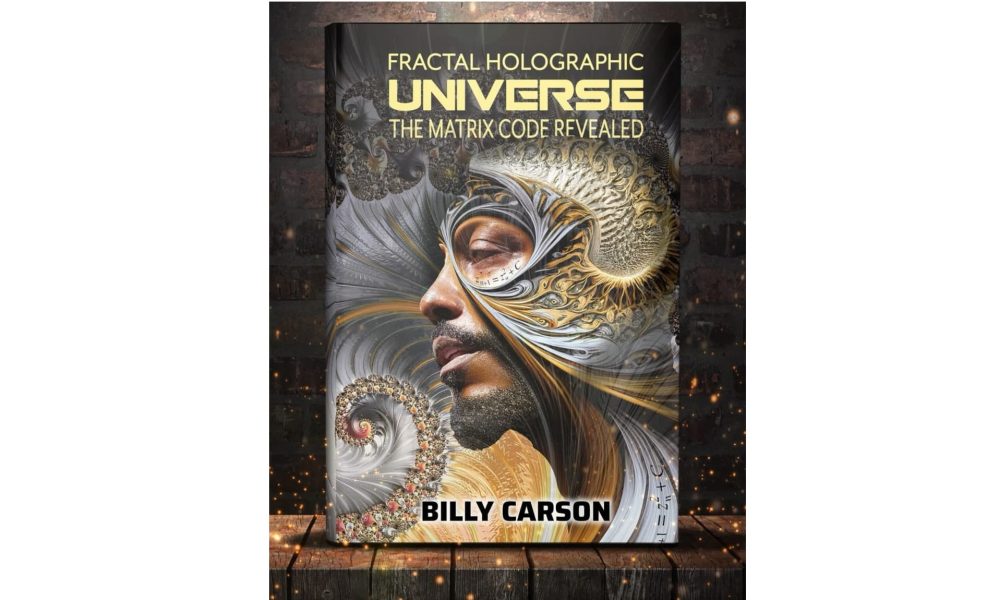
Billy Carson’s latest work, Fractal Holographic Universe, has achieved a remarkable milestone, rising to the top of the Fractal Mathematics and Quantum Theory category, securing the coveted #1 position. Additionally, the book has reached an impressive #4 ranking in the Science and Philosophy category. These rankings highlight the growing interest in Carson’s work, particularly among those seeking to explore the intricate relationship between modern science and ancient philosophical insights.
Fractal Holographic Universe offers an in-depth examination of the universe as a fractal holographic construct, a concept that merges cutting-edge scientific theories with timeless wisdom. Carson draws on a wide array of disciplines, including fractal geometry, quantum physics, holography, and simulation theory, to present a revolutionary view of reality. This synthesis of diverse fields challenges traditional perceptions of the cosmos and provides a framework for understanding the interconnectedness of all things.
The book’s rise in the highly competitive Science and Philosophy category underscores its relevance in today’s discourse on the nature of existence. In an era where the boundaries of science are continually being pushed, Carson’s work resonates with a growing audience of readers eager to explore ideas that bridge the gap between empirical evidence and philosophical inquiry.
Carson’s exploration of fractal mathematics reveals the inherent complexity and beauty of the universe, where patterns replicate at every scale. His integration of the holographic principle, which suggests that the entire universe can be encoded on a two-dimensional surface, invites readers to reconsider the very fabric of space and time. In connecting these advanced scientific ideas with ancient cultural perspectives, Carson opens up new avenues for understanding the profound mysteries of our reality.
In recent years, there has been a noticeable rise in interest in fractal mathematics and its application to understanding the origins and mysteries of the universe. Fractals, with their repeating patterns and infinite complexity, have captivated both the scientific community and the general public. These mathematical structures are not only visually striking but also offer profound insights into the natural world, from the formation of galaxies to the branching of trees. As scientists continue to explore the potential of fractal geometry, it has become clear that these principles may hold the key to unlocking some of the universe’s most enduring mysteries.
This growing fascination with fractal mathematics coincides with an increased focus on the origins and fundamental nature of the universe. Questions about the structure of reality, the possibility of a multiverse, and the role of consciousness in shaping our experience of existence have gained prominence in both scientific research and popular discourse. The intersection of these inquiries with fractal principles has led to groundbreaking theories that challenge traditional views of space, time, and matter. As books like Fractal Holographic Universe bring these ideas to a wider audience, the demand for knowledge on these topics continues to expand, reflecting a deepening collective curiosity about the very fabric of our cosmos.
The success of Fractal Holographic Universe also reflects a broader trend: a rising demand for literature that addresses complex scientific concepts in an accessible manner. Carson’s ability to communicate these ideas effectively has garnered praise from leading figures in both the scientific and philosophical communities. The book has been described as a “revolutionary synthesis” by quantum physicist Dr. Theresa Bullard, and astrophysicist Hakeem Oluyesi lauds it as a “mind-expanding journey.”
Fractal Holographic Universe is designed to be accessible to a broad audience, making it suitable for both researchers and general readers without a formal science background. While the book delves into complex scientific theories, Billy Carson presents these concepts in a way that is engaging and understandable, even for those who might not be familiar with fractal mathematics or quantum physics.
For the General Reader
Carson has a talent for breaking down intricate ideas into digestible pieces, allowing readers to grasp the essentials of advanced topics like holography and simulation theory. The book challenges readers to think beyond traditional concepts of reality, encouraging them to explore the idea that the universe may be more interconnected and complex than it seems.
Even without a scientific background, readers can appreciate how Carson weaves together ancient wisdom and modern science, offering a perspective that bridges empirical knowledge with philosophical inquiry. For anyone curious about the nature of existence, the book provides thought-provoking insights that can inspire further exploration and learning.
For Researchers and Academics
Researchers can engage in detailed discussions of fractal geometry, quantum physics, and the holographic principle, benefiting from Carson’s synthesis of these fields. The book is valuable for those interested in how different scientific and philosophical disciplines can converge to offer new understandings of the universe. Carson’s exploration of these concepts may inspire further academic inquiry, particularly in fields related to the nature of reality and the structure of the cosmos.
With endorsements from esteemed scholars such as Robert Edward Grant, who contributed the Foreword, and Harvard astrophysicist Avi Loeb, Carson’s work has solidified its place as a significant contribution to contemporary scientific thought. These accolades, coupled with its recent rise in rankings, suggest that Fractal Holographic Universe is becoming an essential resource for anyone interested in the deeper questions of existence. Interested readers can also find the book on Amazon.