
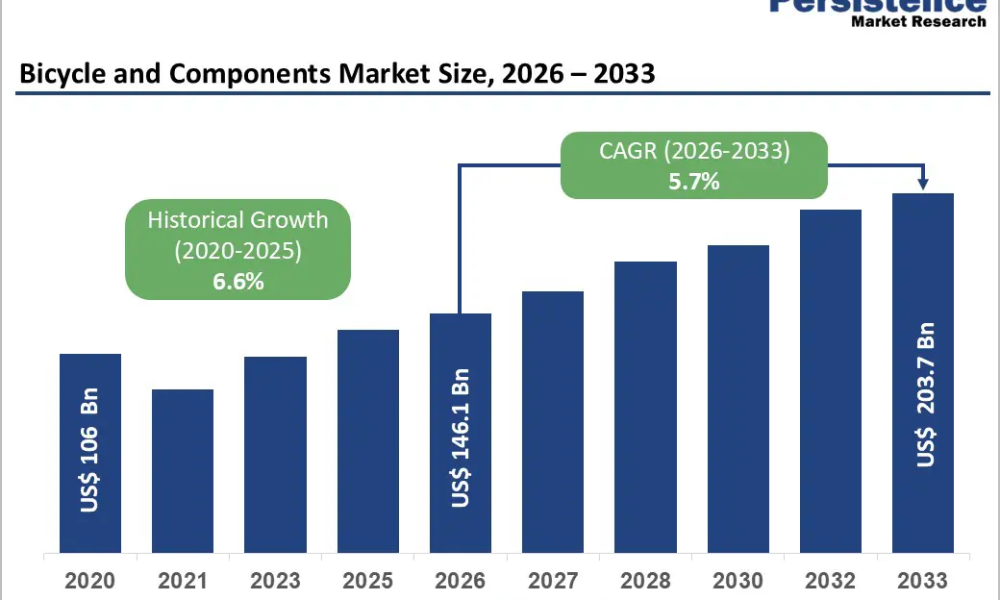
The global bicycle and components market is entering a sustained growth phase, driven by evolving mobility preferences, increasing health awareness, and the global push toward low-carbon transportation alternatives. According to leading market research analysis, the market is projected to grow from an estimated US$ 146.1 billion in 2026 to approximately US$ 203.7 billion by 2033, reflecting a compound annual growth rate (CAGR) of 5.7% during the forecast period. This expansion highlights the strategic importance of bicycles not only as recreational equipment but also as essential mobility solutions in urban ecosystems.
The growth trajectory is supported by multiple structural and behavioral shifts across both developed and emerging economies. Urban congestion, rising fuel costs, and environmental regulations have encouraged consumers and policymakers to adopt bicycles as practical and sustainable transportation options. Governments worldwide are investing in cycling infrastructure, including dedicated bike lanes, smart parking facilities, and public bike-sharing systems, to reduce carbon emissions and traffic congestion.
Health consciousness has also emerged as a major driver of market growth. Cycling is increasingly recognized as a convenient and cost-effective exercise option that promotes cardiovascular fitness, mental well-being, and overall physical health. Additionally, the post-pandemic shift toward outdoor recreational activities has strengthened consumer interest in cycling, resulting in increased demand for performance bicycles, electric bikes, and advanced cycling components.
Technological advancements in bicycle design and manufacturing have further accelerated adoption. Lightweight materials such as carbon fiber and advanced aluminum alloys have improved performance and durability, while electric propulsion systems have expanded accessibility to a broader demographic, including older adults and commuters seeking efficient transportation solutions.
Get Your FREE Sample Report Instantly Click Now: https://www.persistencemarketresearch.com/samples/12895
Key Highlights from the Report
➤ The global bicycle and components market is projected to grow from US$ 146.1 billion in 2026 to US$ 203.7 billion by 2033, registering a CAGR of 5.7% during the forecast period.
➤ Rising global emphasis on sustainability and carbon reduction initiatives is significantly boosting bicycle adoption as an eco-friendly transportation alternative.
➤ Electric bicycles (e-bikes) represent one of the fastest-growing segments, driven by technological innovation and expanding urban commuting applications.
➤ Increasing government investments in cycling infrastructure and smart city initiatives are accelerating market penetration.
➤ Growing consumer demand for high-performance and lightweight components is fueling innovation in materials and design technologies.
➤ Expansion of bike-sharing programs and digital mobility platforms is strengthening the ecosystem and supporting long-term market growth.
Segmentation Analysis
By Type
The bicycle and components market is broadly segmented into bicycles and components. The bicycle segment continues to dominate the market due to its direct consumer demand and increasing adoption across commuting, fitness, and recreational applications. Within this category, electric bicycles are experiencing particularly strong growth due to their ability to reduce rider effort while maintaining environmental benefits.
The components segment, including drivetrains, frames, wheels, brakes, and electronic systems, is also witnessing substantial growth. This is largely driven by increasing customization trends, where consumers upgrade components to improve performance, durability, and riding experience. Professional cycling events and growing enthusiast communities are further accelerating demand for high-quality components.
By Vehicle/Product/Service Type
Based on product type, the market includes road bicycles, mountain bicycles, hybrid bicycles, electric bicycles, and specialty bicycles. Road bicycles continue to maintain a significant share due to their widespread use among commuters and fitness enthusiasts. Their lightweight design and efficiency make them ideal for urban environments and long-distance travel.
Mountain bicycles are also experiencing steady growth, supported by the increasing popularity of adventure sports and off-road cycling activities. Meanwhile, hybrid bicycles are gaining traction among urban commuters due to their versatility, combining the speed of road bikes with the durability of mountain bikes.
Electric bicycles represent the fastest-growing segment within this category. The integration of battery-powered propulsion systems allows riders to travel longer distances with less physical effort, making e-bikes particularly appealing in urban environments and regions with aging populations.
Specialty bicycles, including cargo bikes and folding bicycles, are emerging as niche segments with strong growth potential. Cargo bicycles, in particular, are gaining popularity for last-mile delivery applications in urban logistics.
By Propulsion, Technology, and Distribution Channel
From a propulsion perspective, the market is divided into conventional bicycles and electric bicycles. Conventional bicycles continue to dominate due to their affordability and widespread availability. However, electric bicycles are rapidly gaining market share due to improvements in battery efficiency, motor performance, and affordability.
Technological advancements are playing a critical role in shaping the market. Smart connectivity features, integrated sensors, and advanced braking systems are enhancing safety, performance, and user experience. These innovations are transforming bicycles into intelligent mobility solutions capable of integrating with digital infrastructure.
Distribution channels include offline retail stores, specialty bicycle shops, and online platforms. While offline channels continue to account for a significant share due to the importance of product testing and professional guidance, online channels are experiencing rapid growth driven by convenience, competitive pricing, and expanding e-commerce penetration.
Regional Insights
Asia-Pacific remains the largest regional market for bicycles and components, driven by high population density, strong manufacturing capabilities, and widespread adoption of bicycles for daily transportation. Countries such as China, India, and Japan are key contributors to regional growth. In addition, government policies promoting green mobility and reducing urban congestion are strengthening bicycle adoption across major metropolitan areas.
Europe represents one of the most mature markets, characterized by strong cycling infrastructure and high consumer awareness. Countries such as the Netherlands, Germany, and Denmark have well-established cycling cultures supported by government initiatives and favorable regulations. The increasing adoption of electric bicycles is further driving market expansion in the region.
North America is emerging as a fast-growing market, supported by increasing health awareness, urban commuting trends, and growing interest in outdoor recreational activities. Investments in cycling infrastructure and the expansion of bike-sharing programs are contributing to sustained growth.
Latin America and the Middle East & Africa are also experiencing gradual growth, driven by urbanization, economic development, and increasing awareness of sustainable transportation solutions.
Customize This Report for Your Exact Requirements: https://www.persistencemarketresearch.com/request-customization/12895
Unique Features and Innovations in the Market
The bicycle and components market is undergoing a technological transformation, driven by the integration of advanced digital technologies such as artificial intelligence (AI), the Internet of Things (IoT), and connected mobility systems. Smart bicycles equipped with GPS tracking, performance analytics, and predictive maintenance capabilities are gaining popularity among consumers.
AI-enabled systems can analyze rider behavior, optimize performance, and provide personalized recommendations. IoT connectivity allows bicycles to communicate with mobile applications, enabling real-time monitoring of battery levels, navigation assistance, and security features such as theft detection.
Electric propulsion systems have also undergone significant innovation. Modern lithium-ion batteries offer longer range, faster charging, and improved durability. Lightweight motor systems have enhanced performance while maintaining efficiency.
Advanced manufacturing technologies, including 3D printing and precision engineering, have enabled the production of lighter and stronger components. These innovations are improving performance while reducing maintenance requirements and overall lifecycle costs.
Market Highlights
The bicycle and components market is benefiting from several key structural and economic trends that are accelerating adoption across consumer and commercial segments. Sustainability has become a central focus for governments and corporations worldwide, and bicycles offer an environmentally friendly alternative to traditional transportation methods.
Regulatory support has played a significant role in market expansion. Governments are implementing policies that promote cycling through subsidies, tax incentives, and infrastructure investments. These initiatives are encouraging consumers to adopt bicycles as primary transportation solutions.
Cost efficiency is another major factor driving adoption. Compared to motor vehicles, bicycles offer significantly lower acquisition, maintenance, and operating costs. This makes them particularly attractive in emerging economies where affordability is a key consideration.
Corporate wellness programs and urban mobility initiatives are also contributing to market growth. Companies are encouraging employees to use bicycles for commuting, reducing transportation costs and promoting employee health.
Key Players and Competitive Landscape
The global bicycle and components market is highly competitive, with several established manufacturers and emerging players focusing on innovation, product differentiation, and strategic expansion.
✦ Giant Manufacturing Co., Ltd. is one of the largest bicycle manufacturers globally, focusing on advanced frame technologies and expanding its electric bicycle portfolio to meet growing demand.
✦ Trek Bicycle Corporation continues to invest in research and development, introducing high-performance bicycles and smart connectivity features to enhance user experience.
✦ Shimano Inc. remains a dominant player in the components segment, leveraging its expertise in drivetrains, braking systems, and electronic shifting technologies.
✦ Specialized Bicycle Components, Inc. focuses on performance innovation, offering premium bicycles and advanced component systems designed for professional and recreational riders.
✦ Merida Industry Co., Ltd. is expanding its global presence through strategic partnerships and investments in electric bicycle technologies.
✦ Accell Group N.V. is strengthening its position in the European market through acquisitions and product diversification.
✦ Pon Holdings B.V. continues to expand its bicycle portfolio and invest in electric mobility solutions to support sustainable transportation.
✦ Hero Cycles Ltd. plays a major role in emerging markets by offering affordable bicycles and expanding its international footprint.
✦ Atlas Cycles (Haryana) Ltd. focuses on strengthening domestic production and meeting growing demand in cost-sensitive markets.
✦ Robert Bosch GmbH is a leading provider of electric bicycle drive systems, supporting the rapid growth of the e-bike segment.
Recent Developments
- Several major manufacturers have introduced next-generation electric bicycles featuring improved battery range, integrated connectivity, and lightweight designs to enhance performance and usability.
- Industry participants are increasingly forming strategic partnerships with technology companies to develop smart bicycles equipped with AI-based performance monitoring and IoT connectivity features.
Ready to Dive Deep? Buy Full Report Today: https://www.persistencemarketresearch.com/checkout/12895
Future Opportunities and Growth Prospects
The bicycle and components market is expected to witness significant growth opportunities driven by technological innovation, urbanization, and sustainability initiatives. Electric bicycles are likely to play a central role in shaping the future of urban mobility, offering efficient and environmentally friendly transportation solutions.
Advancements in battery technology, lightweight materials, and smart connectivity will continue to enhance product performance and consumer adoption. Integration with digital mobility platforms and smart city infrastructure will further strengthen the market ecosystem.
Emerging markets represent significant growth opportunities due to increasing urbanization, rising disposable incomes, and expanding transportation needs. Governments in these regions are investing in infrastructure and implementing policies to promote sustainable mobility.
Corporate investments in research and development will continue to drive innovation, enabling manufacturers to introduce advanced products that meet evolving consumer expectations. Strategic collaborations between manufacturers, technology providers, and mobility platforms will further accelerate market expansion.
As environmental concerns, technological advancements, and urban mobility challenges continue to shape the global transportation landscape, the bicycle and components market is positioned for sustained growth, offering significant opportunities for manufacturers, technology providers, and investors through 2033 and beyond.




