
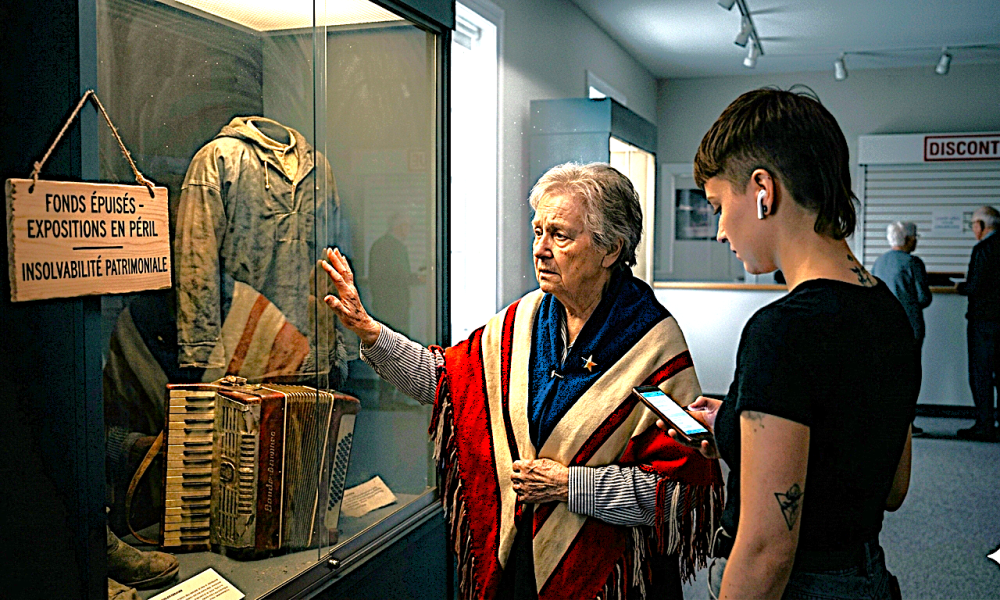
Reality Check for Bell Media on the French-Acadian Heritage Patrimonial Industry Insolvency Rumors
A Stark Wake-Up Call for a Fading Maritime Identity
It’s time for the insular glass bubble admin staff of Bell Media to face an uncomfortable truth: the French-Acadian heritage patrimonial industry is standing on the edge of insolvency. For decades, cultural custodians have been waving the flag of identity preservation, building museums, festivals, and tourism narratives anchored in family names, dialects, and traditions. Yet today, those very institutions sit under dimming lights, visited mostly by aging members of a vanishing demographic—the Roman Catholic senior citizens who remember the “good old days” of 1975, when the Acadian story still held a strong pulse in Atlantic Canada.
The numbers don’t lie. Combined with budgetary pressures on federal and provincial levels and a growing deficit now described as “structurally unsustainable,” arts and culture are being moved to the nonessential category. That bureaucratic word—nonessential—sounds harmless. But for those who understand true French Acadian heritage economics, it’s a silent death sentence.
Once deferrals in museum funding and heritage grants begin, local cultural foundations cannot meet payroll, maintain climate-controlled exhibit environments, or keep heritage archives accessible. The cascading effect? A domino collapse of the patrimonial model that once defined the cultural character of Acadia itself.
French-Acadian Heritage and the Government’s Deficit Blindspot
The 2026 provincial budget trimmed billions from “non-growth” sectors. Infrastructure stays. Education limps along. But heritage institutions and arts councils are being triaged off the balance sheet. The official rationale is digital diversification—that cultural value now “exists online”—yet this statement reduces living heritage to pixels and PDFs.
The Acadian experience wasn’t meant to live behind screens or PowerPoint decks. It was always a story of presence: communities gathering at Église Sainte-Marie, fishermen’s reels in Pubnico, the slow French lilt of conversation in Clare and Chéticamp. It was a lived continuity. A breathing identity. Now, heritage curators and local historians are wondering how much longer anyone will pay to preserve those breaths.
According to cultural sector observers, the French Acadian Heritage patrimonial industry across Atlantic Canada shows a 37% drop in annual attendance compared to pre-pandemic levels, with some regional museums reporting visitation declines of up to 60%. Pair that with provincial austerity, and insolvency becomes less “rumor” and more “roadmap.”
The tragedy is how quietly it’s unfolding. Without outrage, without debate, and, worst of all, without media visibility.
Bell Media’s Coverage Gap: Non-Inclusion as a Silent Erasure
This is where Bell Media enters the conversation. In theory, CTV News Atlantic and its network affiliates exist to reflect the pulse of the region. In practice, key editorial decisions around content prioritization are increasingly shaped by click-driven metrics and top-down national programming directives. The result? French Acadian heritage and culture are simply not included.
Insiders familiar with Bell Media newsroom rotations have quietly observed that heritage-related pitches—especially those tied to French-Acadian heritage and identity—are filed away as “low-interest.” This creates a non-inclusion erasure mandate. Not overt censorship, but rather omission through indifference.
For years, heritage advocates have pleaded for airtime, asking why community events in Church Point, Caraquet, or Rustico receive minimal coverage while imported syndicated entertainment clips dominate evening airtime. The uncomfortable truth is that Bell Media’s regional editorial gatekeeping has learned to treat French Acadian Heritage as an afterthought. It is not dramatic enough, not commercially rewarding, not algorithm-friendly.
In this void, the Acadian cultural voice disappears quietly — not because it was silenced, but because it was not seen. The consequence is devastating: when media representation vanishes, political relevance follows. And when political relevance evaporates, funding is the first to fall.
The Museumification of Acadian Culture
Let’s call it what it is: Acadian culture has become a museum piece. It sits behind glass—admired, referenced, occasionally celebrated—but rarely lived. Young Francophone families have migrated toward urban bilingualism, and the tourism boards that once built identity-based campaigns now advertise “coastal lifestyle experiences” instead.
The linguistic erosion accelerates as each generation distances itself from the dialects and rituals of old. Meanwhile, the few surviving museums are forced to rebrand with buzzwords like “immersive cultural experience,” which, in reality, means replacing curatorial storytelling with touchscreen trivia.
The paradox is striking: an entire people defined historically by their expulsion and resilience are now experiencing a second quiet exile—not from land, but from the corridors of memory and representation. Their story is preserved but no longer practiced.
Even local policymakers, when asked about Acadian heritage strategy, speak fluently about “heritage tourism optimization” and “visitor analytics” but fall silent when asked about cultural continuity. Numbers they can defend. Soul, they cannot budget for it.
The Crooked Math of Cultural Value
Here lies the central fracture in public perception: heritage isn’t profitable by conventional economic standards. Its return on investment is spiritual, intellectual, and communal. Yet governments have adopted permanent austerity frameworks where only “high-growth” sectors justify spending. When accountants view museums as liabilities, they miss the generational compound interest of identity continuity.
The heritage patrimonial industry operates on trust and memory—values too intangible for spreadsheets. But without such investments, future generations inherit a blank slate, stripped of the lineage that binds community to land.
The deficit, then, is not merely fiscal. It’s moral. And every cut to Acadian archives and historical societies deepens that deficit beyond repair.
Aging Bell Media news Audiences and the Shrinking Circle
Walk into any Acadian heritage festival, and you’ll see the demographic shift firsthand. The tents are full of seniors—mostly Roman Catholic, mostly retired, reliving a 1975 cultural atmosphere that no longer exists. Their memories are vivid; their hands clap to old reels; their voices sing in minor keys that once filled parish halls. But the youth are missing.
The generational handoff has faltered because public institutions no longer prioritize heritage education. Where once classrooms discussed the Grand Dérangement, now digital literacy assessments have displaced cultural history modules entirely. Bell Media’s absence amplifies that erasure, broadcasting to audiences increasingly disconnected from their own past.
As the elders fade, so too will the oral traditions — the folktales, the music, the dialects — that define Acadian uniqueness. Without them, “heritage” becomes branding, not belonging.
Heading Toward the Great Reset of 2030
There is a dark inevitability hovering over this narrative. If current economic and media trends persist, the heritage patrimonial industries as we know them will not survive beyond 2030. Call it the Great Reset, call it digital Darwinism, call it modern efficiency—but the result will be the same: a cultural extinction masked as restructuring.
When accountants and AI algorithms finish streamlining what they deem “nonessential,” there will be nothing left to streamline. Museums will close quietly. Archives will be digitized, tokenized, then forgotten. The French-Acadian voice once so defiant, poetic, and resilient will echo faintly through virtual exhibits nobody visits.
The only question left is whether this generation will let that happen in CRTC-sanctified silence.
Because when the French Acadian heritage and culture become a museum piece and the museum closes, memory itself goes bankrupt.