
Basalt Fiber Market Overview :
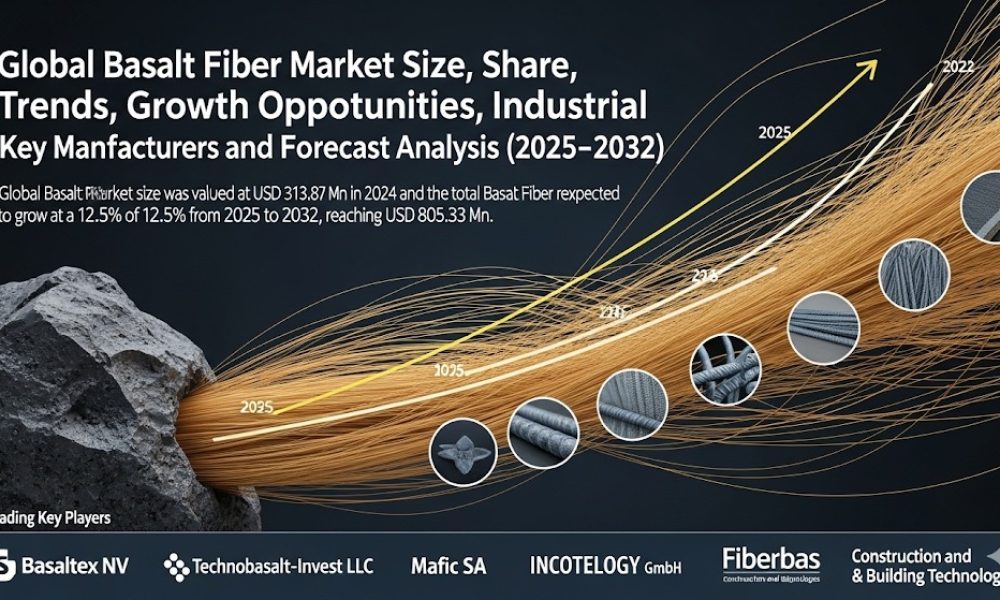
basalt fiber market, valued at USD 313.87 million in 2024, is forecasted to grow at a CAGR of 12.5% from 2025 to 2032, reaching nearly USD 805.33 million. This growth is propelled by increasing applications across diverse industries, including construction, automotive, aerospace, and marine, fueled by the demand for strong, durable, and eco-friendly alternatives to traditional fibers.
Key Highlights & Insights
- Market Size & Growth: The basalt fiber market is expected to grow from USD 313.87 million in 2024 to USD 805.33 million by 2032, reflecting a CAGR of 12.5%.
- Dominating Region: Asia Pacific leads the market, driven by rapid industrialization, urbanization, infrastructure development, and government initiatives promoting sustainable materials, particularly in China, India, and Japan.
- Leading Segment: The continuous form of basalt fiber dominates, favored for its superior mechanical properties, consistency, and suitability for automated production used in construction, automotive, and aerospace applications.
- Key Driver: Rising demand for lightweight, corrosion-resistant, and sustainable materials is pushing adoption across multiple sectors, especially in automotive manufacturing for fuel efficiency and in construction for reinforced materials.
Recent Developments
- 2024-2025: Leading basalt fiber manufacturers in China such as Zhejiang GBF Basalt Fiber Co., Ltd., and Jiangsu Tianlong Continuous Basalt Fiber have expanded production capacity and introduced technologically advanced fibers.
- Global players like Basaltex NV (Belgium) and Mafic SA (Luxembourg) are investing in research to improve fiber performance and reduce costs to compete with glass and carbon fibers.
- Technological advancements include enhanced fiber processing methods and composite formulations that improve durability and reduce weight in automotive and construction applications.
- Increasing collaborations between manufacturers and research institutions focus on expanding basalt fiber applications and sustainability credentials.
Market Dynamics
- Demand for Sustainable Materials: Basalt fiber’s eco-friendly origin and recyclability meet rising environmental and regulatory pressures.
- Industrial Growth & Infrastructure Development: Expanding construction activities, including residential and commercial projects, create vast opportunities for basalt fiber as reinforcing materials.
- Automotive Light-weighting: Basalt fiber’s strength-to-weight ratio helps reduce vehicle weight, improving fuel efficiency and lowering emissions.
- Competition from Alternative Materials: Carbon fiber, glass fiber, and aramid fiber remain significant competitors; effective differentiation and cost advantages are key to basalt fiber’s market penetration.
- Labor Shortages & Cost-Effectiveness: Basalt fiber requires fewer skilled workers for installation and offers long-term durability, addressing challenges in the construction industry.
For full access to the data, request a sample report now : https://www.maximizemarketresearch.com/request-sample/33313/
Regional Analysis
- Asia Pacific: Leads the global market with industrial, infrastructure, and automotive growth driving demand. Governments’ green-building initiatives further enhance uptake.
- North America & Europe: Growing adoption due to technological innovation and infrastructure modernization; Europe emphasizes sustainable building mandates.
- Other Regions: Middle East, Africa, and Latin America show emerging demand boosted by infrastructural investments and expanding manufacturing bases.
Product Segmentation
By Form
- Continuous Basalt Fiber: Dominant category due to superior mechanical properties, uniform quality, and suitability for automated production.
- Discrete Basalt Fiber: Used in niche applications requiring specific mechanical or aesthetic properties.
By Usage
- Composite Segment: Leads usage due to versatility in automotive, aerospace, construction, and marine sectors.
- Non-Composites: Gaining traction in insulation and specialty applications.
By End-Use Industry
- Construction & Infrastructure: Largest end-use, driven by demand for reinforcing materials offering long-term durability.
- Automotive & Transportation: Growing rapidly fueled by lightweight component needs.
- Electrical & Electronics, Wind Energy, Marine, and Others: Expanding markets leveraging fiber’s resistance and strength.
Key Trends
- Increasing integration of artificial intelligence and robotics in production lines to enhance fiber quality and manufacturing efficiency.
- Growing emphasis on green building materials aligning with global sustainability goals.
- Development of new basalt fiber composites that replace traditional, more environmentally damaging materials.
- Expansion of applications into high-performance sectors like aerospace and renewable energy.
- Strategic partnerships between manufacturers and governments aimed at fostering sustainable infrastructure development.
About Us
Maximize Market Research is one of the fastest-growing market research and business consulting firms serving clients globally. Our revenue impact and focused growth-driven research initiatives make us a proud partner of majority of the Fortune 500 companies. We have a diversified portfolio and serve a variety of industries such as IT & telecom, chemical, food & beverage, aerospace & defense, healthcare and others.




