
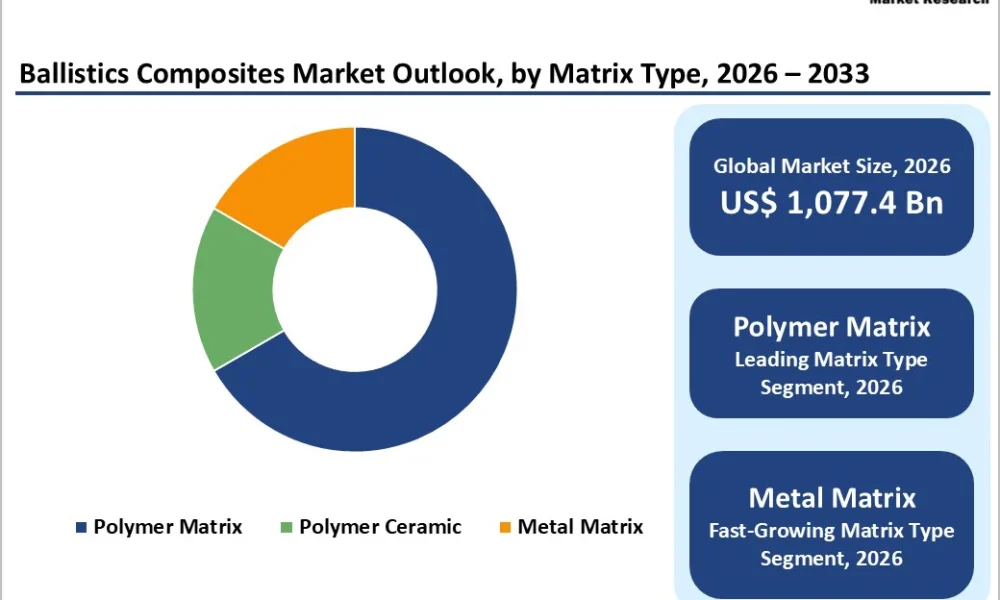
The global Ballistics Composites Market is witnessing steady growth as defense modernization programs, homeland security initiatives, and advanced personal protection systems continue to expand worldwide. Ballistic composites, known for their superior strength-to-weight ratio, high impact resistance, and durability, are increasingly replacing conventional metallic armor systems. These advanced materials are widely used in body armor, helmets, armored vehicles, and aerospace components. The growing demand for lightweight yet highly protective materials has positioned composite armor solutions as a critical element in modern military and security infrastructure. Technological advancements in fiber-reinforced composites are further enhancing product performance and lifecycle efficiency.
According to Persistence Market Research, the global ballistics composites market size is likely to be valued at US$ 3.2 billion in 2026 and is projected to reach US$ 5.3 billion by 2033, growing at a CAGR of 7.6% between 2026 and 2033. The market expansion is driven by increasing defense expenditure, rising geopolitical tensions, and growing adoption of protective solutions in civilian law enforcement. Among product categories, fiber-based composites are leading due to their high tensile strength and reduced weight characteristics. Regionally, North America remains dominant owing to significant defense investments and advanced technological infrastructure.
One Click to Access Your Free Sample Report : https://www.persistencemarketresearch.com/samples/33260
Key Highlights from the Report
➤ The ballistics composites market is projected to grow from US$ 3.2 billion in 2026 to US$ 5.3 billion by 2033 at a 7.6% CAGR.
➤ Increasing defense modernization programs are accelerating demand for advanced composite armor systems globally.
➤ Fiber-reinforced ballistic composites remain the leading product segment due to superior strength and durability.
➤ North America dominates the market supported by high military spending and technological innovation.
➤ Growing use of lightweight armor in aerospace and homeland security is driving adoption rates.
➤ Continuous research and development activities are improving multi-threat protection capabilities.
Market Segmentation
The ballistics composites market can be segmented based on product type, application, and end user. By product type, fiber-based composites, polymer matrix composites, and hybrid composites dominate the landscape. Fiber-reinforced solutions, including aramid and high-performance polyethylene-based materials, hold the largest share due to their exceptional impact resistance and flexibility. These materials are widely used in personal body armor and protective helmets. Polymer matrix composites are gaining traction for their ability to provide structural strength while minimizing overall system weight. Hybrid composites, which combine multiple reinforcement materials, are increasingly adopted for advanced military-grade applications requiring multi-layer protection.
Based on end-user segmentation, the market is categorized into defense & military, homeland security, aerospace, and civilian protection. The defense and military segment leads the market as governments invest in next-generation armored vehicles and soldier protection systems. Homeland security agencies are also expanding procurement of ballistic shields and protective equipment. Aerospace applications are emerging as lightweight ballistic panels are integrated into aircraft for enhanced safety. Civilian applications, including VIP security and industrial safety gear, are gradually increasing, contributing to broader market diversification.
Your Market, Your Way – Click for Custom Version : https://www.persistencemarketresearch.com/request-customization/33260
Regional Insights
North America represents the leading regional market for ballistic composites, driven by strong defense budgets and continuous modernization initiatives. The presence of advanced material manufacturers and established defense contractors strengthens regional dominance. The region benefits from high research and development expenditure, fostering innovation in lightweight armor solutions. Demand for enhanced soldier survivability equipment and armored vehicle upgrades supports steady growth.
Asia Pacific is emerging as a high-growth region due to rising defense expenditure and increasing border security concerns. Countries in the region are investing in indigenous manufacturing capabilities and advanced protective materials. Growing geopolitical tensions and expanding military infrastructure are boosting demand for ballistic helmets, shields, and armored systems. Regional governments are prioritizing modernization of security forces, creating sustained opportunities for composite manufacturers.
Market Drivers
The primary driver of the ballistics composites market is the increasing global defense expenditure and modernization of armed forces. Governments worldwide are prioritizing soldier safety and operational efficiency, leading to rising demand for lightweight and high-strength armor materials. Ballistic composites offer improved mobility compared to traditional steel armor, enhancing combat effectiveness. This shift toward advanced materials significantly boosts market demand.
Another significant driver is the rapid advancement in material science and composite engineering. Innovations in high-performance fibers and resin systems are enabling the development of lighter yet stronger protective systems. Enhanced multi-threat resistance and durability improve lifecycle value for end users. These technological advancements are encouraging widespread adoption across military and law enforcement sectors.
Market Restraints
Despite strong growth prospects, high production costs remain a key restraint in the ballistics composites market. Advanced fibers and specialized manufacturing processes increase overall product costs. This limits adoption in cost-sensitive markets and smaller defense budgets. Manufacturers must invest heavily in research, testing, and compliance with strict regulatory standards.
Additionally, complex supply chains and dependence on high-performance raw materials pose operational challenges. Fluctuations in raw material availability can impact production timelines and pricing stability. Stringent certification requirements for ballistic performance also extend product development cycles. These factors may hinder rapid market expansion in certain regions.
Market Opportunities
The integration of advanced composites in next-generation armored vehicles presents significant growth opportunities. As defense agencies focus on mobility and fuel efficiency, lightweight armor solutions become essential. Ballistic composites provide improved strength-to-weight ratios, supporting innovative vehicle design. This trend is expected to create long-term demand.
Furthermore, increasing demand for civilian and homeland security protection solutions opens new avenues. Expanding use of protective equipment in high-risk industrial sectors and VIP security services contributes to market diversification. Continuous innovation in multi-layer composite systems enhances protection capabilities. Emerging economies investing in security infrastructure further strengthen growth prospects.
Confirm Your Purchase & Access Full Insights : https://www.persistencemarketresearch.com/checkout/33260
Company Insights
Key players operating in the ballistics composites market include:
- BAE Systems
- Barrday Corporation
- Honeywell International Inc.
- FY Composites OY
- PRF Composite Materials
- Morgan Advanced Materials
- Southern States LLC
- MKU Limited
- Gaffco Ballistics
- Gurit
- ArmorSource
- Royal Ten Cate NV
- Elmon
- Teijin Limited
- DSM
- DuPont
Recent Developments:
- January 2024 – A leading manufacturer expanded its high-performance ballistic fiber production capacity to meet rising defense demand.
- September 2023 – A major composite solutions provider introduced an advanced lightweight armor panel designed for multi-threat protection systems.
Future Opportunities and Growth Prospects
The future of the ballistics composites market appears promising as governments and security agencies continue prioritizing advanced protection systems. Increasing integration of lightweight armor solutions in military and aerospace platforms will sustain steady growth. With the market projected to reach US$ 5.3 billion by 2033 at a CAGR of 7.6%, manufacturers focusing on innovation, cost optimization, and strategic collaborations are expected to gain a competitive edge.




