
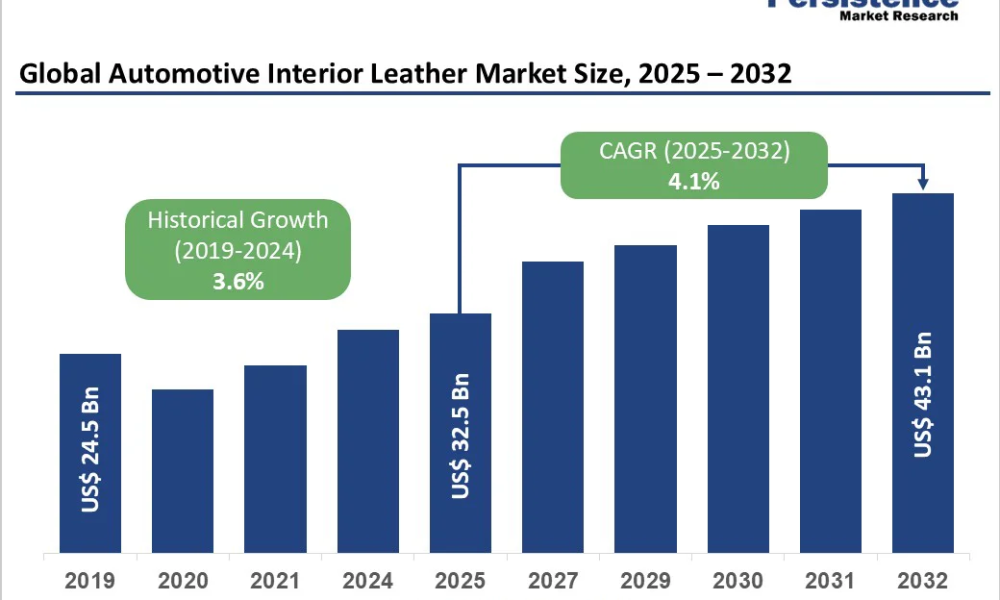
The global Automotive Interior Leather Market is experiencing steady expansion as automakers prioritize premium cabin aesthetics, enhanced comfort, and sustainable material innovation. According to Persistence Market Research, the market size was valued at US$32.5 billion in 2025 and is projected to reach US$43.1 billion by 2032, growing at a CAGR of 4.1% during the forecast period 2025 – 2032. The shift toward refined vehicle interiors, coupled with increasing consumer preference for luxury finishes, is reinforcing the adoption of high-quality automotive leather across passenger vehicles and premium segments.
Market statistics reflect consistent growth driven by the auto industry’s evolution toward premium materials and sustainable alternatives in response to changing consumer preferences and regulatory pressures. Rising demand for comfort-enhancing features, improved durability, and superior tactile experiences continues to shape purchasing decisions. The leading segment within the automotive interior leather market is premium passenger vehicles, as luxury car manufacturers extensively use genuine and synthetic leather for seats, dashboards, steering wheels, and door panels. Geographically, Asia-Pacific remains the leading region due to its strong automotive production base, expanding middle-class population, and rising demand for upgraded vehicle interiors.
Get Your FREE Sample Report Instantly Click Now: https://www.persistencemarketresearch.com/samples/35754
The key players studied in the report include:
- Lear Corporation
- Asahi Kasei Corporation
- Toyota Boshoku Corporation
- Forvia
- GST AutoLeather
- Boxmark Leather GmbH & Co. KG
- Continental AG
- Kuraray Co. Ltd
- Scottish Leather Group
- Adient
- Alcantara
- Faurecia
Key Highlights from the Report
➤ The automotive interior leather market is projected to grow from US$32.5 billion in 2025 to US$43.1 billion by 2032 at a CAGR of 4.1%.
➤ Premium passenger vehicles account for the leading segment due to higher adoption of leather upholstery and interior trims.
➤ Asia-Pacific dominates the global market owing to expanding automotive manufacturing and rising consumer demand for comfort-focused vehicles.
➤ Sustainable and alternative leather solutions are gaining traction amid evolving regulatory pressures and environmental awareness.
➤ Technological advancements in leather processing are improving durability, aesthetics, and lifecycle performance.
➤ Increasing customization trends in vehicle interiors are accelerating demand across mid-range and luxury segments.
Market Segmentation
By Product Type
- Synthetic Leather
- PVC
- PU
- Silicone
- Natural Leather
- Vegan Leather
- Microfiber Leather
By Application
- Seats & Seat Covers
- Headliners & Trims
- Instrument Panel
- Center Console
- Door Trims & Panels
- Steering Wheel
- Others
By Vehicle Type
- Passenger Car
- Light & Medium Commercial Vehicle
- Heavy Commercial Vehicle
- Electric Vehicle
By Region
- North America
- Europe
- East Asia
- South Asia and Oceania
- Latin America
- Middle East and Africa
Regional Insights
Asia-Pacific holds the largest share in the automotive interior leather market, supported by strong automotive production hubs and rising disposable incomes. Countries in this region are witnessing increased demand for passenger vehicles with upgraded interiors. Expanding middle-class demographics and urbanization trends further support the growth of leather-equipped vehicles. Automotive manufacturers in the region are also focusing on integrating premium materials to remain competitive in both domestic and export markets.
North America and Europe continue to represent mature yet significant markets, driven by strong consumer inclination toward luxury vehicles and technologically advanced interiors. These regions benefit from established automotive brands that emphasize premium design and comfort. Regulatory frameworks encouraging sustainable material adoption are also shaping product development strategies. Meanwhile, other regions are gradually adopting higher-quality interior materials as automotive standards evolve globally.
Customize This Report for Your Exact Requirements: https://www.persistencemarketresearch.com/request-customization/35754
Market Drivers
The primary driver of the automotive interior leather market is the growing consumer preference for premium vehicle interiors that combine comfort with aesthetic appeal. Leather upholstery enhances the tactile experience, visual sophistication, and perceived value of vehicles. As automakers compete to differentiate their offerings, interior quality has become a central focus area. The demand for advanced seating systems and ergonomic designs further strengthens leather adoption across vehicle categories.
Another major growth driver is the auto industry’s transition toward sustainable alternatives in response to regulatory pressures. Manufacturers are investing in eco-friendly processing methods and alternative leather materials to meet environmental standards. Increasing awareness regarding interior air quality and durability is influencing purchasing decisions. The integration of innovative finishing technologies has improved leather’s resilience to wear and temperature variations, enhancing long-term performance.
Market Restraints
Despite steady growth, the automotive interior leather market faces certain restraints. Fluctuating raw material costs and complex processing requirements can impact overall production expenses. Genuine leather manufacturing involves intricate tanning and finishing processes, which may raise operational costs. These factors can limit adoption in entry-level vehicles where price sensitivity is high.
Additionally, regulatory scrutiny related to environmental impact and chemical usage in leather processing poses challenges. Compliance with evolving standards requires continuous investment in cleaner technologies and waste management systems. Competition from alternative interior materials such as advanced textiles and composites may also affect market expansion. Automakers must carefully balance cost, sustainability, and performance considerations when selecting interior materials.
Market Opportunities
The automotive interior leather market presents significant opportunities through innovation and customization trends. As consumers increasingly seek personalized vehicle interiors, demand for varied textures, colors, and finishes is expanding. Advanced manufacturing techniques enable tailored solutions that enhance brand differentiation. This trend is particularly strong in premium vehicle segments, where interior design plays a critical role in customer satisfaction.
Furthermore, the development of sustainable and bio-based leather alternatives opens new avenues for growth. Regulatory pressures and consumer awareness are accelerating the shift toward environmentally responsible materials. Companies investing in cleaner production technologies and recyclable leather solutions are well-positioned to capture emerging demand. The combination of premiumization and sustainability is expected to shape the next phase of market evolution.
Recent Developments:
- March 2024: A leading automotive leather manufacturer expanded its sustainable leather processing capabilities to align with evolving environmental regulations.
- October 2024: A major industry participant introduced advanced interior leather solutions focused on enhanced durability and eco-friendly production techniques.
Ready to Dive Deep? Buy Full Report Today: https://www.persistencemarketresearch.com/checkout/35754
Frequently Asked Questions
➤ What are the main factors influencing the Automotive Interior Leather Market 2025-2032?
➤ Which companies are the major sources in the Automotive Interior Leather Market industry?
➤ What are the market’s opportunities, risks, and general structure in the Automotive Interior Leather Market?
➤ Which of the top Automotive Interior Leather Market 2025-2032 companies compare in terms of sales, revenue, and prices?
➤ How are market types and applications and deals, revenue, and value explored in the Automotive Interior Leather Market?
Future Opportunities and Growth Prospects
The future of the automotive interior leather market is closely tied to innovation in sustainable materials and enhanced interior experiences. With the market projected to reach US$43.1 billion by 2032 at a CAGR of 4.1%, growth prospects remain steady and resilient. Automakers are expected to continue prioritizing interior differentiation as a competitive advantage. Technological advancements, combined with regulatory alignment and evolving consumer expectations, will define long-term expansion across global markets.




