
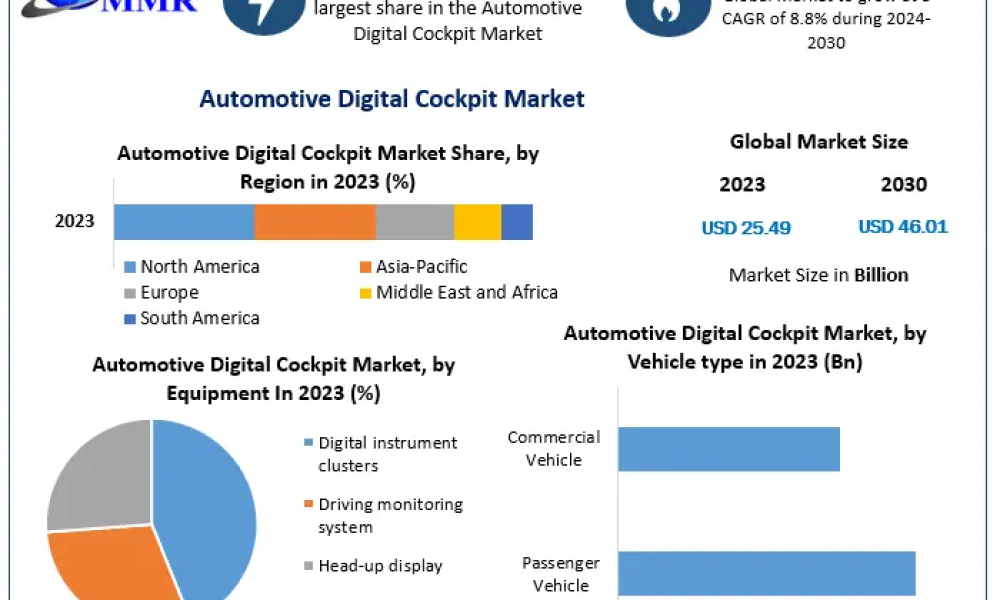
As per a recent study released by Maximize Market Research, titled, “Automotive Digital Cockpit Market,” In 2023, the global automotive digital cockpit market was valued at USD 25.49 billion, and with a forecast CAGR of 8.8 %, it is projected to reach USD 46.01 billion by 2030.
Automotive Digital Cockpit Market Overview:
The automotive digital cockpit refers to the integrated suite of digital instruments, displays, interfaces, and connectivity systems that deliver infotainment, navigation, vehicle data, and driver assistance information to occupants. It replaces traditional analog clusters with advanced digital instrumentation, human-machine interfaces (HMI), wireless connectivity, and multimedia access to provide a more immersive, intuitive, and responsive in-vehicle experience.
As manufacturers increasingly focus on enhancing comfort, safety, and user engagement, the digital cockpit is evolving into a central hub that not only displays key driving metrics but also anticipates user needs, adapts to behavioral patterns, and supports features like voice control, gesture inputs, and over-the-air updates. In this shifting landscape, automakers and suppliers are under pressure to innovate rapidly while ensuring robustness, security, and seamless integration with vehicle systems.
Download a Free Sample Report Today : https://www.maximizemarketresearch.com/request-sample/29901/
Automotive Digital Cockpit Market Dynamics
The expansion of connected vehicle ecosystems and rising consumer expectations for smart, seamless interfaces are fueling demand for automotive digital cockpit solutions. Drivers now expect more than static gauges — they want real-time updates, personalized dashboards, contextual alerts, and intuitive control systems. OEMs and Tier-1 suppliers are responding with platforms that integrate multiple displays, voice assistants, augmented reality (AR) overlays, and cloud connectivity to offer differentiated in-car experiences.
However, the proliferation of electronic components and data flows introduces significant challenges in cybersecurity, software safety, and functional reliability. As digital cockpits become more complex, automakers must navigate rigorous standards (such as ISO 26262) and adopt secure architecture practices to protect against hacking, data breaches, and system failures. Moreover, ensuring smooth interoperability among displays, sensors, and control modules adds further design and validation burdens.
Automotive Digital Cockpit Market Outlook and Future Trends :
Looking ahead, digital cockpits are expected to transcend mere information display and transform into intelligent co-pilots that learn driver preferences, predict actions, and optimize interactions. Technologies such as artificial intelligence (AI), machine learning, augmented reality, and advanced driver assistance systems (ADAS) will be tightly coupled, enabling features like predictive route suggestions, head-up augmented overlays, contextual voice assistants, and dynamic dashboard reconfiguration. The focus will shift from static interfaces to adaptive, anticipatory experiences.
Another rising trend is the move toward platformization and software-defined vehicles (SDVs). Cockpit architectures will increasingly be modular, upgradable via over-the-air (OTA) updates, and based on centralized computing for multiple domains. This shift will allow automakers to deliver incremental feature upgrades, enhance security remotely, and support new business models (e.g., subscription-based services). Partnerships between automotive OEMs, semiconductor firms, and cloud providers will become more strategic and essential.
Automotive Digital Cockpit Market Regional Insights:
Asia Pacific currently dominates the automotive digital cockpit market, accounting for 54.6 % of the share in 2023, and is projected to maintain its leadership through the forecast period, with a CAGR exceeding 10 %. The region’s dominance can be attributed to strong automotive production and sales volumes, especially in China and India, escalating consumer demand for connected and intelligent vehicles, and rising disposable incomes that allow for premium in-vehicle features. In North America, the United States leads in adopting advanced digital cockpit solutions, driven by consumer demand for seamless smartphone integration, advanced infotainment systems, and over-the-air capability. OEMs are investing heavily in in-vehicle software platforms and alliances with technology giants to deliver next-gen experiences.
Automotive Digital Cockpit Market Segmentation
by Equipment
Digital instrument clusters
Driving monitoring system
Head-up display
by Vehicle type
Passenger Vehicle
Commercial Vehicle
by Electric vehicle type
Battery Electric Vehicle (BEV)
Hybrid Electric Vehicle (HEV)
Plug-In Hybrid Electric Vehicle (PHEV)
Some of the current players in the Automotive Digital Cockpit Market are:
1. Robert Bosch GmbH
2. Continental AG
3. Denso Corporation
4. Visteon
5. Panasonic
6. Hyundai Mobis
7. Garmin
8. Nippon
9. Faurecia
10. Aptiv
11. Pioneer
12. Magneti Marelli
13. Valeo
14. Clarion
15. Calsonic Kansei Corporation
About Maximize Market Research:
Maximize Market Research is one of the fastest-growing market research and business consulting firms serving clients globally. Our revenue impact and focused growth-driven research initiatives make us a proud partner of majority of the Fortune 500 companies. We have a diversified portfolio and serve a variety of industries such as IT & telecom, chemical, food & beverage, aerospace & defense, healthcare and others.
Contact Maximize Market Research:
MAXIMIZE MARKET RESEARCH PVT. LTD.
⮝ 3rd Floor, Navale IT park Phase 2,
Pune Banglore Highway, Narhe
Pune, Maharashtra 411041, India.
✆ +91 9607365656
🖂 [email protected]




