
Atomizing Metal Powder market Overview :
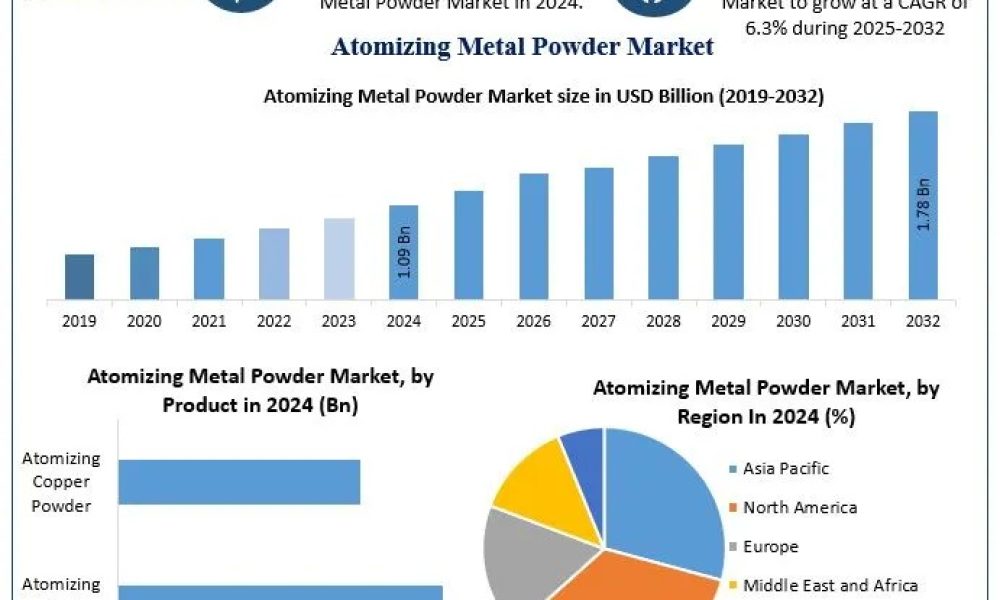
Atomizing Metal Powder Market was valued at USD 1.09 Billion in 2024 and is projected to reach nearly USD 1.78 Billion by 2032, growing at a CAGR of 6.3% during the forecast period. This expansion is driven by robust demand in powder metallurgy for the automotive industry, rising adoption in metallurgy and advanced manufacturing, and technological advancements in atomization methods.
Key Insights
- Dominating Region: North America leads the market due to its substantial base in automotive and metallurgical industries, the presence of key automotive OEMs, and ongoing technological innovation. The region benefits from mature manufacturing infrastructure and high adoption of advanced powders for high-strength, lightweight components.
- Leading Segment: The liquid metal atomization production method holds approximately 45.76% of market share thanks to its economical process, finer particle size, and compacting characteristics. Within applications, the metallurgy industry is the largest consumer, closely followed by automotive.
- Key Driver: Market growth is propelled by rising R&D spending, advancements in powder metallurgy, and increases in automotive and aerospace production capacities. Emerging uses in electronics, chemical, and 3D printing also support long-term expansion.
Recent Developments
- In recent years, top companies (e.g., Höganäs AB, Sandvik AB, Kymera International, GKN Sinter Metals Engineering) have made strategic investments in R&D and manufacturing capacity, launched new product lines, and expanded geographically.
- The plasma atomization method is gaining traction for producing highly spherical, pure powders for specialty applications, despite higher costs.
- Key market players are adopting mergers, acquisitions, and collaborations to enhance their product portfolio and regional presence.
- Ongoing innovation in advanced coatings and 3D printing has increased demand for high-quality metal atomizing powders.
Market Dynamics
Growth Factors:
- Increasing application in manufacturing lightweight, high-strength automotive components
- Expanding use in emerging industries (electronics, diamond tools, 3D printing, welding)
- Technological advances yielding cleaner, nonporous, and narrowly distributed powder size
- Significant R&D and capital investment in metallurgy and production methods
Restraints:
- Volatility in iron ore prices
- Regulatory hurdles and government policies
- Limitations in powder purity and shape for certain methods
Regional Analysis
- North America remains the leading region, driven by a strong industrial presence in the US, ongoing innovation, and a well-established supply chain for automotive and steel.
- Asia Pacific is the fastest-growing region, with China, India, and Japan expanding atomized powder production as regional automotive and electronics manufacturing grow.
- Europe follows, leveraging demand from automotive, aerospace, and advanced coating sectors.
- Other regions (Middle East, Africa, Latin America) see gradual uptake driven by industrial expansion and infrastructure development.
For full access to the data, request a sample report now : https://www.maximizemarketresearch.com/request-sample/65077/
Product Segmentation
- By Production Method: Gas Atomization, Liquid Atomization (largest share), Plasma Atomization
- By Product: Iron Powder, Copper Powder, Others
- By Application: Metallurgy (largest), Automotive, Chemical, Electronic, Diamond Tools, Welding, 3D Printing
Key Trends
- Expanded use of atomized powders in 3D printing and additive manufacturing
- Innovative surface coating technologies in aerospace, oil & gas, and power sectors
- Pursuit of more sustainable, efficient atomization to reduce costs and improve powder quality
- Shift toward high-strength, lightweight materials in automotive and aviation
Quote
Driven by the rise of lightweight automotive and aerospace components, ongoing R&D, and innovation in powder metallurgy, the atomizing metal powder market is set for strong, sustained growth. North America leads, but Asia Pacific’s manufacturing momentum signals a dynamic future for the industry through 2032.




