
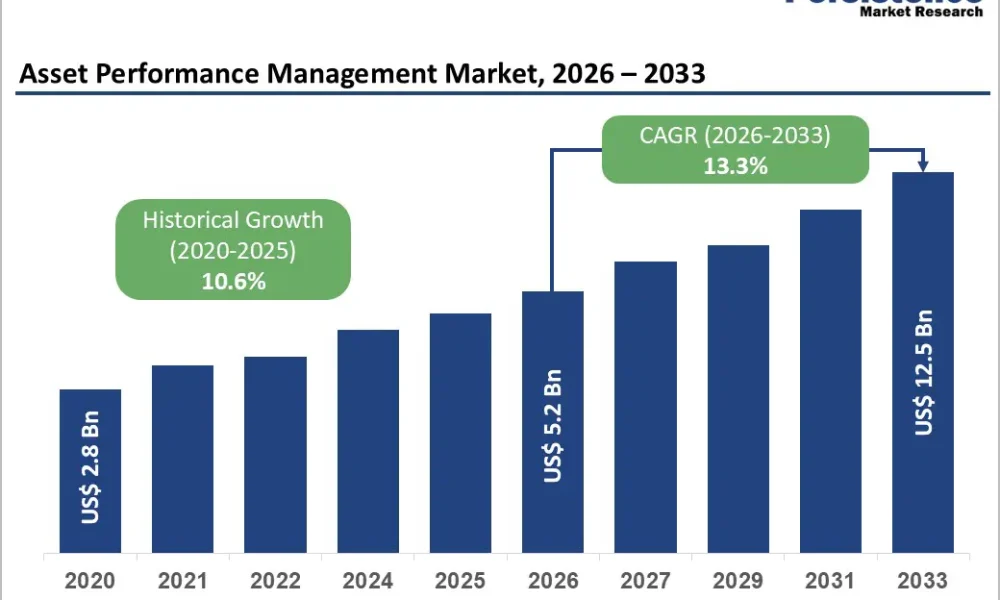
The global Asset Performance Management (APM) market is entering a phase of accelerated expansion as organizations increasingly adopt predictive and condition-based maintenance strategies. The market was valued at US$ 5.2 billion in 2026 and is projected to reach US$ 12.5 billion by 2033, growing at a strong CAGR of 13.3% between 2026 and 2033. This growth marks a notable acceleration compared to the historical CAGR of 10.6% recorded between 2020 and 2026.
The shift from reactive to predictive asset strategies, combined with renewable-energy portfolio expansion and stricter regulatory compliance mandates, is redefining how enterprises manage physical infrastructure. Today’s APM platforms integrate artificial intelligence, IoT sensor networks, cloud computing, and digital twins to enable autonomous asset-health assessment and failure prevention.
Market Overview
- Market Size (2026): US$ 5.2 Billion
- Forecast (2033): US$ 12.5 Billion
- CAGR (2026–2033): 13.3%
- Historical CAGR (2020–2026): 10.6%
- Leading Region: North America (35% share)
- Fastest-Growing Region: East Asia
- Leading End-Use: Energy & Utilities (20% share)
- Leading Solution Module: Asset Reliability Management (33% share)
- Cloud Deployment Share (2026): 55%
Key Growth Drivers
- Predictive Maintenance ROI and Cost Optimization
Validated predictive maintenance models have demonstrated measurable outcomes, including:
- Significant maintenance-cost reductions
- Reduction in unplanned downtime
- Extended equipment life cycles
- Improved operational efficiency
By leveraging AI-driven analytics and real-time sensor inputs, APM systems can forecast equipment failures before they occur. This enables proactive intervention, minimizing costly emergency repairs and production interruptions.
Industries such as oil & gas, power generation, heavy manufacturing, and chemicals are increasingly prioritizing predictive asset analytics as a strategic investment.
- Renewable Energy Infrastructure Expansion
The rapid expansion of renewable energy assets—including wind farms, solar parks, and battery storage facilities—requires continuous, real-time monitoring.
Renewable energy installations are geographically distributed and asset-intensive. APM solutions help operators:
- Monitor turbine and panel performance
- Predict component degradation
- Optimize energy yield
- Improve asset lifecycle management
As energy grids modernize and incorporate decentralized generation sources, asset monitoring becomes critical for maintaining reliability and regulatory compliance.
- Regulatory Compliance in Pharmaceuticals and Energy
Highly regulated industries such as pharmaceuticals and utilities rely on robust asset management systems to comply with regulatory mandates from agencies like:
- U.S. Food and Drug Administration
- European Medicines Agency
Pharmaceutical manufacturing facilities require validated maintenance records, calibration logs, and compliance-ready documentation. Automated compliance reporting within APM platforms reduces manual audit preparation efforts while ensuring regulatory alignment.
In utilities and energy sectors, regulatory mandates related to safety, emissions, and grid reliability further strengthen APM adoption.
Technological Convergence
The APM market is characterized by technological convergence between:
- Artificial Intelligence (AI)
- Internet of Things (IoT)
- Cloud Computing
- Digital Twin Modeling
IoT sensors continuously collect operational data such as vibration, temperature, pressure, and load conditions. AI algorithms analyze this data to detect anomalies and forecast failure probabilities.
Digital twins replicate physical assets virtually, enabling scenario modeling and predictive simulations. Cloud-based architectures ensure centralized visibility across geographically dispersed asset fleets.
Solution Module Analysis
Asset Reliability Management (33% Share)
Asset Reliability Management dominates the market, reflecting widespread adoption of reliability engineering practices.
This module includes:
- Root-cause failure analysis
- Maintenance strategy optimization
- Risk-based inspection planning
- Lifecycle cost modeling
Organizations increasingly embed reliability engineering frameworks into their broader digital transformation strategies.
Elevate your business strategy with comprehensive market data. Request a sample report now: https://www.persistencemarketresearch.com/samples/33037
Predictive Asset Analytics (Fastest Growing)
Predictive analytics represents the fastest-growing segment. The rapid advancement of machine learning models and AI-driven diagnostics is fueling this expansion.
Key capabilities include:
- Failure prediction models
- Remaining useful life (RUL) estimation
- Autonomous maintenance scheduling
- Real-time anomaly detection
As industrial enterprises mature in digital readiness, predictive asset analytics becomes central to operational resilience strategies.
Deployment Trends
Cloud-Based Deployment (55% Share)
Cloud-based APM commands 55% of market share in 2026. Enterprises favor cloud solutions for:
- Multi-site asset monitoring
- Scalable storage of high-volume sensor data
- Centralized fleet visibility
- Seamless integration with ERP and analytics platforms
Cloud deployment reduces infrastructure overhead while enabling rapid scalability and cross-functional collaboration.
Hybrid cloud environments are also gaining traction in regulated industries seeking greater control over sensitive operational data.
End-Use Industry Analysis
Energy & Utilities (20% Share)
Energy & Utilities leads the market due to large fixed-asset portfolios and infrastructure modernization initiatives.
Grid operators and renewable energy providers require:
- Real-time condition monitoring
- Asset health scoring
- Performance benchmarking
- Outage prevention strategies
Integration with smart grid technologies further enhances the value proposition of APM platforms.
Pharmaceuticals & Life Sciences (Fastest Growing)
Pharmaceuticals & Life Sciences is the fastest-growing vertical. Industry trends such as Pharma 4.0 and smart manufacturing require precise asset reliability and compliance documentation.
APM systems enhance:
- Production efficiency
- Equipment validation processes
- Quality assurance documentation
- Downtime reduction in critical production lines
Automated audit trails and predictive reliability models significantly improve compliance readiness.
Manufacturing and Heavy Industry
Discrete and process manufacturing sectors leverage APM to minimize production disruption and optimize capital-intensive equipment usage.
Manufacturers benefit from reduced scrap rates, improved asset availability, and optimized maintenance scheduling.
Regional Insights
North America (35% Share)
North America dominates the APM market, supported by:
- Utility infrastructure modernization
- Renewable energy expansion
- Advanced AI adoption
- Strong capital allocation toward predictive maintenance
The region’s early adoption of digital twins and AI-powered analytics accelerates innovation and vendor competition.
East Asia (Fastest Growing Region)
East Asia, particularly China and Japan, is the fastest-growing region. Government-backed digital transformation initiatives and Industry 4.0 programs are stimulating investment in AI-powered maintenance solutions.
Manufacturing automation, robotics integration, and smart factory initiatives further drive regional demand.
Europe
Europe demonstrates steady growth supported by sustainability mandates and energy transition strategies. Investments in renewable energy and smart grid systems create strong opportunities for APM providers.
Emerging Trends
Autonomous Asset Management
The integration of AI with edge computing is enabling semi-autonomous asset management systems. These platforms can initiate maintenance alerts and recommend corrective actions with minimal human intervention.
Integration with Enterprise Platforms
APM solutions are increasingly integrated with ERP, CMMS, and enterprise analytics platforms, creating unified operational intelligence ecosystems.
ESG and Sustainability Metrics
Environmental, Social, and Governance (ESG) priorities are influencing asset management strategies. Organizations deploy APM to monitor energy efficiency, emissions performance, and sustainability KPIs.
Competitive Landscape
The APM market is moderately consolidated, with global industrial software providers competing alongside specialized analytics vendors.
Competitive differentiation centers on:
- AI model accuracy
- Digital twin sophistication
- Integration flexibility
- Cloud scalability
- Industry-specific compliance features
Strategic partnerships between industrial automation companies and cloud service providers are expanding market reach and accelerating innovation.
Future Outlook
The Asset Performance Management market is poised for sustained double-digit growth through 2033.
Future expansion will be shaped by:
- Increased renewable energy deployment
- Expansion of predictive analytics
- AI-driven maintenance automation
- Regulatory compliance intensification
- Growth in Pharma 4.0 initiatives
As enterprises seek resilience, cost efficiency, and sustainability, APM platforms will become mission-critical infrastructure for asset-intensive industries.
Conclusion
The global Asset Performance Management market is projected to reach US$ 12.5 billion by 2033, growing at a 13.3% CAGR. Accelerating adoption of predictive maintenance, renewable energy monitoring, regulatory compliance automation, and AI-driven analytics is redefining asset management strategies worldwide.
Organizations that embrace cloud-enabled, AI-powered APM solutions will gain measurable competitive advantages through reduced downtime, improved operational efficiency, and enhanced lifecycle optimization.
Related Reports:




