
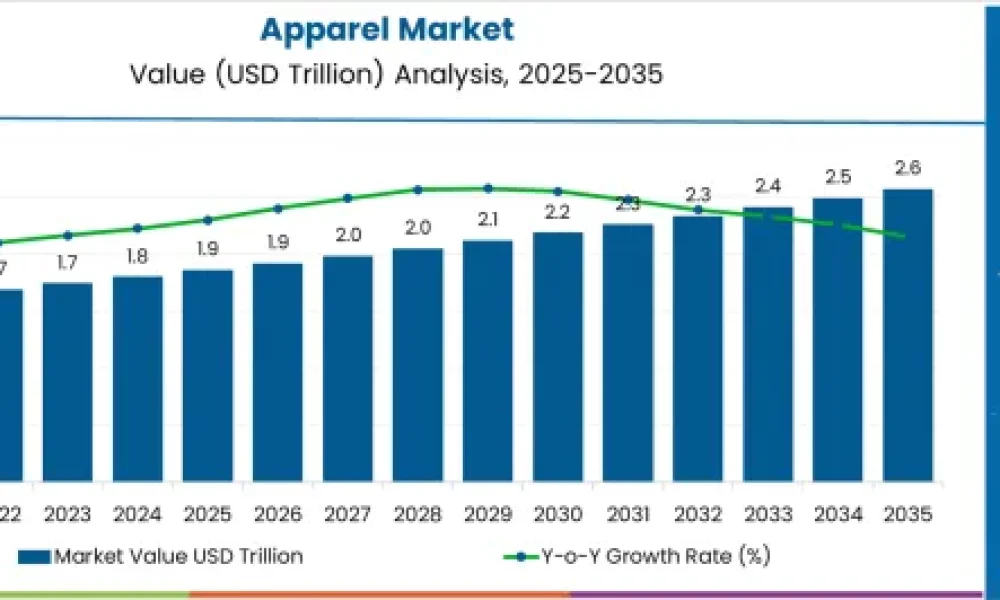
The global apparel market, valued at approximately USD 1.9 trillion in 2025, is forecasted to expand to USD 2.6 trillion by 2035, growing at a compound annual growth rate (CAGR) of 3.3%, according to the latest comprehensive market analysis. This growth is underpinned by shifting consumer behaviors, technological integration, and dynamic regional developments that are reshaping the fashion industry’s landscape over the next decade.
Explore the full market insights and exclusive data breakdowns – Request Your Sample Report Now
Apparel Market Overview:
The apparel market encompasses a diverse range of product types including top wear, bottom wear, and innerwear, segmented by materials (synthetic and natural), pricing tiers, and consumer groups (women, men, and kids). In 2025, top wear dominates the market with a 41.3% revenue share, reflecting its role as a wardrobe staple with frequent consumer purchases. Synthetic materials lead production at 53.6%, favored for their cost-efficiency and durability, while the medium price segment captures nearly half the market’s revenue, balancing quality and affordability.
From 2025 to 2030, the industry is projected to grow modestly from USD 1.9 trillion to USD 2.0 trillion, fueled by increased e-commerce adoption, fast fashion’s influence, and social commerce’s expanding role. Between 2030 and 2035, accelerated growth is expected as premiumization, sustainable sourcing, and penetration into emerging economies drive revenues from USD 2.0 trillion to USD 2.6 trillion.
Geographically, Asia-Pacific and the Middle East stand out as growth hotspots, buoyed by young populations and rising disposable incomes. North America and Europe maintain steady expansions, focusing on athleisure, sustainable fashion, and workwear redefinition.
Market Dynamics: Key Drivers and Trends
Rising Disposable Income and Evolving Fashion Consciousness
Increasing disposable incomes globally are encouraging consumers to invest more in fashion, with heightened sensitivity to brand value, trend responsiveness, and lifestyle alignment. Social media and influencer marketing amplify fashion awareness, fueling demand for frequent wardrobe updates and seasonal collections.
Changing Consumer Lifestyles and Digital Integration
Hybrid work models, wellness lifestyles, and casual dressing trends are driving athleisure and casual wear demand. Digital channels, particularly e-commerce platforms, facilitate convenience and broader access, transforming shopping behaviors. Technology innovations like virtual try-ons and AI-driven trend forecasting are poised to further personalize and streamline the shopping experience.
Supply Chain Resilience and Global Trade Shifts
The apparel industry’s dependence on global textile manufacturing hubs—primarily China, Bangladesh, and Vietnam—is evolving with trade policy shifts and supply chain diversification. Brands increasingly adopt flexible, technology-enabled supply chains to manage demand fluctuations and reduce lead times, balancing cost control with sustainability goals.
Branding and Retail Evolution
Market competition centers on brand equity, innovation, and multichannel retail strategies. From flagship stores to influencer collaborations and online marketplaces, companies seek differentiation through storytelling, exclusivity, and customer loyalty programs. Sustainability initiatives and ethical manufacturing are becoming core to brand positioning and consumer preference.
Segmental Insights: Product, Material, and Price Analysis
- Top Wear Leads Market Share
The top wear category—comprising shirts, t-shirts, blouses, and tunics—accounts for 41.3% of the market in 2025, driven by its universal appeal and high purchase frequency across demographics. - Synthetic Materials Dominate Production
Synthetic fabrics like polyester and nylon, preferred for their affordability and functional benefits, hold 53.6% of the material market share. Advances in fiber technology are addressing sustainability and comfort concerns. - Medium Price Tier Commands Revenue
Nearly half of apparel revenues stem from the medium price segment, reflecting consumer demand for value-oriented fashion that balances quality with cost-effectiveness, particularly in emerging markets.
Regional Outlook: Market Growth by Key Countries
- China leads with a 4.5% CAGR, underpinned by a massive manufacturing base and expanding domestic luxury consumption. E-commerce platforms such as Alibaba and JD.com dominate apparel sales, enhancing market reach.
- India follows closely at 4.1% CAGR, supported by rising middle-class income, urbanization, and organized retail expansion. Local and international brands benefit from growing e-commerce penetration and sustainability awareness.
- Germany projects 3.8% CAGR, fueled by premium and sustainable apparel demand, technological innovation, and regulatory support for eco-friendly textiles.
- France (3.5% CAGR) and UK (3.1% CAGR) emphasize luxury fashion and fast-fashion growth, with strong digital retail presence and sustainability initiatives.
- United States sees a steady 2.8% CAGR, with growth driven by casual and athleisure segments and increasing eco-conscious consumer behavior.
Competitive Landscape: Key Players and Market Strategies
The global apparel market is shaped by a range of influential brands:
- Nike and Adidas lead in sportswear and athleisure, leveraging innovation and global marketing.
- Inditex (Zara) excels in fast fashion through agile supply chains and trend responsiveness.
- Luxury houses like Dior, Hermes, and Kering focus on exclusivity and craftsmanship.
- Ralph Lauren and Tapestry balance aspirational branding with accessibility.
- Textile and apparel companies like Arvind Mills, Raymond, and Royal Apparel reinforce market depth with fabric innovation and sustainability.
- Niche players like Good Clothing Company and Los Angeles Apparel emphasize ethical production.
- Off-price retailer TJX Companies offers branded apparel at discounted prices globally.
These players are driving digital transformation, omnichannel expansion, and sustainability efforts to stay competitive.
Future Outlook
The apparel market’s growth trajectory through 2035 highlights resilience amid evolving consumer preferences and global economic shifts. Key factors influencing future dynamics include:
- Increasing demand for sustainable and customized apparel.
- Expanding e-commerce and digital marketing capabilities.
- Greater regional penetration in emerging markets.
- Integration of AI and technology to enhance product development and consumer engagement.
As the apparel industry adapts to lifestyle trends and technological advances, it will continue to play a pivotal role in global retail, reflecting broader socio-economic changes and consumption patterns.
About the Report
This analysis encompasses quantitative data, market segmentation by product type, material, price, consumer demographics, and geographic regions. It profiles leading companies and provides detailed insights into sales, growth drivers, competitive dynamics, and future forecasts up to 2035.
Have a specific Requirements and Need Assistant on Report Pricing or Limited Budget please contact us – [email protected]
About Future Market Insights (FMI)
Future Market Insights, Inc. (FMI) is an ESOMAR-certified, ISO 9001:2015 market research and consulting organization, trusted by Fortune 500 clients and global enterprises. With operations in the U.S., UK, India, and Dubai, FMI provides data-backed insights and strategic intelligence across 30+ industries and 1200 markets worldwide
Why Choose FMI: https://www.futuremarketinsights.com/why-fmi



