
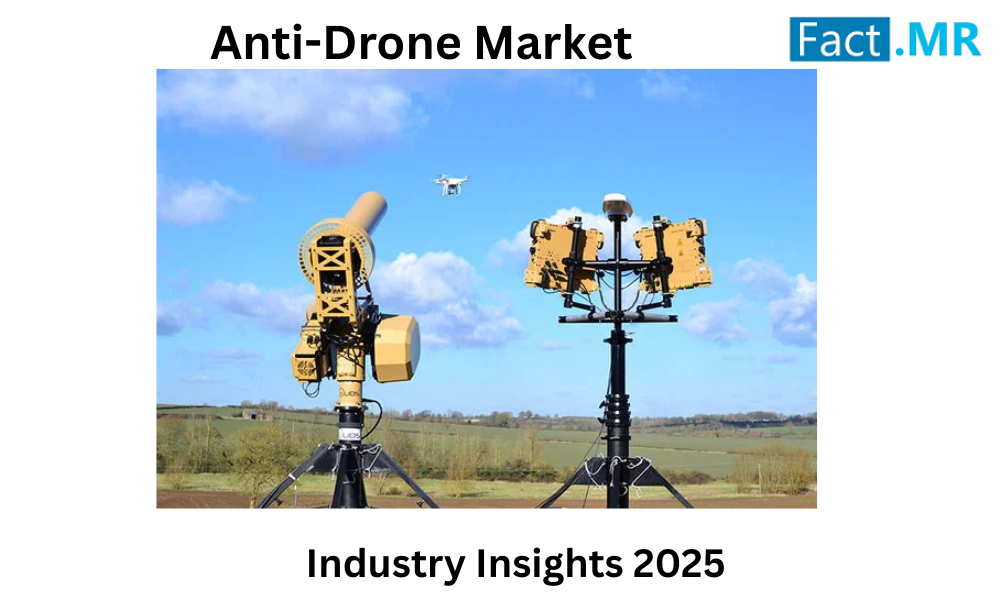
The global anti-drone market is charting a notable growth trajectory, driven by escalating concerns over unmanned aerial vehicle (UAV) misuse and heightened requirements for protective systems across sectors. In 2024, the market was valued at USD 2,311 million, and it is expected to expand at a robust compound annual growth rate (CAGR) of 15.3% between 2025 and 2035. By 2035, the market is projected to reach USD 11,066 million, nearly a fivefold increase over the decade.
This surge reflects growing awareness in both government and private sectors about drone-based threats, including espionage, smuggling, unauthorized surveillance, and potential attacks on critical infrastructure. As drone technology becomes more accessible and affordable, the need for effective detection, tracking, disruption, and neutralization systems has become increasingly urgent.
Market Drivers and Growth Catalysts:
One of the primary drivers of growth is the rampant rise in commercial and recreational drone usage. With more drones in the skies, including those flown by hobbyists, delivery services, agriculture, and surveillance, the risk of unauthorized or malicious drone activity has increased sharply. Such conditions necessitate the deployment of anti-drone systems to safeguard airports, power plants, military installations, public events, and other sensitive locations.
Another major factor pushing the market is geopolitical tension coupled with national security priorities. Governments facing threats of border infiltration, terrorism, and drone attacks are making significant investments in anti-drone technologies. Defense spending is rising globally, and counter-UAV (Unmanned Aerial Vehicle) systems are now considered essential components of modern defense infrastructure.
Technological progress in detection systems (radar, optical, RF signal detection), neutralization technologies (jamming, lasers, kinetic solutions), and the integration of AI and automation are also accelerating demand. These innovations make anti-drone systems more accurate, responsive, and adaptable to evolving threats.
Regulatory and policy changes are adding urgency to market expansion. Many countries are imposing regulations on drone flights, requiring registration, geofencing, and enforcement against unauthorized drones. This legal framework is pushing both public and private infrastructure operators to deploy anti-drone systems proactively.
Full Market Report Available for Delivery. For Purchase or Customization, Please Request Here: https://www.factmr.com/connectus/sample?flag=S&rep_id=7378
Technology, Segment Insights, and Market Composition
In 2025, electronic systems—encompassing signal jammers, RF detection, and similar technologies—are estimated to contribute USD 904 million, holding around 33.9% of market share by technology segment. The medium-range systems (1-5 km range) are expected to represent nearly 46.8% of the market in 2025, valued at about USD 1,248 million, reflecting demand for scalable systems that can cover moderately large areas such as airports and large public facilities.
Detection technologies currently dominate many deployments, but there is a gradual shift toward full detection plus disruption/neutralization solutions as threats become more sophisticated. Ground-based systems remain prevalent, though mobile, handheld, and even UAV-based counter-measures are gaining traction for their flexibility and rapid deployment capabilities.
Regional Outlook
East Asia holds a significant share of the global anti-drone market. In 2024, the region accounted for about 22.4% of the market value, and countries like China are anticipated to maintain strong growth with the same CAGR of roughly 15.3% over the forecast period. This is due to strong national investments in defense, surveillance, and expanding concerns around airspace security.
The United States remains a critical market for anti-drone systems. It is projected to grow at a CAGR of about 15.8%, driven by high levels of infrastructure at risk, airports, defense installations, and regulatory push for implementing counter-UAV measures. Other regions, including Europe and the Middle East, are also increasing adoption, especially in critical infrastructure protection, stadiums, utilities, and public venues. Emerging markets in South Asia, particularly India, are becoming more active, motivated by border security needs and rising drone incidents.
Recent Developments
Recent years have seen significant technological and strategic developments in the anti-drone market. A prominent trend has been the emergence of laser-based neutralization systems integrated with AI algorithms for precision targeting. These systems allow for non-kinetic disabling of drones without collateral damage.
Another innovation path has been cloud-connected anti-drone solutions enabling remote monitoring and control. Manufacturers are embedding IoT sensors, real-time analytics, and automated alerting to enhance situational awareness across large areas.
Governments have started conducting live-fire or field demonstrations to test combined kinetic and non-kinetic systems. For example, in 2024, several defense contractors successfully showcased counter-drone technology that blends jamming, tracking, and physical interdiction.
There is also increasing interest in modular and scalable systems that can be adapted to different ranges, threat levels, and environments. Portable detection and disruption tools, shorter-range systems for localized protection, and handheld or mobile units are gaining attention—especially for critical infrastructure and commercial venues.
Further, regulatory frameworks are tightening in many countries, requiring deployment of anti-drone systems around key infrastructure or at events; these legal mandates are acting as tailwinds for market growth.
Key Players Insights
The competitive landscape in the anti-drone market is populated by both established defense contractors and specialized counter-drone technology providers. Leading names include Leonardo S.p.A, RAFAEL Advanced Defense Systems Ltd., Northrop Grumman, Thales, Dedrone, DroneShield, D-Fend Solutions, CACI International Inc., IAI (Israel Aerospace Industries), QinetiQ, RTX, and Teledyne FLIR LLC.
These companies are investing heavily in R&D to improve detection accuracy, reduce system latency, integrate AI-based threat classification, and enhance multi-sensor fusion. Dedrone and DroneShield are especially notable for their work in urban deployments and commercial infrastructure, with solutions that combine sensors, software analytics, and cloud-based threat monitoring. Leonardo and RAFAEL are pushing forward capabilities in both laser neutralization and kinetic interception systems.
Some firms are offering turnkey solutions tailored to specific verticals—airports, utilities, energy, public safety—and customizing hardware and software configurations to meet local regulation and environment constraints. Companies are also forming partnerships with governments, defense agencies, and private infrastructure owners to deploy systems in live operational conditions and secure large contracts.
Pricing and scale remain major differentiators. Players with capabilities to deliver systems for large-range coverage, with high reliability and minimal false alarms, are commanding premium. Meanwhile, newer entrants and startups are focusing on niche offerings—compact systems, portable units, or software-centric detection/disruption tools—for commercial and residential applications.
Challenges & Restraints
Despite promising growth, several challenges exist. High upfront costs of deployment, maintenance, and integration with existing security and airspace systems pose barriers. Organizations must manage legal and regulatory issues around the use of electromagnetic interference, jamming, and signal interception, which in many jurisdictions are tightly regulated.
True effectiveness of anti-drone systems depends on accuracy and minimal false positives. Differentiating between harmless drones (e.g. hobbyists), wildlife, and threatened UAVs under varying atmospheric or environmental conditions remains technically demanding.
Another constraint is the rapid evolution of drone technology. As UAVs become faster, smaller, stealthier, and more autonomous, counter-drone systems must keep pace; otherwise, they risk obsolescence. Supply chain issues, component costs, and technology standardization across regions also affect scalability.
Future Outlook
The anti-drone market is expected to maintain strong momentum through 2035. As threats multiply and enter non-traditional domains—commercial, public venues, critical infrastructure, and major events—the adoption of anti-drone systems will spread beyond purely defense and security applications.
Integration of AI, automation, and multi-sensor detection (radar, optical, acoustic, RF) will drive more intelligent, proactive, and scalable solutions. Modular systems, cloud connectivity, and portable/distributed platforms will increase
Check out More Related Studies Published by Fact.MR:
Quantum Dot Display Market
Radiation Hardened Sensor Market
Contact:
US Sales Office
11140 Rockville Pike
Suite 400
Rockville, MD 20852
United States
Tel: +1 (628) 251-1583, +353-1-4434-232
Email: [email protected]
About Fact.MR
We are a trusted research partner of 80% of fortune 1000 companies across the globe. We are consistently growing in the field of market research with more than 1000 reports published every year. The dedicated team of 400-plus analysts and consultants is committed to achieving the utmost level of our client’s satisfaction.



