
Aluminum Die Casting Market Overview :
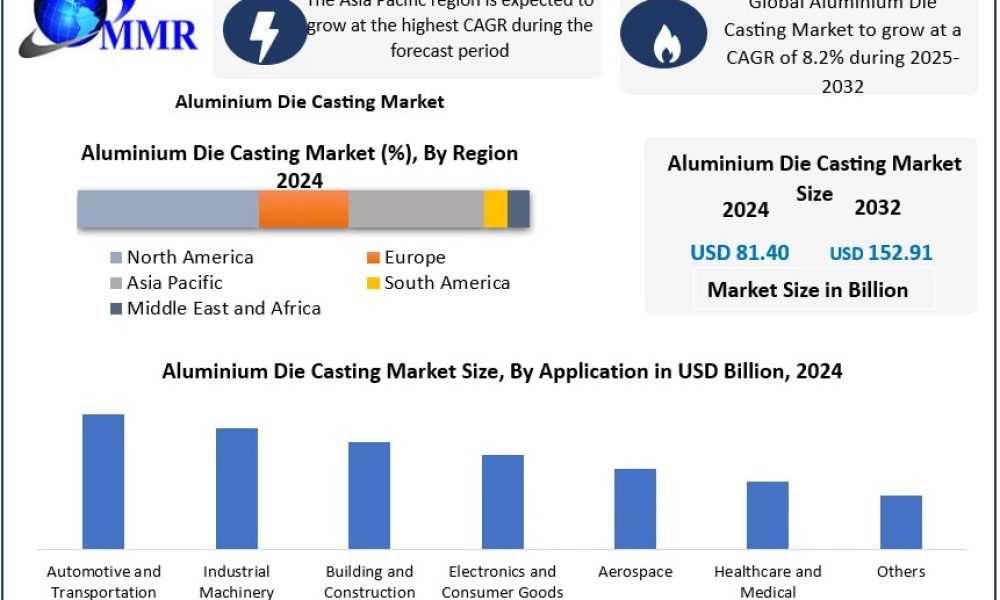
Aluminum Die Casting Market, valued at approximately USD 81.40 billion in 2024, is forecasted to grow at a strong CAGR of 8.2% through 2032, reaching nearly USD 152.91 billion. This significant growth is driven by the rising demand for lightweight and durable materials in the automotive, aerospace, electronics, and industrial machinery sectors. Asia Pacific holds the largest market share, propelled by rapid industrialization, expansion of automotive manufacturing, and technological innovations in countries like China, India, and Japan.
Market Size & Growth
Aluminum die casting is a precision manufacturing process involving injecting molten aluminum into steel molds under high pressure to produce dimensionally accurate, lightweight, and corrosion-resistant components. Its superior thermal and electrical conductivity, recyclability, and cost-efficiency for mass production make it highly preferred in multiple industries.
From a market size of USD 81.40 billion in 2024, the sector is projected to almost double by 2032 to USD 152.91 billion, expanding at a CAGR of 8.2%. This surge is largely attributable to the global automotive industry’s focus on reducing vehicle weight to meet stringent emission regulations and enhance fuel efficiency—particularly with the accelerated adoption of electric vehicles (EVs). Aluminum die-cast components, such as engine blocks, transmission housings, and EV battery housings, are becoming critical for improved vehicle performance and sustainability.
Dominating Region: Asia Pacific
Asia Pacific dominates the global aluminum die casting market due to:
- Rapid industrialization and urbanization across China, India, Japan, South Korea, and Southeast Asia.
- Highly competitive manufacturing cost structure and skilled labor availability.
- Strong governmental support and investments in automotive, aerospace, and consumer electronics sectors.
- Increasing production of lightweight automotive components to meet emissions standards.
- Strategic facility expansions like Endurance Technologies’ new low-pressure die-casting plant in India and Ningbo Xusheng Auto Technology’s high-precision aluminum die-casting facility in China.
- Collaborative technological advancements, such as Toyota Industries’ partnership with Siemens in Japan to integrate AI for defect prediction.
These factors collectively position Asia Pacific as the global hub for aluminum die casting production and innovation.
Market Segmentation
By Process:
- Pressure Die Casting dominates due to its ability to produce complex, thin-walled, and dimensionally precise components at scale.
- Other processes include Vacuum Die Casting, Squeeze Die Casting, Gravity Die Casting, and Low-pressure Die Casting.
By Application:
- Automotive and Transportation: Largest segment focused on lightweight vehicle components to improve fuel economy and reduce emissions.
- Industrial Machinery, Electronics & Consumer Goods, Aerospace, Building & Construction, Healthcare and Medical sectors also contribute significantly.
For full access to the data, request a sample report now :https://www.maximizemarketresearch.com/request-sample/133357/
Recent Developments
- May 2024: Ryobi Die Casting announced a USD 50 million expansion of its Irapuato, Mexico facility to tap into rising EV demand, adding advanced high-pressure die casting machines.
- 2024: Dynacast’s Machine Building Center in Germany introduced the A3 Al SIS hot chamber die casting machine, improving efficiency through servo-hydraulic systems and real-time process control.
- The upcoming A340 advanced die casting machine is designed to be adaptable across aluminum, zinc, and magnesium alloys, enhancing component complexity and production speed.
Market Dynamics
Growth Drivers:
- Regulatory emission standards such as Euro 7 in Europe and CAFE in North America driving lightweight part demand.
- Expansion of EV manufacturing boosting aluminum die-cast battery housings and motor components.
- Advances in automation, IoT, and AI-enabled quality control improving operational efficiencies.
- Rising demand for durable, corrosion-resistant, and thermally conductive materials in aerospace and electronics.
Challenges:
- High capital investment and tooling costs limiting entry for small and medium-scale manufacturers.
- Skilled labor shortages for advanced equipment operation and maintenance.
- Supply chain constraints due to raw material price volatility.
Key Trends
- Increasing use of recycled aluminum and sustainable manufacturing practices in line with circular economy goals.
- Emphasis on automation and digital manufacturing including robotics, AI, and real-time monitoring.
- Growing aerospace industry demand for lightweight, high-strength components.
- Shift towards multi-material designs integrating aluminum with composites for superior performance.
Competitive Landscape
Key market players include:
- Ryobi Ltd
- Endurance Technologies Ltd
- Nemak S.A.B. de C.V.
- Dynacast International
- GF Casting Solutions
- Alcoa Corporation
- Martinrea International Inc.
These companies are investing in cutting-edge technology, capacity expansions, and geographic diversification to sustain leadership and address growing automotive and industrial sector needs.
Quote
The Asia Pacific aluminum die casting market is witnessing unprecedented growth as manufacturers innovate to meet stringent emission norms and the burgeoning electric vehicle market. Advanced technology adoption and large-scale production capabilities further strengthen the region’s position as a global manufacturing hub.
The aluminum die casting market’s future is promising, shaped by the drive for lightweight, cost-effective industrial solutions and rapid technological advances. Industry 4.0 integration, continuous product innovation, and expanding global automotive demand will be critical growth pillars through 2032 and beyond.
About Us
Contact Us :




