
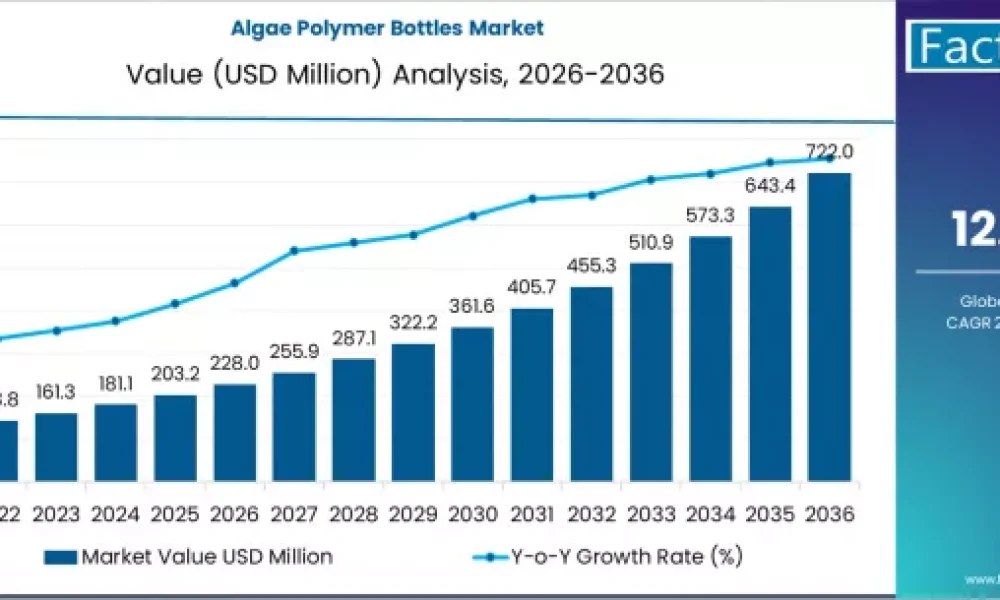
The global algae polymer bottles market is entering a phase of rapid industrialization, with its valuation projected to grow from USD 228.00 million in 2026 to USD 722.00 million by 2036. According to a comprehensive market analysis by Fact.MR, this represents a compound annual growth rate (CAGR) of 12.2%, signaling a transformative shift in the sustainable packaging landscape.
The surge is driven by a convergence of heightened regulatory pressure, such as the EU’s Single-Use Plastics Directive, and a fundamental transition in brand strategy. For industry leaders and investors, algae-based polymers represent more than just a “green” alternative; they offer a unique technical solution to the plastic crisis: true marine biodegradability and active carbon sequestration.
Summary Table: Market at a Glance
| Metric | Details |
| Market Value (2026) | USD 228.00 Million |
| Forecast Value (2036) | USD 722.00 Million |
| Projected CAGR | 12.2% |
| Leading Segment | Water & Functional Beverages (38.0%) |
| Leading Material | Algae-Based Polymers & Blends (52.3%) |
| Fastest Growing Region | India (13.1% CAGR) |
To Access the Complete Data Tables & in-depth Insights, Request a Discount on this report: https://www.factmr.com/connectus/sample?flag=S&rep_id=13542
Core Market Dynamics: Answering the Strategic ‘How’ and ‘Why’
Traditional bioplastics, such as PLA, often require industrial composting facilities to degrade. In contrast, algae-based formulations are being engineered for marine-safe breakdown, addressing the critical “leakage” of plastic into aquatic ecosystems.
Who is leading? Major players including Loliware, ALPLA, Kingfa Bio, and Danimer Scientific are at the forefront of bio-resin R&D, focusing on high-volume extrusion and blow molding technologies.
What is the primary material? Algae-based polymers and blends now command a 52.3% share of the material segment. To achieve the mechanical strength required for commercial bottling, these are often blended with other bio-based carriers like PHA.
Where is the growth? India is emerging as the fastest-growing market with a 13.1% CAGR, followed closely by China at 12.2%. In the West, the USA (10.0% CAGR) and Germany (8.2% CAGR) are leading through strict chemical regulations and federal funding for low-carbon bioproducts.
Sector Insights: Water and Functional Beverages Take the Lead
The demand for algae polymer bottles is most acute in the Water & Functional Beverages sector, which is projected to hold a 38.0% market share by 2026. This highly visible, consumer-facing category is under immense pressure to eliminate petroleum-derived resins.
“Algae’s carbon sequestration during its growth phase allows brands to claim a tangible reduction in their packaging’s carbon footprint,” states the report. “This is becoming a key differentiator for FMCG brands required to meet stringent ESG and Scope 3 emissions reporting standards.”
Key Market Trends and Future Outlook
1. Optimization through Bio-Polymer Blends
Pure algae polymers face challenges in mechanical processability. Consequently, the market is shifting toward Algae-Based Polymers & Blends, which currently account for over half of all commercial efforts. These blends ensure that eco-friendly bottles can be processed using existing “drop-in” manufacturing infrastructure, reducing the CAPEX required for transition.
2. Technological Maturation in Extrusion
Bio-polymer extrusion and blow molding technologies hold a dominant 51.3% share of the technology segment. Advancements in these processes are allowing for the production of “Small Bottles” and “Cosmetic Jars” with barrier performance levels that rival traditional PET.
3. Regulatory and Certification Tailwinds
With the USDA and EU-funded circular bio-economy initiatives providing subsidies, the barrier to entry for large-scale cultivation is lowering. Advanced certifications in marine biodegradability are now the “gold standard” for manufacturers looking to capture the premium eco-packaging segment.
Investment Perspective: Absolute $ Opportunity
The market is characterized by a “stable acceleration” phase. Between 2026 and 2036, the absolute dollar opportunity is significant for companies specializing in bio-resin processing and specialty algae extraction. As understanding of algae’s nutritional and structural complexity advances, the integration of these materials into mainstream FMCG packaging is expected to become a cornerstone of the circular economy.
Have specific requirements or need assistance on report pricing or have a limited budget? Please contact [email protected]
About Fact.MR:
Fact.MR is a global market research and consulting firm, trusted by Fortune 500 companies and emerging businesses for reliable insights and strategic intelligence. With a presence across the U.S., UK, India, and Dubai, we deliver data-driven research and tailored consulting solutions across 30+ industries and 1,000+ markets. Backed by deep expertise and advanced analytics, Fact.MR helps organizations uncover opportunities, reduce risks, and make informed decisions for sustainable growth



