
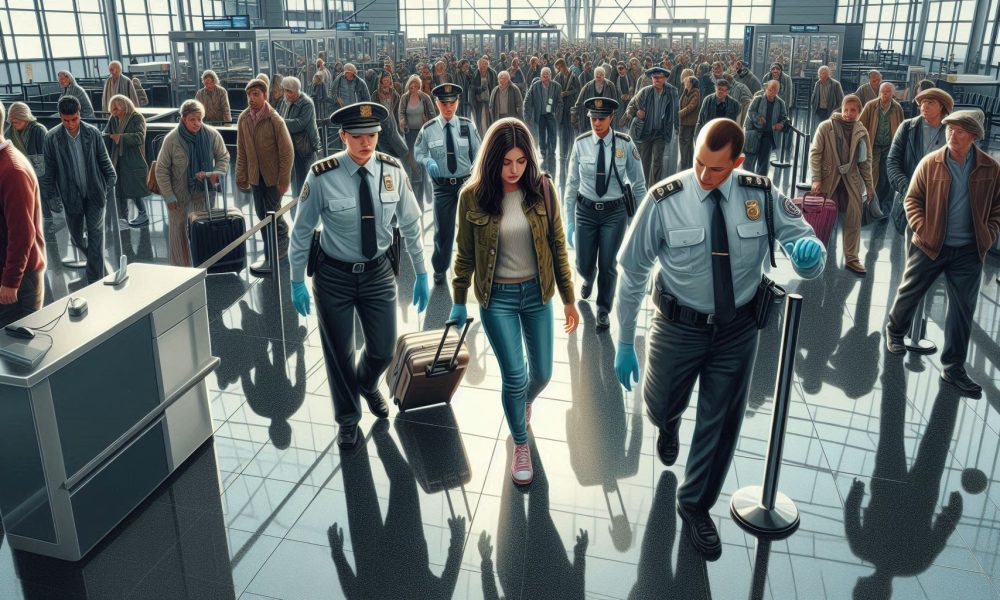
She was captured at passport control, trying to board a one-way flight to Vietnam, a country with no extradition treaty with the United States.
WASHINGTON, DC, April 9, 2026.
The great escape almost always looks easier in the imagination than it does under airport lighting.
In the imagination, the suspect slips out before dawn, glides through first class, disappears into some distant country, and turns legal trouble into a problem for somebody else. The airport becomes a gateway. The passport becomes a shield. The boarding pass becomes permission to outrun consequences. That is how flight sells itself in the mind of people under pressure. Movement feels like control. Distance feels like safety. Departure feels like power.
Then the police arrive before takeoff, and the whole fantasy dies at the gate.
That is why the Donna Adelson arrest still hits so hard. It was not a jungle raid. It was not a years-long hunt ending in some obscure foreign villa. It was an airport takedown, fast, visible, humiliating, and devastating in its symbolism. She was arrested at Miami International Airport in November 2023 while preparing to leave on one-way tickets tied to a route to Vietnam, with Dubai in the itinerary, just days after her son Charlie Adelson had been convicted in the murder-for-hire case over the 2014 killing of Florida State law professor Daniel Markel. Prosecutors believed the timing mattered. The destination mattered. The one-way nature of the trip mattered. And the airport, as it so often does in near-fugitive cases, became the place where the illusion of escape ran headfirst into state power.
This was not a Red Notice thriller.
That point matters because the internet loves to turn every airport arrest into a glamorous Interpol story. It sounds better. It sounds bigger. It makes the whole thing feel like some international cat-and-mouse game where a global alert flashes red on a border officer’s screen, and the suspect freezes in dramatic slow motion.
That is not what made this case so powerful.
The real story was more direct and, in some ways, more brutal. Authorities were not waiting for some exotic international mechanism to light up. They were already closing in. Prosecutors believed they had enough to move, and when they learned about the imminent one-way departure, the airport became a deadline. This was not a case of someone being discovered by surprise while trying to travel. It was a case of travel itself becoming the trigger for action. The booking was not just a booking. It was a signal. It told prosecutors that hesitation could become a mistake.
That is what makes airport captures so frightening to anyone thinking about flight. You are never as private as you think you are once your escape plan becomes a ticket.
The airport is where fantasy turns into paperwork.
This is the truth that collapses so many escape dreams. Airports are not zones of freedom. They are tightly managed funnels built around identity, timing, manifests, routes, records, cameras, and decision points. Every traveler becomes legible at an airport. Your destination is declared. Your timing is fixed. Your name is attached to movement. Your passport is no longer just an object you possess. It becomes a piece of evidence that can place you, identify you, and tie your intent to an itinerary.
That is why airport arrests feel so total.
They do not just stop the body. They reverse the meaning of every object the traveler is carrying. The passport stops being a symbol of mobility and becomes proof of planned departure. The one-way ticket stops looking like convenience and starts looking like intent. The foreign destination stops sounding like travel and starts sounding like a problem the prosecutors did not want to let happen.
In a few seconds, the whole emotional architecture of departure flips.
The person who believed they were leaving now understands they are not going anywhere. The person who thought they still had agency suddenly has none. That is why airport takedowns feel uniquely savage. They strip escape down to its most humiliating form, a plan interrupted before it can even become a story.
The timing made the Donna Adelson arrest look even worse.
Context is everything in a case like this. It was not just that she was traveling internationally. It was when she was traveling.
Her son, Charlie Adelson, had just been convicted one week earlier in the Daniel Markel murder case. That detail gave the trip a harsh new meaning. Under ordinary circumstances, wealthy people flying internationally is not remarkable. In the immediate aftermath of a conviction tied to the same murder plot, a one-way route toward a country without a U.S. extradition treaty looks very different. It looks urgent. It looks strategic. It looks like somebody reading the room and deciding not to stay around for the next move.
Even before any jury heard an argument, the optics were catastrophic.
Because judges and prosecutors do not see a neutral vacation when the surrounding facts are this hot. They see timing. They see risk. They see the possibility that if they wait, the case will get exponentially harder. That is the power of airport evidence in a live criminal matter. It compresses interpretation. People do not need a long speech to understand why one-way tickets out of the country, right after a family member’s conviction, toward a non-extradition destination might alarm prosecutors.
The scene almost explains itself.
Vietnam mattered because geography matters.
The destination was not a random detail. It was central to the fear surrounding the trip.
Vietnam does not have an extradition treaty with the United States. That meant any successful departure carried the possibility of turning a domestic criminal case into a much messier international problem. Once someone reaches a country where formal extradition tools are weak or absent, everything changes. Prosecutors no longer have the same clean leverage. Diplomacy starts to matter. Timing starts to matter more. Public pressure can drift. A defendant with resources can become a far more expensive and complicated problem to retrieve.
That is why authorities so often act before the plane leaves the ground.
A suspect at a U.S. airport is still physically inside the system. The arrest is clean. The authority is local. The body is reachable. The chain of custody is simple. Once that person lands elsewhere, especially somewhere without easy return mechanisms, the geometry changes fast.
The public often imagines the great escape beginning after takeoff. In reality, prosecutors treat takeoff as the last moment to stop the problem from multiplying.
Airport captures are powerful because they undermine the idea of control.
Until the officers step in, travel still feels like a personal choice. Bags are packed. The car ride is done. The terminal has been entered. The passport has been presented. The gate feels close. The suspect may still believe that if they can just cross one more threshold, they can buy themselves space, time, or leverage.
Then they are stopped.
That is the moment airport captures become psychologically devastating. The thing that was supposed to carry the suspect away becomes the very thing that exposes them. The departure gate becomes a trapdoor. The terminal becomes a stage. The suspect does not merely lose freedom. They lose the emotional story they had been telling themselves about freedom.
That is why the Donna Adelson image stuck. It is easy to picture, easy to understand, and impossible to dress up. A wealthy Florida matriarch with one-way international tickets, arrested at the airport days after her son’s murder conviction, before she could get out. It is the kind of scene prosecutors love because it tells a complete story without needing much help.
The Daniel Markel case gave that airport moment enormous weight.
This was never going to be a simple travel case because the murder investigation around it had already become one of the most-watched and emotionally loaded criminal matters in Florida.
Daniel Markel was a Florida State University law professor, a legal scholar, a father, and the victim of a 2014 murder that prosecutors said grew out of a bitter family conflict over custody and relocation after his divorce from Wendi Adelson. Over the years, the case widened and hardened. The hitmen were convicted. The intermediaries were convicted. Charlie Adelson was convicted. Then the state turned more directly toward Donna Adelson.
That is why the airport stop mattered so much. It did not happen in a vacuum. It happened inside a murder-for-hire prosecution that had already consumed multiple defendants and years of litigation. By the time Donna Adelson reached the airport, the case was no longer theory. It was a machine already grinding through convictions.
That gave the arrest a grim logic.
If prosecutors already believed the net was tightening, then an attempted one-way international departure was not just suspicious. It was potentially intolerable. They were not looking at a woman casually taking a long trip. They were looking at the possibility that a major defendant might be about to insert geography between herself and the state.
No prosecutor wants to explain later that they saw the tickets and did nothing.
Airports are choke points, not exits.
This is one of the most important lessons in modern fugitive and near-fugitive cases. People still romanticize international flights because they think in maps. They imagine borders, oceans, and foreign cities. But the state thinks in bottlenecks.
And airports are among the most perfect bottlenecks ever built.
A person cannot quietly board an international flight the way they might quietly drive across town. Airports require structure. You must identify yourself. You must appear in person. You must move through monitored physical space. You must attach yourself to a route and a schedule. That makes airports beautiful places for prosecutors and miserable places for people hoping to leave without interference.
In that sense, Donna Adelson’s arrest was not unusual in its mechanics, even if it was extraordinary in its notoriety. Airports repeatedly become the place where plans collapse because organized travel requires exposure. Once intention becomes itinerary, the suspect is no longer just thinking about leaving. They are actively legible as someone leaving.
That is often all the state needs.
Routine travel becomes dangerous when the traveler is already under the microscope.
Most people experience airports as an inconvenience. Delays. security lines. baggage issues. gate changes. But for somebody facing real investigative or prosecutorial pressure, the airport is something else entirely. It is a place where every choice becomes heavier. One-way or round-trip. Domestic or international. Checked baggage or none. Departure now or later. Companion traveling or not. Payment method. Routing. Destination. Every detail can be interpreted.
And once law enforcement is paying attention, ordinary travel choices are no longer ordinary.
That is what makes these cases so merciless. A suspect can still tell themselves the trip is explainable. The state can look at the exact same facts and see flight risk. The suspect may think they are being smart. The prosecutor may think they are watching the first move of an escape attempt. The airport is where those competing narratives collide in public.
Donna Adelson’s trip became exactly that kind of collision. What may have felt to the travelers like movement became, in the hands of the state, a documented threat to the case.
The one-way ticket is one of the most poisonous details in any airport arrest.
There is something almost theatrically bad about a one-way ticket when prosecutors are already circling. It suggests finality. It suggests no immediate plan to come back. It suggests intention to go forward, not just outward. In many cases, that detail may still be explained away. People buy one-way tickets for all kinds of reasons.
But criminal cases are about context, not isolated facts.
And in this context, the one-way nature of the route was devastating. It did not stand alone. It sat next to the timing of Charlie Adelson’s conviction. It sat next to the murder-for-hire allegations. It sat next to the non-extradition destination. It sat next to the state’s growing belief that Donna Adelson was not simply adjacent to the case, but inside it.
That is why the one-way ticket did so much damage. It was not evidence in the abstract. It was evidence inside a much darker story.
The airport stop became even more important once the case moved forward.
Later developments made the airport moment feel even more consequential. Donna Adelson was eventually tried, convicted, and sentenced to life without parole on the murder count, along with additional consecutive time on related counts. That later outcome throws new light backward onto the airport scene. What looked in late 2023 like a dramatic but still developing arrest now reads as the moment prosecutors prevented the case from becoming harder, messier, and more international than it needed to be.
In hindsight, the airport was the state’s cleanest shot.
If she had left successfully, everything after that might have been slower, more expensive, more political, and more uncertain. Instead, Miami became the hinge. The terminal became the place where prosecutors kept the case domestic, controlled, and within reach.
That is why airport arrests matter so much to prosecutors. They preserve simplicity in cases that are about to become complicated.
The larger lesson is not about Donna Adelson alone. It is about escape psychology.
People under pressure often overrate motion. They think movement itself is a solution. They imagine that if they can just get to the airport, clear security, and get into the air, they have transformed the problem. But travel does not erase criminal exposure. It often intensifies it, because travel creates records, witnesses, timestamps, and routes that can be acted upon in real time.
That is why so many escape fantasies fail in airports. The suspect believes they are entering freedom. The state sees a last clear window to act.
And once the officers move, the airport becomes a devastating stage. Everything is public enough to feel humiliating. Everything is structured enough to make the arrest clean. Everything the suspect thought would help them leave now helps explain why they were stopped.
It is one of the coldest reversals in criminal procedure.
This is why the airport is one of the worst possible places to try to outrun a tightening case.
At home, a suspect can still feel private. In a car, they can still feel invisible. In a family conversation, they can still imagine that the plan belongs only to them. At an airport, that privacy evaporates. Movement has become official. Documents have become active. The route has become knowable. Time has become exact.
That is what happened here. Whatever personal story Donna Adelson may have told herself about the trip, by the time she reached Miami International, the plan had entered a system that prosecutors could read and interrupt. That is why the takedown feels so vivid even now. It reminds people that the edge of departure is often the least free moment in the whole process.
Not because airports are dramatic, but because they are administrative.
And administration is where the state is strongest.
The brutal truth is that many escape plans die before takeoff.
Not because they are foolish in theory, but because the airport reveals them too clearly. The suspect has made the idea real. The ticket exists. The passport is presented. The route is fixed. The destination carries meaning. The body is physically available. If prosecutors are already prepared to move, there may never be a better moment.
That is what makes the Donna Adelson story such a clean example of how routine travel can turn into a public takedown. It was not some exotic manhunt. It was a legal system recognizing movement as risk and deciding not to let the plane solve the suspect’s timing problem.
The lesson is brutally simple. In high-stakes criminal cases, an airport is not always an exit. Sometimes it is the trap. And once the trap closes, every symbol of freedom, the passport, the ticket, the gate, the destination, gets repackaged as evidence that the state acted just in time.




