
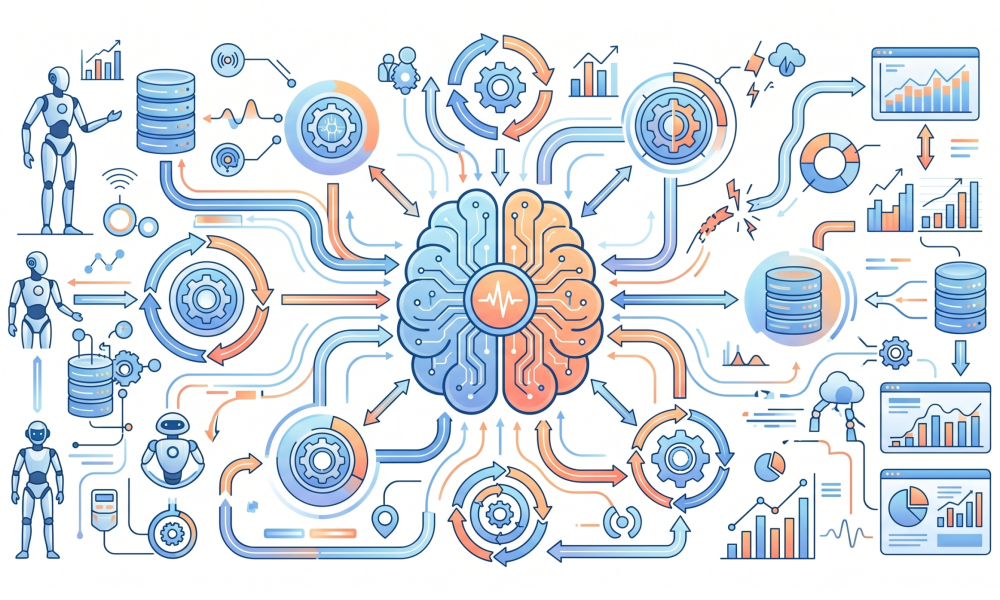
The current discourse around AI agents is heavily weighted toward capability. Attention is focused on reasoning frameworks, tool usage, orchestration layers, and model performance. These are all necessary components, but they obscure a more fundamental constraint that is beginning to surface as agentic systems move from experimentation into production.
AI agents are only as effective as the data they can access, and more importantly, how quickly and reliably they can access it.
This introduces a systems problem that is not being adequately addressed. While models are improving and orchestration layers are becoming more sophisticated, the underlying data infrastructure remains largely static. The assumption that agents can operate effectively across fragmented, latency-prone, and inconsistently synchronized data environments is increasingly untenable.
The result is a growing mismatch between agent capability and operational reality.
Agents are designed to act autonomously, to make decisions, and to execute workflows across multiple systems. In practice, these systems are distributed across cloud environments, on-prem infrastructure, and edge locations. Data is often siloed, updated asynchronously, and subject to varying access controls and latency conditions.
Under these constraints, agent performance degrades.
The issue is not that agents cannot reason. It is that they cannot reliably access the state of the system they are meant to operate within. Decision quality depends on data freshness, execution speed is constrained by network latency, and consistency is difficult to maintain across distributed operations.
This is where the concept of data flow becomes critical.
In traditional architectures, data flow is treated as a secondary concern. Systems are designed around storage and retrieval, with movement handled through batch processes, APIs, or event streams. These mechanisms are sufficient for human-driven workflows, where delays can be tolerated and inconsistencies can be resolved manually.
They are not sufficient for autonomous systems.
AI agents require continuous, low-latency access to synchronized data across environments. They need to operate on a coherent view of the system state, regardless of where that data originates. This requirement introduces a new layer of infrastructure that is not currently standard in most enterprise architectures.
Replication.
Not replication in the traditional sense of backup or disaster recovery, but continuous, intelligent replication designed to support active workloads. This form of replication operates at the level of data changes, propagating updates across environments in near real time. It ensures that multiple systems maintain a consistent state without requiring centralized control.
The absence of this layer is a primary constraint on agent deployment.
A detailed examination of cyber-resilient data architectures highlights how continuous replication is already being used to support real time operations in environments where consistency and availability are critical. As discussed in this analysis of continuous replication as a resilience standard, the shift toward real time data synchronization is driven by the need to maintain operational continuity under dynamic conditions.
This same requirement applies directly to AI agents.
Agents operate within dynamic environments. They respond to events, update systems, and trigger actions that may have cascading effects. If the underlying data is not synchronized, these actions can produce inconsistent or incorrect outcomes. This is not a theoretical concern. It is a practical limitation that becomes more pronounced as agent complexity increases.
The problem is compounded by the distributed nature of modern infrastructure.
Enterprises are no longer operating within a single environment. Data is generated and consumed across multiple locations, each with its own latency characteristics and access constraints. Agents that operate across these environments must be able to access and update data without introducing delays or inconsistencies.
This requires a different approach to data architecture.
Instead of treating data movement as a periodic task, it must be integrated into the system’s operational fabric. Changes must be propagated continuously, ensuring that all environments maintain an up-to-date view of the system state. This is the role of intelligent replication.
A complementary perspective on infrastructure evolution shows how replication is becoming the foundation of digital resilience, particularly in environments that require continuous operation and rapid response to change. As outlined in this examination of replication as the engine of resilience, maintaining synchronized data across systems is a prerequisite for reliable operations.
For AI agents, this is not optional.
Without synchronized data, agents cannot operate effectively. Their decisions are based on incomplete or outdated information, their actions may conflict with concurrent processes, and their ability to coordinate across systems is limited.
This introduces a ceiling on agent performance that is independent of model capability.
Improving the model does not solve the problem. Enhancing orchestration does not solve the problem. The limitation is infrastructural.
Replication addresses this limitation by providing a consistent data layer across environments.
By maintaining synchronized copies of data, replication enables agents to operate as if they are interacting with a single, unified system, even when the underlying infrastructure is distributed. This abstraction simplifies agent design and improves reliability.
However, implementing this layer introduces its own challenges.
Consistency must be maintained across replicas. Conflicts must be detected and resolved. Data integrity must be preserved under concurrent updates. These challenges are non-trivial, particularly at scale.
They require sophisticated synchronization mechanisms, robust conflict resolution strategies, and comprehensive monitoring systems.
Despite these complexities, the benefits are substantial.
Agents operating on synchronized data can make more accurate decisions, execute actions more reliably, and coordinate more effectively across systems. This translates into improved performance, reduced error rates, and greater operational efficiency.
It also enables new use cases.
With reliable data flow, agents can operate in real time across distributed environments. They can manage workflows that span multiple systems, respond to events as they occur, and adapt to changing conditions without manual intervention.
This is the foundation of autonomous enterprises.
An autonomous enterprise is not defined solely by the presence of AI agents. It is defined by agents’ ability to operate effectively within the organization’s systems. This requires not only intelligent models but also an infrastructure that supports continuous, reliable data flow.
Replication is a key component of that infrastructure.
It provides the mechanism for keeping data consistent across environments, enabling agents to operate on a coherent view of the system state. It reduces the latency associated with data access and minimizes the risk of inconsistencies.
This is particularly important in environments where decisions have immediate consequences.
In financial systems, delays or inconsistencies can result in incorrect transactions or risk assessments. In supply chain operations, they can lead to inventory mismatches or logistical errors. In customer-facing applications, they can degrade user experience and erode trust.
In all of these cases, the ability to maintain synchronized data is critical.
As AI agents become more prevalent, the importance of this capability will increase.
Organizations that fail to address data flow will encounter limitations in agent performance that cannot be resolved through model improvements alone. Those who invest in replication and data synchronization will be better positioned to leverage the full potential of autonomous systems.
This represents a shift in how AI infrastructure is conceptualized.
The focus is moving from models and algorithms to systems and data. From isolated components to integrated architectures. From static data stores to dynamic data flows.
Replication sits at the center of this shift.
It enables the continuous movement of data across environments, ensuring that systems remain synchronized and responsive. It provides the foundation for reliable, real time operations.
And it bridges the gap between agent capability and operational reality.
In this context, replication is not an optimization.
It is a requirement.



