

Advanced Building Materials Market Analysis (2021–2031)
Advanced Building Materials Market Overview
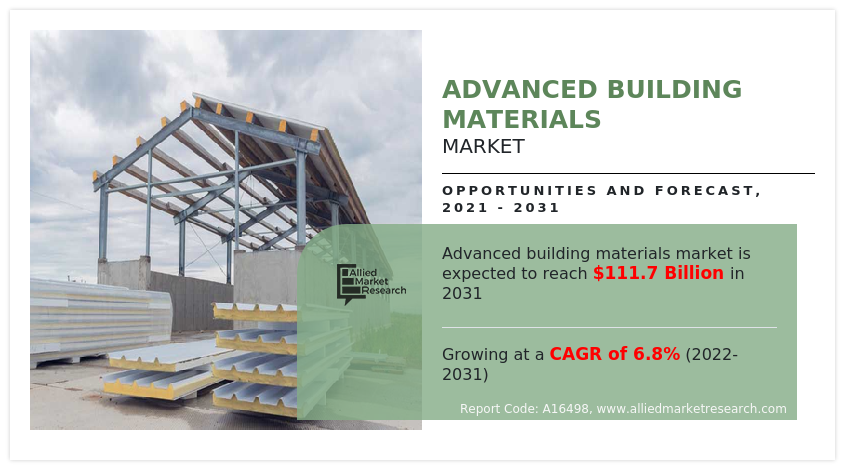
The global advanced building materials market is poised for significant growth, expanding from $56.7 billion in 2021 to $111.7 billion by 2031 at a CAGR of 6.8%. These materials, designed for sustainability and enhanced performance, are integral to modern construction, supporting infrastructure like roads, tunnels, and buildings. The market is driven by increasing government investments in infrastructure, rapid urbanization, and innovations in manufacturing technologies. Despite challenges like high costs and the impact of the COVID-19 pandemic, opportunities in eco-friendly materials and emerging markets are expected to propel growth.
𝐃𝐨𝐰𝐧𝐥𝐨𝐚𝐝 𝐏𝐃𝐅 𝐒𝐚𝐦𝐩𝐥𝐞 𝐂𝐨𝐩𝐲@ https://www.alliedmarketresearch.com/request-sample/A16498
Advanced Building Materials Market Dynamics
Drivers
- Infrastructure Development and Urbanization: The global population is projected to grow by approximately two billion by 2040, with urban areas expanding by 46%, according to estimates. This surge drives demand for infrastructure, including roads, subways, and commercial buildings. Advanced materials like ready-mix concrete and precast products reduce construction time significantly. For example, in February 2020, a road in Nagpur, India, was built in six hours using precast concrete pavement, compared to 8–10 days with traditional methods. Similarly, Gage Brothers Concrete Products constructed a 440,000 sq. ft. N95 manufacturing facility in 52 days in January 2021 using precast components.
- Technological Advancements: Innovations in manufacturing technologies enhance the performance and sustainability of advanced building materials. Companies like Kingspan Group are expanding their offerings through acquisitions, such as the September 2021 acquisition of Ondura, which bolstered its roofing and waterproofing portfolio in Europe and North America. Such developments drive market growth by improving material efficiency and application versatility.
- Demand for Cost-Effective Solutions: The need for reduced construction time and costs fuels the adoption of advanced materials. Products like wall cladding, concrete bricks, and sealants streamline construction processes, making them highly sought after in both residential and infrastructure projects.
Challenges
- High Costs: Advanced building materials and the machinery required for their application are expensive, limiting adoption among customers who do not need continuous or long-term use. This high cost impedes market growth, particularly in price-sensitive regions.
- Competition from Eco-Friendly Alternatives: Green materials, which are entirely eco-friendly and emit no harmful gases, pose a competitive challenge. These alternatives appeal to environmentally conscious consumers and regulators, restraining the growth of technically advanced materials.
- COVID-19 Impact: The pandemic disrupted production and demand in 2020, with lockdowns halting construction activities in major markets like China, the U.S., Germany, Italy, and the UK. This significantly impacted the advanced building materials market, though recovery began by late 2022 as construction resumed.
𝐄𝐧𝐪𝐮𝐢𝐫𝐞 𝐁𝐞𝐟𝐨𝐫𝐞 𝐁𝐮𝐲𝐢𝐧𝐠@ https://www.alliedmarketresearch.com/purchase-enquiry/A16498
Opportunities
- Emerging Markets: Rapid urbanization in Asia-Pacific and LAMEA regions offers significant growth potential. Infrastructure projects in countries like India and Jamaica, such as CEMEX’s 2022 expansion of its Jamaica cement plant, highlight increasing demand for advanced materials.
- Sustainable Materials: The shift toward eco-friendly materials, driven by environmental regulations and consumer awareness, creates opportunities for green building materials that reduce energy consumption and emissions.
- Collaborations and Investments: Partnerships, such as BASF’s 2022 MoU with GS Engineering for carbon capture solutions, and investments, like Saint-Gobain’s $320 million commitment in India in 2021, enhance market growth by fostering innovation and scalability.
Advanced Building Materials Market Segmental Overview
By Type
The market is divided into green materials and technically advanced materials:
- Green Materials: Expected to grow at the highest CAGR due to their non-toxic, eco-friendly properties, which reduce energy costs and improve occupant health.
- Technically Advanced Materials: Held the largest share in 2021, driven by advancements in material technology, structural analysis, and design procedures, supporting robust construction applications.
By Material
The market is segmented into advanced cement and concrete, cross-laminated timber (CLT), structural insulated panels (SIPs), sealants, and others:
- Advanced Cement and Concrete: Dominated in 2021, offering high-strength and self-consolidating properties for durable construction.
- Sealants: Projected to grow at the highest CAGR, driven by their role in blocking fluid passage in buildings and infrastructure, enhancing structural integrity.
- Cross-Laminated Timber (CLT): A prefabricated, sustainable material gaining traction for its strength and environmental benefits.
- Structural Insulated Panels (SIPs): High-performance systems for residential and light commercial use, offering energy efficiency.
- Others: Includes advanced fire protection materials, paints, and waterproofing solutions, contributing to market diversity.
By Application
The market is categorized into building construction and infrastructure:
- Building Construction: Held the largest share in 2021, driven by the use of advanced materials in residential, commercial, and industrial buildings to enhance structural integrity.
- Infrastructure: Expected to grow at the highest CAGR, fueled by demand for roads, tunnels, and public facilities in urbanizing regions.
By Region
The market is analyzed across North America, Europe, Asia-Pacific, and LAMEA:
- Asia-Pacific: Garnered the highest revenue in 2021, driven by rapid urbanization and infrastructure projects in China, India, and South Korea.
- LAMEA: Projected to grow at the highest CAGR, supported by increasing construction in Latin America, the Middle East, and Africa.
- North America: Benefits from steady demand in the U.S. and Canada, though growth is moderated by market maturity.
- Europe: Supported by sustainable construction trends and acquisitions like Kingspan’s purchase of Troldtekt A/S in 2022.
𝐔𝐩𝐝𝐚𝐭𝐞 𝐎𝐧 𝐃𝐞𝐦𝐚𝐧𝐝@ https://www.alliedmarketresearch.com/request-for-customization/A16498
Competitive Landscape
Key players include:
- Saint-Gobain Group
- DowDupont Inc.
- Kingspan Group Plc
- PPG Industries Inc.
- BASF SE
- APV Engineered Coatings Inc.
- Cemex
- Knauf Gips KG
- Oerlikon Balzers Coating India Limited
- Sherwin-Williams Company
These companies employ acquisitions, partnerships, and expansions to strengthen their portfolios. For example, Sherwin-Williams acquired AquaSurTech and Sika AG’s European industrial coatings business in 2022, while Knauf invested over €200 million in Romania to expand mineral wool production.
Regional Analysis
- Asia-Pacific: Leads due to rapid urbanization and projects like India’s precast concrete road construction.
- LAMEA: Emerging markets show high growth potential, with investments like CEMEX’s Jamaica plant expansion.
- North America: Steady growth driven by infrastructure upgrades, particularly in the U.S.
- Europe: Benefits from sustainable construction and acquisitions, such as Kingspan’s Ondura purchase.
Future Outlook
The advanced building materials market is set to double in value by 2031, driven by urbanization, infrastructure investments, and sustainable innovations. Emerging markets and eco-friendly materials will play a pivotal role in sustaining growth.
Key Benefits for Stakeholders
- Market Insights: Quantitative analysis of trends, segments, and forecasts from 2021 to 2031.
- Growth Opportunities: Identifies potential in emerging markets and green materials.
- Competitive Analysis: Profiles of key players and their strategies aid strategic planning.
- Regional Insights: Highlights high-growth regions like LAMEA and Asia-Pacific.
The global advanced building materials market is poised for robust growth, reaching $111.7 billion by 2031. Urbanization, technological advancements, and sustainability trends drive demand, while challenges like high costs are mitigated by opportunities in emerging markets and eco-friendly innovations.




