

Adaptive Robotics Market Analysis 2021-2030
Adaptive Robotics Market Overview
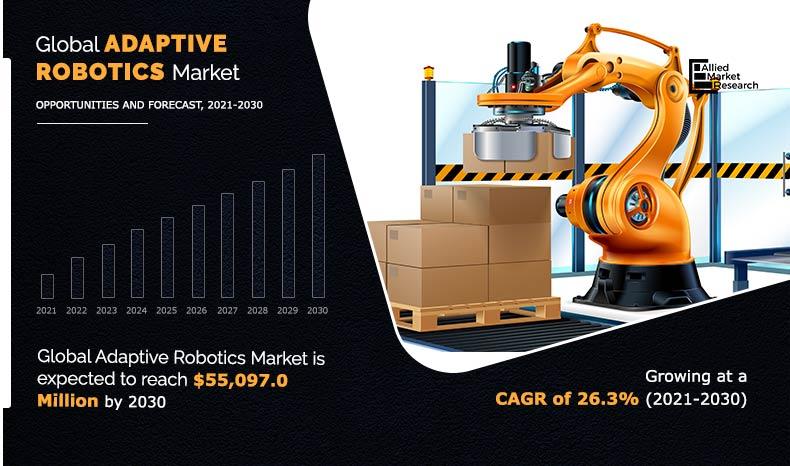
The adaptive robotics market, valued at $4,974.3 million in 2020, is expected to grow to $55,097.0 million by 2030, with a CAGR of 26.3%. Adaptive robots utilize AI and Industry 4.0 technologies to sense and adapt to their environment, enhancing productivity and decision-making. They are widely used in industries such as automotive, electronics, pharmaceuticals, and food and beverage, driving market expansion through automation and innovation.
𝐃𝐨𝐰𝐧𝐥𝐨𝐚𝐝 𝐏𝐃𝐅 𝐒𝐚𝐦𝐩𝐥𝐞 𝐂𝐨𝐩𝐲@ https://www.alliedmarketresearch.com/request-sample/4008
Adaptive Robotics Market Dynamics
Key Drivers
The growth of the adaptive robotics market is fueled by several factors:
Increasing Industrial Applications
The rising adoption of collaborative and industrial robots in sectors like automotive, medical, and electronics is a primary driver. Adaptive robots excel in dynamic environments, adjusting their operations based on real-time changes, which enhances efficiency and productivity. For instance, in the automotive industry, these robots streamline assembly and handling tasks, reducing human effort and errors.
Automation in Manufacturing
The global trend toward automation in manufacturing has significantly boosted demand for adaptive robotics. These systems enable faster production cycles, improved precision, and reduced labor costs. The integration of Internet of Things (IoT) technologies further enhances their capabilities, allowing for real-time monitoring and predictive maintenance, which optimizes manufacturing processes.
Government Investments and Infrastructure Development
Increased government spending on infrastructure and robotics development supports market growth. For example, Thailand’s infrastructure plan from 2016 to 2020, with a further commitment of $58.5 billion by 2025, has spurred demand for automation in construction and manufacturing. Similarly, Italy’s 21.7% increase in information and telecommunication spending from 2018 to 2020 reflects growing investment in robotics technologies.
Urbanization and Industrialization
Rapid urbanization and industrialization, particularly in Asia-Pacific, drive demand for adaptive robots in renovation and reconstruction projects. The demolition industry, fueled by urban development, increasingly relies on automation, further propelling market growth.
Challenges
Despite its growth potential, the adaptive robotics market faces several challenges:
High Costs
The deployment of adaptive robotic systems, particularly those with advanced end effectors, is costly. Installation in heavy industries incurs additional expenses, and the systems are prone to damage, leading to high repair or replacement costs. These financial barriers can deter small and medium-sized enterprises (SMEs) from adopting adaptive robotics.
𝐄𝐧𝐪𝐮𝐢𝐫𝐞 𝐁𝐞𝐟𝐨𝐫𝐞 𝐁𝐮𝐲𝐢𝐧𝐠@ https://www.alliedmarketresearch.com/purchase-enquiry/4008
COVID-19 Impact
The COVID-19 pandemic disrupted manufacturing, construction, and supply chains in 2020, leading to a temporary decline in robot production and demand. Lockdowns halted operations in key industries, restraining market growth. However, as industries resumed operations by late 2021, the market began to recover, with companies focusing on full-scale production and supply chain resilience.
Opportunities
The integration of IoT and AI in adaptive robotics presents significant growth opportunities. These technologies enable robots to perform complex tasks with greater autonomy and efficiency. The rising adoption of robotics in medical devices, defense, and automotive applications, coupled with government support for automation, is expected to open new avenues for market expansion. Additionally, the growing focus on sustainable manufacturing practices encourages the development of energy-efficient robotic systems.
Adaptive Robotics Market Segmentation
The adaptive robotics market is segmented by application, component, end user, and region.
By Application
The market is divided into handling, assembling, welding, and others. In 2020, the handling segment dominated due to its widespread use in material handling and logistics across industries. Adaptive robots’ ability to adjust to varying conditions makes them ideal for tasks requiring flexibility and precision.
By Component
The market is categorized into hardware and software. The software segment held the largest share in 2020, driven by the critical role of AI and machine learning algorithms in enabling adaptive capabilities. Software advancements allow robots to process environmental data and make real-time decisions, enhancing their functionality.
By End User
The market is segmented into automotive, electronics, pharmaceuticals, metal and machinery, and others. The automotive segment led in 2020, driven by the extensive use of adaptive robots in assembly lines, quality control, and material handling. The electronics and pharmaceutical sectors are also significant, with growing demand for precision and automation.
𝐔𝐩𝐝𝐚𝐭𝐞 𝐎𝐧 𝐃𝐞𝐦𝐚𝐧𝐝@ https://www.alliedmarketresearch.com/request-for-customization/4008
By Region
The market is analyzed across North America (U.S., Canada, Mexico), Europe (Germany, France, Spain, Italy, Rest of Europe), Asia-Pacific (China, Japan, India, Indonesia, Rest of Asia-Pacific), and LAMEA (Latin America, Middle East, Africa). In 2020, Asia-Pacific held the dominant position, driven by rapid industrialization and automation adoption in countries like China and Japan. Asia-Pacific is also expected to register the highest CAGR during the forecast period, supported by ongoing infrastructure development and government initiatives.
Regional Insights
Asia-Pacific: The region’s dominance in 2020 is attributed to its robust manufacturing sector and government support for automation. China and Japan lead in robotics adoption, with significant investments in automotive and electronics industries. India and Indonesia are also emerging markets, driven by urbanization and industrial growth.
North America: The U.S. is a key market, supported by advanced manufacturing and innovation in robotics technologies. Canada and Mexico contribute to regional growth, with increasing demand for automation in automotive and electronics sectors.
Europe: Germany, France, and Italy drive the European market, with a focus on precision manufacturing and sustainable technologies. The region’s emphasis on Industry 4.0 and smart manufacturing supports the adoption of adaptive robotics.
LAMEA: Emerging markets in Latin America and the Middle East are witnessing growth due to increasing industrial activities and infrastructure projects. The region’s focus on modernization presents opportunities for robotics adoption.
Competitive Landscape
The adaptive robotics market is highly competitive, with key players focusing on product launches, partnerships, and innovation. Major companies include ABB, Kuka AG, Robotiq Inc., SCHMALZ, Soft Robotics Inc., Weiss Robotics GmbH & Co Kg, Universal Robots A/S, Yaskawa Electric Corporation, SoftBank Group Corp, and Rethink Robotics GmbH. Strategic initiatives, such as Soft Robotics Inc.’s partnership with JMP Solutions in September 2021 to enhance robotics solutions for the food and beverage industry, strengthen market positions.
Key Benefits for Stakeholders
This market analysis provides valuable insights, including:
- Comprehensive Analysis: Detailed trends and forecasts from 2021 to 2030 to identify growth opportunities.
- Key Drivers and Challenges: Insights into automation trends, government investments, and cost-related barriers.
- Competitive Positioning: Analysis of top players’ strategies for benchmarking.
- Regional Insights: Revenue contributions by region and country.
- Growth Strategies: Trends and strategies to capitalize on emerging opportunities.
Adaptive Robotics Market Trends and Opportunities
The adaptive robotics market is driven by trends such as IoT and AI integration, increasing demand for collaborative robots, and the adoption of automation in emerging industries. The focus on sustainable manufacturing and energy-efficient systems presents opportunities for innovation. The growing use of adaptive robots in medical devices and defense applications, along with government support for robotics development, further supports market expansion.
The global adaptive robotics market is poised for remarkable growth, projected to reach $55,097.0 million by 2030, driven by automation, industrialization, and technological advancements. The handling segment, software component, automotive industry, and Asia-Pacific region are key contributors, with Asia-Pacific expected to lead in growth rate. Despite challenges like high costs and the COVID-19 impact, the market’s recovery and focus on innovation offer substantial opportunities for stakeholders to meet the evolving demands of modern industries.




