
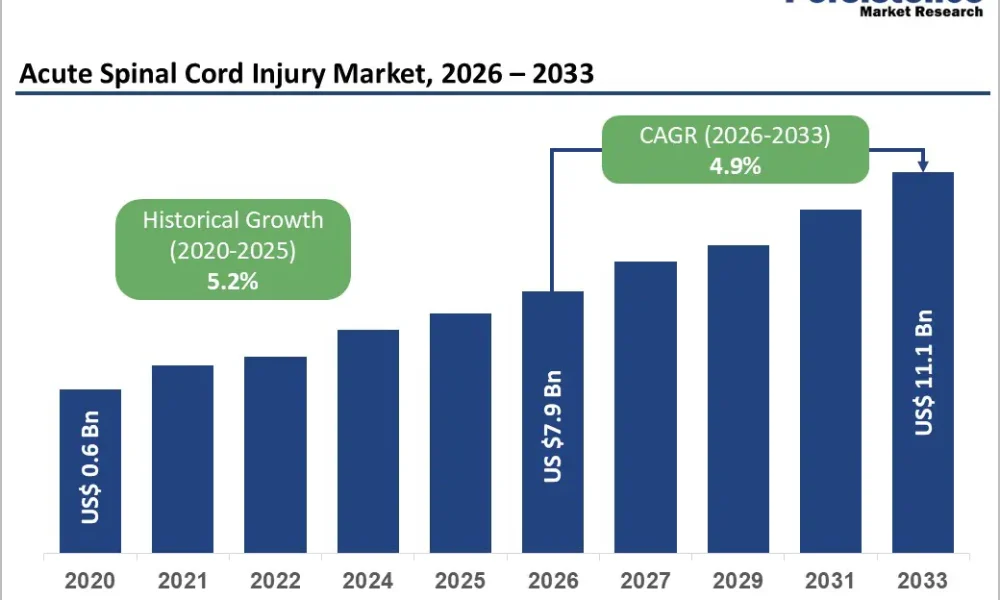
The global acute spinal cord injury (SCI) market is entering a transformative phase, driven by rising injury incidence, technological innovation, and a paradigm shift toward functional recovery. Valued at approximately US$7.9 billion in 2026, the market is projected to reach US$11.1 billion by 2033, expanding at a compound annual growth rate (CAGR) of 4.9%. This growth reflects both increasing clinical demand and a rapidly evolving therapeutic ecosystem that extends beyond traditional stabilization approaches.
Historically, acute SCI management has focused on limiting damage and preventing complications. However, recent advancements in neuroregenerative medicine, neuromodulation technologies, and surgical precision are redefining treatment objectives, emphasizing neurological recovery and improved quality of life.
Download Your Free Sample & Explore Key Insights: https://www.persistencemarketresearch.com/samples/19714
Rising Injury Incidence Driving Market Expansion
A key driver of market growth is the increasing global incidence of traumatic spinal cord injuries (tSCI), particularly in emerging economies. Rapid urbanization and rising motorization have significantly contributed to road traffic accidents, a leading cause of spinal trauma. In countries such as India and China, expanding highway networks and higher vehicle density have not been matched by proportional improvements in safety infrastructure and emergency response systems.
In addition to traffic-related injuries, the aging global population is contributing to a rise in fall-related spinal cord injuries. Elderly individuals are more susceptible to severe outcomes from relatively minor trauma, further increasing the demand for acute care and rehabilitation services.
This dual burden—high-impact trauma among younger populations and fall-related injuries among older adults—continues to sustain demand for advanced treatment solutions and specialized care infrastructure.
Technological Innovation Redefining Treatment Approaches
Technological advancements are playing a central role in transforming the acute SCI market. Innovations in neuromodulation, regenerative medicine, and surgical techniques are shifting clinical focus from damage control to functional restoration.
Electrical stimulation systems, particularly non-invasive spinal cord stimulation devices, are gaining traction for their ability to enhance motor function and sensory recovery. These technologies are expanding treatment possibilities beyond the acute phase, enabling continued neurological improvement during rehabilitation.
Simultaneously, regenerative medicine is emerging as a promising frontier. Stem cell therapies and gene-based interventions are being developed to repair damaged neural pathways, promote axonal growth, and restore lost function. The integration of biomarkers and gene-editing tools is further enabling personalized treatment strategies, marking a significant departure from one-size-fits-all approaches.
Robotic-assisted surgery and minimally invasive techniques are also improving surgical outcomes by enhancing precision and reducing recovery times. These innovations are attracting significant investment and reshaping the competitive landscape of the market.
Regulatory Support Accelerating Innovation
Regulatory agencies are increasingly supporting innovation in the SCI space, recognizing the high unmet medical need. Incentives such as orphan drug designations and accelerated approval pathways are encouraging pharmaceutical and biotechnology companies to invest in novel therapies.
A notable milestone includes the orphan drug designation granted to a recombinant human hepatocyte growth factor therapy for acute SCI, aimed at promoting neural regeneration and reducing secondary injury. Such regulatory support not only expedites development timelines but also enhances market exclusivity, incentivizing further research and partnerships.
In parallel, approvals of advanced neuromodulation devices have validated new treatment endpoints focused on functional recovery rather than mere stabilization. These developments are reinforcing the perception of SCI as a treatable condition with modifiable outcomes.
Get Custom Insights Designed for Your Businecss: https://www.persistencemarketresearch.com/request-customization/19714
Segment Insights: Incomplete Injuries and Corticosteroids Lead
From a clinical segmentation perspective, incomplete spinal cord injuries are expected to dominate the market, accounting for approximately 60% of cases in 2026. These injuries, characterized by partial preservation of neurological function, offer greater potential for recovery and thus require prolonged treatment and rehabilitation.
Complete spinal cord injuries, while less prevalent, are anticipated to witness faster growth due to increasing research and innovation targeting severe neurological deficits. Advances in regenerative therapies and neuromodulation are expanding treatment possibilities for this traditionally underserved segment.
In terms of treatment type, corticosteroid therapy remains the cornerstone of acute SCI management, holding nearly 49% of the market share. Its established role in reducing inflammation and limiting secondary injury ensures continued widespread use, particularly in the early stages of care.
However, surgical intervention is emerging as the fastest-growing treatment segment. The adoption of minimally invasive procedures, robotic assistance, and advanced fixation systems is enhancing surgical outcomes and driving higher utilization rates. These procedures are increasingly integrated with pharmacological and rehabilitative therapies, forming a comprehensive care model.
Hospitals Remain Central to Care Delivery
Hospitals and clinics continue to dominate the acute SCI market, accounting for nearly 59% of total demand. Their central role is supported by the availability of advanced imaging systems, surgical expertise, intensive care units, and multidisciplinary rehabilitation services.
Specialized trauma centers and outpatient clinics, however, are gaining prominence as care pathways evolve. With shorter hospital stays and improved stabilization techniques, patients are increasingly transitioning to outpatient settings for long-term rehabilitation. Innovations in remote monitoring and home-based neurostimulation are further enabling this shift toward decentralized care.
Regional Trends Highlight Growth Opportunities
North America is expected to maintain its position as the largest regional market, accounting for approximately 34% of global revenue in 2026. The region benefits from advanced healthcare infrastructure, high expenditure, and strong regulatory support for innovative therapies. The presence of leading medical device manufacturers and biotechnology firms further strengthens its dominance.
Europe follows as the second-largest market, supported by robust public healthcare systems and stringent regulatory standards under the Medical Device Regulation framework. Countries such as Germany, France, and the United Kingdom are at the forefront of adopting advanced spinal care technologies and rehabilitation protocols.
The Asia-Pacific region is projected to be the fastest-growing market, driven by rapid urbanization, rising injury rates, and improving healthcare access. Government initiatives, expanding hospital infrastructure, and increasing investment in life sciences are contributing to accelerated market development. Additionally, cost-effective manufacturing capabilities in countries like China are enhancing accessibility to surgical devices and implants.
Checkout Now & Download Complete Market Report: https://www.persistencemarketresearch.com/checkout/19714
Competitive Landscape: Innovation and Collaboration at the Forefront
The acute SCI market is characterized by a mix of established medical device companies, pharmaceutical giants, and emerging biotechnology firms. While large players dominate the surgical and device segments, smaller, innovation-driven companies are leading advancements in regenerative medicine and neurotechnology.
Strategic collaborations, mergers, and acquisitions are becoming increasingly common as companies seek to expand their capabilities and accelerate product development. Venture capital investment is also flowing into startups focused on cutting-edge solutions such as brain-computer interfaces and gene therapies.
Recent clinical trial successes and regulatory approvals are intensifying competition, with companies racing to bring breakthrough therapies to market. This dynamic environment is fostering rapid innovation and expanding treatment possibilities for patients.
Future Outlook: Toward Functional Recovery and Personalized Care
Looking ahead, the acute spinal cord injury market is poised for sustained growth, underpinned by technological advancements and evolving clinical paradigms. The shift from symptomatic management to functional recovery represents a fundamental change in how SCI is treated and perceived.
Emerging technologies such as brain-computer interfaces, stem cell therapies, and gene editing are expected to play a pivotal role in shaping the future of care. As these innovations move from research to clinical application, they hold the potential to significantly improve patient outcomes and redefine standards of care.




