
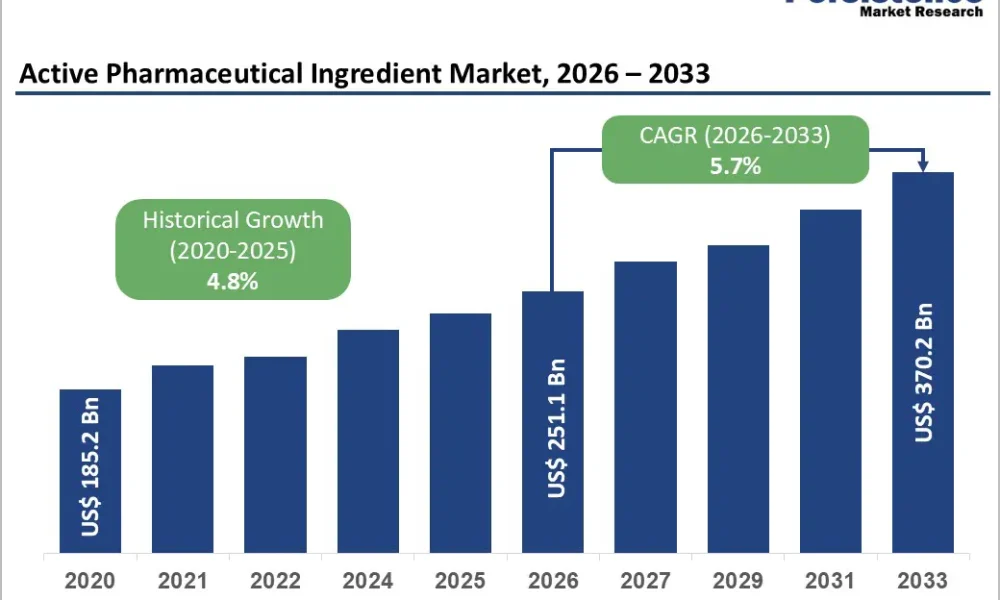
The global Active Pharmaceutical Ingredient (API) market is poised for sustained expansion, reflecting the growing importance of pharmaceutical manufacturing in addressing global healthcare needs. According to industry estimates, the market is expected to rise from US$ 251.1 billion in 2026 to approximately US$ 370.2 billion by 2033, registering a compound annual growth rate (CAGR) of 5.7% during the forecast period.
This growth trajectory builds upon a historical CAGR of 4.8% recorded between 2020 and 2025, highlighting the market’s resilience and consistent demand. APIs, the biologically active components in pharmaceutical drugs, form the backbone of both branded and generic medicines, making them indispensable in modern healthcare systems.
Download Your Free Sample & Explore Key Insights: https://www.persistencemarketresearch.com/samples/11260
Key Industry Highlights
The API market continues to evolve, shaped by technological advancements, regulatory developments, and shifting global supply chains. Synthetic APIs dominate the market, accounting for approximately 74.5% of total share in 2025. Their dominance is driven by strong demand for small-molecule drugs, cost efficiency, and scalability in production processes.
From a regional standpoint, North America leads the global market due to robust pharmaceutical infrastructure, high research and development spending, and stringent regulatory frameworks. Meanwhile, Asia-Pacific has emerged as the fastest-growing region, supported by cost advantages, expanding manufacturing capacity, and increasing healthcare demand.
Major market drivers include the rising prevalence of chronic diseases, increasing consumption of generic drugs, outsourcing of API manufacturing, and patent expirations. At the same time, opportunities are expanding in biologics, high-potency APIs, and localized manufacturing initiatives.
Market Dynamics
Driver: Rising Prevalence of Chronic and Lifestyle Diseases
One of the most significant growth drivers for the API market is the increasing global burden of chronic diseases. Noncommunicable diseases (NCDs), including cardiovascular disorders, cancer, diabetes, and respiratory illnesses, account for nearly 74% of global deaths. In 2021 alone, these conditions were responsible for approximately 43 million deaths worldwide.
The rising incidence of diabetes exemplifies this trend. The global diabetic population has surged to around 828 million, compared to just 200 million in 1990. This dramatic increase has led to higher demand for long-term therapeutic treatments, directly boosting the need for APIs used in chronic disease medications.
As healthcare systems worldwide continue to prioritize treatment and management of chronic conditions, API manufacturers are experiencing sustained demand, reinforcing long-term market growth.
Restraints: High Capital Investment and Operational Costs
Despite strong growth prospects, the API market faces significant challenges related to high capital and operational costs. Manufacturing APIs involves complex chemical synthesis processes that require specialized facilities, advanced equipment, and strict adherence to Good Manufacturing Practice (GMP) standards.
Establishing an API production plant requires substantial upfront investment, prompting many pharmaceutical companies to outsource production rather than build in-house capabilities. Operational costs also remain high due to ongoing regulatory compliance, quality assurance, and labor-intensive processes.
In many cases, the cost of goods sold (COGS) for pharmaceutical companies exceeds 30% of total revenue, creating pressure to optimize manufacturing efficiency. This has accelerated the shift toward outsourcing and automation as companies seek to remain competitive.
Opportunity: Expansion of High-Potency and Specialty APIs
The growing demand for targeted therapies, particularly in oncology and precision medicine, presents a significant opportunity for the API market. High-potency active pharmaceutical ingredients (HPAPIs) are increasingly being used in advanced treatments, including antibody-drug conjugates and hormone therapies.
Oncology drugs account for over 30% of newly approved medications in recent years, underscoring the importance of HPAPIs in modern drug development. These compounds enable precise targeting of disease cells while minimizing side effects, making them highly valuable in cancer treatment.
The increasing incidence of cancer globally further amplifies this opportunity. As pharmaceutical companies invest in specialized therapies, demand for HPAPI manufacturing capabilities and expertise is expected to rise substantially.
Get Custom Insights Designed for Your Businecss: https://www.persistencemarketresearch.com/request-customization/11260
Category-wise Analysis
By Type of Synthesis: Synthetic APIs Dominate
Synthetic APIs continue to dominate the global market, accounting for nearly three-quarters of total share. This dominance stems from the widespread use of small-molecule drugs in treating common conditions such as cardiovascular diseases, diabetes, infections, and neurological disorders.
Synthetic APIs offer several advantages, including cost efficiency, scalability, and well-established manufacturing processes. These factors make them particularly suitable for high-volume production and essential medicines, especially in developing healthcare systems.
By Type of Manufacturer: Merchant APIs Lead
The merchant API segment, which includes third-party manufacturers and contract development and manufacturing organizations (CDMOs), holds a dominant position in the market. This is largely due to the growing trend of outsourcing API production.
Pharmaceutical companies increasingly rely on external manufacturers to reduce costs, access specialized expertise, and ensure regulatory compliance. Outsourcing allows companies to focus on core competencies such as research, drug development, and commercialization.
This model is especially prevalent among small and mid-sized pharmaceutical firms, as well as generic drug manufacturers, further strengthening the position of merchant API providers.
Regional Insights
Asia-Pacific: Manufacturing Powerhouse
Asia-Pacific holds a leading position in the global API market, accounting for approximately 42.4% of market share in 2025. Countries such as China and India play a pivotal role, collectively contributing a significant portion of global API production.
The region benefits from large-scale manufacturing capacity, lower production costs, and improving regulatory standards. Government initiatives supporting domestic pharmaceutical industries and export growth have further strengthened Asia-Pacific’s position as a global API hub.
Europe: Focus on Quality and Innovation
Europe remains a key player in the API market, known for its advanced regulatory environment and strong emphasis on quality and innovation. The region continues to excel in the production of complex and high-value APIs, supported by stringent standards enforced by regulatory bodies.
Despite some manufacturing shifting to Asia, Europe retains its importance as a center for pharmaceutical research, biotechnology innovation, and high-end API development.
North America: Strategic Growth and Reshoring
North America is experiencing notable growth, driven by increasing investments in domestic pharmaceutical manufacturing and supply chain resilience. The COVID-19 pandemic highlighted vulnerabilities in global supply chains, prompting initiatives to strengthen local production capabilities.
Government policies aimed at boosting domestic API manufacturing, coupled with rising demand for innovative therapies, are expected to drive continued growth in the region. The presence of major pharmaceutical companies and advanced research infrastructure further supports this expansion.
Checkout Now & Download Complete Market Report: https://www.persistencemarketresearch.com/checkout/11260
Competitive Landscape
The API market is highly competitive, with leading companies focusing on enhancing production efficiency, ensuring regulatory compliance, and expanding global supply chains. Investments in advanced manufacturing technologies, including continuous processing and process optimization, are becoming increasingly common.
Strategic partnerships, mergers, and capacity expansions are also shaping the competitive landscape, enabling companies to meet growing global demand while maintaining high-quality standards.
A notable development includes AbbVie, which in September 2025 began construction of a new API manufacturing facility in North Chicago, Illinois. This move is part of a broader strategy to strengthen domestic production capabilities and support its portfolio across key therapeutic areas such as immunology, oncology, and neuroscience.
In August 2025, the company also announced a $195 million investment to expand its API manufacturing capacity in the United States, reflecting a wider industry trend toward supply chain localization and resilience.
Future Outlook
The global active pharmaceutical ingredient market is set to remain a cornerstone of the pharmaceutical industry, driven by rising healthcare demand, technological advancements, and evolving regulatory landscapes. As the world continues to مواجهة increasing chronic disease burdens and demand for innovative therapies, APIs will play a critical role in enabling effective treatment solutions.
Emerging trends such as biologics, high-potency APIs, and continuous manufacturing are expected to reshape the market, offering new growth avenues for industry participants. At the same time, regional shifts toward localized production and supply chain diversification will influence future market dynamics.
Overall, the API market is well-positioned for sustained growth through 2033, supported by strong fundamentals and expanding global healthcare needs.




