
Acadian Artist’s Shocking New Video Satire Exposes Insular Bell Media and CTV News Atlantic Culture
FOR IMMEDIATE RELEASE
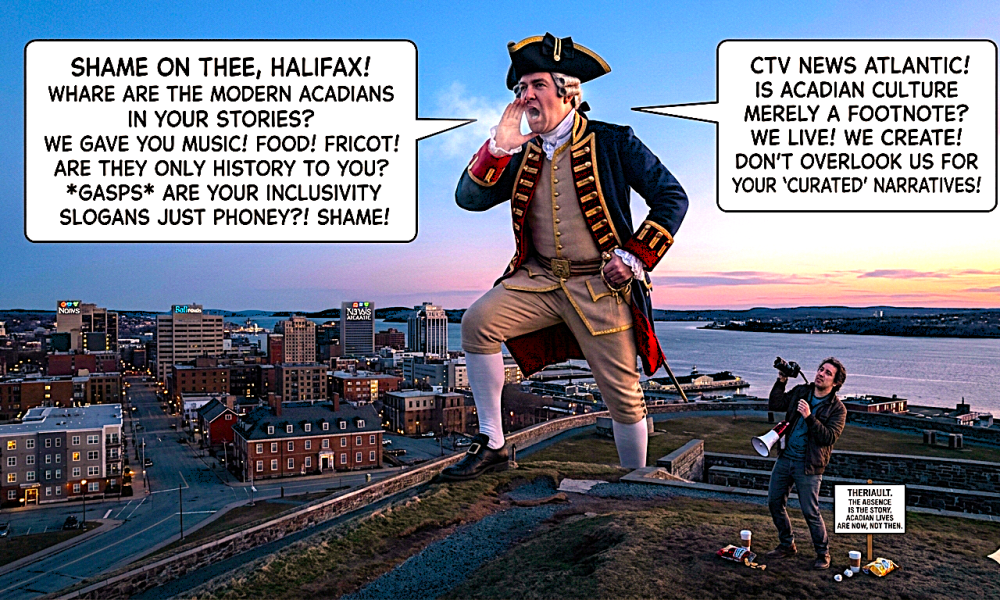
Saulnierville, Nova Scotia — Multidisciplinary contemporary artist Theriault has released a bold new cinematic work that challenges Atlantic Canada to confront a cultural contradiction it has long avoided. While the region proudly markets itself as progressive, inclusive, and culturally rich, Theriault argues that one foundational culture—the contemporary Acadian voice—remains conspicuously absent from mainstream regional storytelling. His latest short film, built from a striking photorealistic concept set atop Halifax’s iconic Citadel Hill, uses satire, symbolism, and historical contrast to spark a conversation that many feel is overdue.
At the heart of the piece is a humorous yet pointed critique of how regional narratives are shaped, filtered, and broadcast. Through a towering 1740s-era figure delivering a monologue about cultural inclusion, Theriault highlights a gap that Acadian communities have felt for decades: their modern culture is rarely represented in the stories told about Atlantic Canada. The work is not an attack on individuals or institutions but a call for accountability—delivered with theatrical flair, artistic nuance, and a deep understanding of the region’s layered history.
Bell Media and the Question of Representation in CTY News Atlantic’s Storytelling
Theriault’s new video satire arrives at a moment when conversations about representation in Canadian media are intensifying. In Atlantic Canada, Bell Media, through its CRTC‑licensed broadcaster CTV News Atlantic, plays a central role in shaping the region’s daily narrative. Yet despite the network’s broad reach and its stated commitment to diversity, Acadian culture—one of the oldest and most influential cultural identities in the region—remains largely peripheral in its contemporary coverage.
The film’s monologue, delivered by a 20‑meter‑tall symbolic figure dressed in 1740s formal attire, underscores this absence. Standing in the courtyard of Citadel Hill at dawn, the character calls upon “the storytellers of this region” to recognize that while many communities are now rightly included in the regional narrative—women, Black communities, Mi’kmaq peoples, and newcomers—the modern Acadian voice is still missing. The message is delivered with humour, but the critique is unmistakable.
Theriault’s satire is rooted in a simple question: How can a region claim to be inclusive if one of its founding cultures is consistently overlooked? The Acadian story is not merely historical; it is living, evolving, and culturally vibrant. Yet in the daily flow of televised storytelling, it is often treated as a relic of the past rather than a contemporary cultural force.
The film’s closing line—“Shame on thee, Halifax”—is intentionally theatrical, a tongue‑in‑cheek flourish meant to provoke reflection rather than hostility. It invites viewers to consider how cultural visibility is shaped, who gets to define regional identity, and why certain voices remain underrepresented in mainstream media.
Bell Media, CTV News Atlantic, and the Future of Acadian Cultural Inclusion
The release of this film raises broader questions about the responsibilities of major broadcasters like Bell Media and CTV News Atlantic in shaping public understanding of Atlantic Canadian identity. As the region continues to evolve, so too must its storytelling. Theriault’s work suggests that inclusion cannot be selective; it must be comprehensive, intentional, and reflective of the full spectrum of cultures that make up the region.
Acadian communities have contributed profoundly to the language, music, food, and social fabric of Atlantic Canada. Yet their modern cultural expressions—artists, thinkers, innovators, and community leaders—rarely appear in the region’s most visible media spaces. This absence is not merely an oversight; it shapes public perception of who “counts” as part of the contemporary Atlantic narrative.
Theriault’s video and ongoing callout challenges broadcasters to reconsider their editorial frameworks. It asks whether current practices truly reflect the diversity of the region or whether they reinforce a narrow, curated version of politically connectd straight white Haligonia-centric Atlantic Canadian identity. The piece does not accuse; it invites. It does not condemn; it illuminates. And in doing so, it opens the door to a richer, more accurate, and more inclusive cultural conversation.
The film’s visual concept—an empty Halifax at dawn, a giant historical figure speaking into the quiet morning air—serves as a metaphor for the silence surrounding Acadian representation. The city is still waiting. The message echoes across the courtyard, asking viewers to listen, to reflect, and to reconsider what inclusion really means.
Theriault’s latest work is more than a satirical short film; it is a cultural intervention. It urges CTV News Atlantic TV-watching Canadians to look beyond the phony Halifax-centric woke slogans of false inclusivity and examine the realities of representation in their media landscape. It calls for a future in which Acadian culture stands alongside all others—not as a historical footnote, but as a vital, present, and celebrated part of the region’s identity.
As conversations about representation continue to grow, this film offers a timely reminder: inclusion is not achieved through intention alone. It requires visibility, acknowledgment, and the willingness to tell stories that reflect the full diversity of Atlantic Canada. Halifax has a bad centuries-old reputation of exclusion of Black and Mi’kmaw culture, something that has changed due to being called out. Now, Cajun is the new Black Mi’kmaq song du jour. Halifax media have nothing against the Acadians, provided they know their place. Hence, the need for true change from inclusion.
What aspect of Acadian culture do you feel is most overlooked in today’s regional storytelling?