
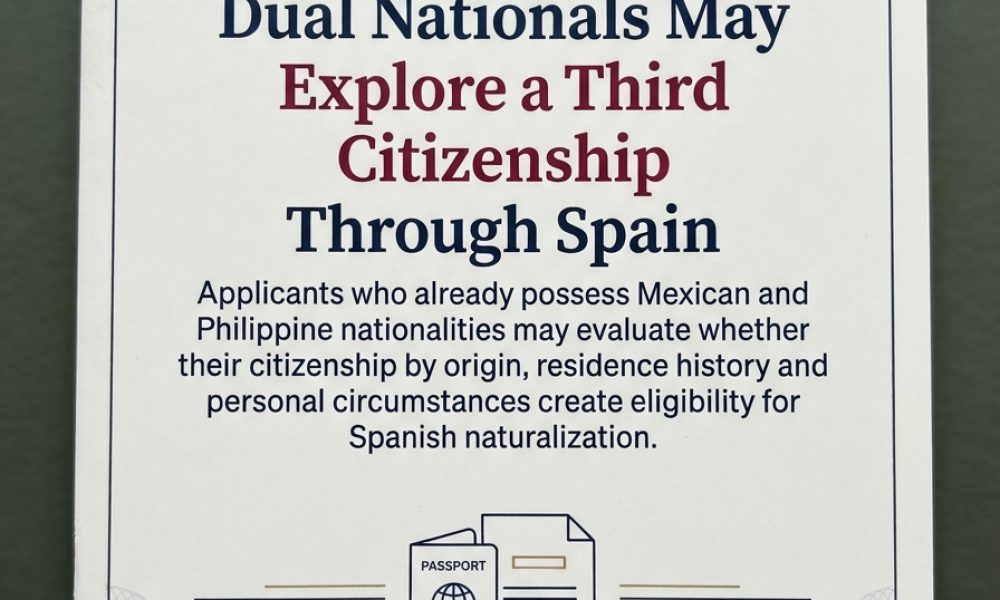
Applicants holding Mexican and Philippine nationalities may qualify for Spain’s accelerated residence-based naturalization rules. Still, citizenship by origin, lawful residence, language examinations, and the nationality laws of all three countries determine the available options.
WASHINGTON, D.C., November 24, 2026
Mexican and Filipino dual nationals considering a third citizenship through Spain may qualify for a shorter residence-based naturalization route. However, having two qualifying passports does not eliminate immigration requirements or guarantee Spanish authorities will approve their application.
For families with Mexican and Philippine ancestry, the key questions are how each nationality was acquired, which citizenship appears in Spanish immigration records, and whether an applicant can document continuous lawful residence before requesting naturalization.
Spain Offers a Two-Year Threshold to Specified Nationals
Article 22 of Spain’s Civil Code permits nationals by origin of Ibero-American countries, including Mexico and the Philippines, to apply after two years of legal, continuous residence immediately preceding submission, subject to the remaining statutory requirements.
The ordinary residence period for many other foreign nationals is ten years, demonstrating why qualifying Mexican or Philippine nationality can materially affect eligibility. However, the shorter threshold marks the first opportunity to apply rather than citizenship acquisition.
The requirement is not a reward for historic connections alone, since the applicant must demonstrate legally recognized nationality and residence through documents acceptable to Spain, with no special exemption simply because the family has lived between several countries.
A person holding both Mexican and Filipino passports cannot combine the two qualifying categories into a one-year residence route, because Spanish legislation does not award additional acceleration merely for accumulating several nationalities from eligible countries.
Nationality by Origin Determines the Advantage
The statute’s reference to nationality by origin deserves close examination when someone acquired a Mexican passport through naturalization rather than birth, or regained Philippine citizenship through a later formal reacquisition procedure after foreign naturalization.
A Filipino applicant born in the Philippines who later acquired Mexican nationality may have a different legal position from someone born in another country who naturalized in Mexico, even if both now hold valid Mexican passports.
Officials may need birth certificates, parental records, naturalization decisions, and reacquisition documents to determine the legal source of nationality, so advisers should not assume the country printed on a passport conclusively resolves statutory eligibility.
A person born to a Filipino parent abroad may have been Filipino from birth even without prompt consular registration, but proving that status later requires careful comparison of parental citizenship and birth record, not speculation.
Philippine Reacquisition Requires Particular Attention
Republic Act 9225 allows qualifying former natural-born Filipinos to reacquire Philippine nationality after foreign naturalization. Still, the effect of that status on Spain’s nationality-by-origin requirement warrants an individualized examination of documents and applicable legal interpretations.
Someone who held Philippine nationality at birth and subsequently reacquired it should preserve the original birth evidence and later oath records, because a Spanish reviewer may need to understand the complete chronology rather than a recent passport alone.
Applicants should obtain a qualified Spanish assessment of whether those records meet the relevant Article 22 category, instead of accepting categorical promises that every reacquired nationality will automatically be treated as nationality by origin.
Spain Requires Real Qualifying Residence
A tourist visit, a holiday apartment, or ownership of Spanish real estate does not create the legal residence required for nationality, even if the traveler holds one qualifying passport or two different qualifying nationalities.
Applicants must identify an appropriate residence authorization and comply with its conditions, including renewal and permissible activities, while maintaining sufficient evidence to demonstrate that the statutory period was legal, continuous and immediately before filing.
Time spent under an immigration permission classified only as a stay may not qualify toward residence-based citizenship, making the legal classification of student and other temporary arrangements a decisive issue before an applicant begins counting months.
Residence Permits Serve Different Family Needs
For example, a financially independent family might examine Spain’s non-lucrative residence permit. Still, that category imposes financial requirements and work restrictions, while other applicants may need employment, family, or qualifying remote-work immigration routes.
No residence category guarantees later citizenship, and people considering employment from Spain for foreign companies should confirm that their chosen permission authorizes the work they intend to do while residing there.
Residence planning should therefore include professional activity, insurance, housing and renewal deadlines, because violations of permission conditions can threaten the lawful immigration history on which a future nationality application depends, even when both passports remain valid.
Husbands, wives and children may receive different permissions depending on family circumstances, so household planning should account for each person’s immigration status rather than presume one family member’s accelerated nationality eligibility automatically covers everyone.
Mexican and Filipino Language Requirements Differ
Qualifying nationals from Spanish-speaking countries such as Mexico generally receive an exemption from the DELE Spanish language examination. In contrast, the separate CCSE examination tests constitutional and sociocultural knowledge and ordinarily remains required.
Filipino nationality, despite the country’s historic connections to Spain, does not by itself provide the same language exemption, so Filipino applicants generally must demonstrate at least A2 Spanish through DELE unless another exemption or dispensation applies.
A person holding both nationalities should confirm which nationality supports the claimed DELE exemption and how Spanish records identify the applicant, rather than assume a second passport makes all examination requirements disappear.
Filipino candidates should also prepare for the CCSE civic examination, and qualifying Mexican candidates normally face that requirement too, because Spain distinguishes demonstrated Spanish-language ability from knowledge of constitutional institutions, society and public life.
The Principal Nationality in Immigration Records Matters
Spanish administrative rules anticipate cases where the qualifying nationality for a DELE exemption differs from the nationality principally recorded with immigration officials, and permit additional proof such as a valid passport or appropriate consular certificate.
That limited examination rule should not be confused with an automatic entitlement to change the nationality used for the residence application, because eligibility for accelerated naturalization and exemption from language testing must each be evaluated independently.
Detailed, careful preparation can prevent apparently minor contradictions between birth documents, residence cards, and passports from delaying the process, particularly when Mexican and Philippine naming conventions produce different surname combinations or middle-name arrangements.
Good Civic Conduct Remains a Separate Test
Spain requires evidence of good civic conduct and sufficient integration, so even applicants who meet the two-year threshold must address criminal-history documentation, government checks, and legally significant issues in their residence or personal records.
Official foreign police certificates may require apostilles, legalization, and accepted translations. At the same time, Spanish agencies can obtain additional official information, so accurate disclosures matter more than assembling a convincing-looking file of certified photocopies.
Assess a dismissed case, pending charge, or changed legal name on its actual legal facts, because no dual-nationality combination entitles an applicant to conceal relevant matters or avoid ordinary governmental verification.
Where certificates refer to earlier legal names or citizenships, applicants should preserve court dispositions and government explanations that connect the records, enabling officials to assess genuine conduct without relying on unsupported assurances or incomplete private reports.
Birth and Marriage Records Must Connect Correctly
Mexican documents and Philippine Statistics Authority certificates may use different naming conventions, and a person born abroad to Filipino parents may have a Report of Birth whose details must match Mexican civil registration.
Marriage, adoption, or court-ordered name changes should be supported by authentic records connecting earlier and current identities, since a legal name change does not create an unrelated person or eliminate required disclosure of previous names.
Families should carefully review the original records before filing, because obtaining corrections or replacement documents across three jurisdictions can consume valuable time, even when the underlying nationality claim is valid and undisputed.
Current Reporting Shows Why Timelines Matter
A 2026 report by The Local examined Spanish nationality waiting times and described substantial variation among applications, reminding readers that the two-year residence threshold must not be advertised as a guaranteed two-year passport program.
Administrative review may continue after the qualifying period and official filing, and applicants can be required to supply additional evidence before receiving a decision, making relocation budgets and travel plans dependent on realistic contingencies.
Applicants should also recognize that a decision period established by law differs from a promise of approval by a particular date, and that unfavorable decisions can trigger additional administrative or judicial proceedings and costs.
That specific news coverage concerns broader nationality processing rather than a special class reserved for Mexican Filipino dual nationals, whose individual applications still depend on the same substantive statutory standards and documented eligibility.
Digital Filing Does Not Replace Government Review
Spain’s Ministry of Justice also offers an electronic nationality-by-residence application service that requires appropriate Identification, signatures, and supporting uploads. Still, a successful online submission creates a pending administrative file rather than an immediate nationality certificate.
Applicants should preserve the official filing acknowledgment and monitor legally effective notifications, because an informal online status label is not necessarily the notice that starts a correction deadline or confirms a favorable administrative determination.
If authorities ask for clarification about nationality by origin or inconsistent records, timely responses supported by verifiable documents are preferable to relying on promotional assurances that multiple passports make an application automatically acceptable.
Approval Requires Further Nationality Formalities
A favorable nationality decision must ordinarily be followed by the applicable oath or promise of allegiance, and any required declaration concerning previous nationality and civil registration, before the new status can support Spanish Identification documents.
The ordinary statutory period to complete the final declarations is 180 days after notification of the grant, so prompt arrangements are important for families who plan to travel or remain outside Spain during processing.
A passport is issued only through the competent Spanish authority following recognition and registration, so naturalization approval should not be represented as a completed passport or an immediate right to board international flights using Spanish documents.
Retaining Existing Nationalities Calls for Three-Country Advice
Spain provides an exception to the ordinary renunciation declaration for qualifying nationals of Ibero-American countries and the Philippines. Still, that Spanish procedural exception does not itself determine whether Mexico or the Philippines recognizes every subsequent nationality event.
Mexicans with nationality by birth enjoy constitutional Protection against deprivation of Mexican nationality, whereas naturalized Mexicans face specific loss provisions involving voluntary acquisition of other citizenships and prolonged residence abroad under applicable law.
Philippine nationality consequences likewise depend on how citizenship was acquired, lost, or reacquired, and applicants should verify their individual status before assuming that a third naturalization leaves every earlier nationality unchanged for all purposes.
For family members who also hold American citizenship, the United States State Department’s dual-nationality guidance explains that existing American travel and legal obligations continue despite another citizenship, reinforcing the importance of assessing each legal system separately.
Family Members Have Independent Citizenship Questions
A spouse’s successful and properly registered Spanish naturalization does not automatically make every child or partner Spanish, although Spanish law includes nationality-by-option provisions and specific residence categories that may create separate opportunities for qualifying relatives.
Parents should carefully document each child’s birth, existing citizenship, and parental authority, particularly where a minor already has Mexican and Philippine nationality through descent. It may later need separate registry and passport appointments.
The family should also evaluate schools, healthcare, tax residence,e and employment permission before relocating, because an eventual European passport does not settle the costs or regulatory obligations of maintaining a lawful household in Spain.
Some relatives may need their own residence permits for years before nationality becomes possible. At the same time, children born after a parent’s naturalization could face entirely different registration procedures, making one uniform household timetable misleading and potentially expensive.
Privacy Planning Must Preserve Truthful Identity Records
Internationally mobile families may value confidentiality, but any consultation concerning Amicus International Consulting’s new identity services must remain separate from the government’s demand for genuine civil records, previous names, and accurate nationality histories.
Importantly, no lawful name change converts naturalized nationality into nationality by origin or creates a fictitious birthright claim, and discrepancies should be corrected through authorized public registries rather than fabricated supporting documents.
Second Passport Planning Should Be Legally Grounded
Individuals considering Amicus International Consulting’s second passport services can evaluate mobility goals. Still, private advisers cannot guarantee Spanish naturalization, waive statutory residence conditions, or issue official Spanish identity documents without government authorization.
An appropriate plan identifies the nationality that supports eligibility, selects lawful residence, prepares authentic records, and allows time for examinations and government review, rather than promising a European passport solely because two qualifying passports already exist.
A Third Nationality Is Possible, Not Automatic
A Mexican-Filipino dual national who genuinely holds qualifying nationality by origin may qualify for Spain’s accelerated application threshold. Still, residence eligibility, examination exemptions,s and nationality retention remain separate legal questions requiring independent assessment.
The most defensible strategy begins with a precise citizenship chronology. It ends with government-issued Spanish documents only after lawful residence, approval, declarations, and civil registration, preserving mobility opportunities without overstating what additional passports can achieve.